

This test covers color fastness to dry cleaning only. Commercial dry cleaning practice normally includes other treatments such as water staining, solvent staining, and steam pressing, and if a textile's full response to dry cleaning is to be evaluated, other standard test methods must be used.
The presence of absorbed water in dry cleaning solvent, or the presence of detergent and water in dry cleaning solvent, is known to alter the color fastness properties of some materials. This test requires the material being tested to be evaluated in a dry state using only the solvent in containers containing no water.
Dry cleaning resistance refers to resistance to dry cleaning in perchloroethylene without further qualification in this standard. However, other solvents used in textile cleaning may be used if necessary.
In principle, a textile sample in contact with a specified adjacent fabric or fabrics in a cotton fabric bag is agitated in perchloroethylene with non-wearing steel discs, then wrung or centrifuged and dried in hot air. The color change of the sample and the staining of adjacent fabric or fabrics are assessed using grayscales or instrumentally, relative to the original sample.
Perchloroethylene and other solvents can be hazardous to human health. Therefore, it is important to follow guidelines for the safe use of solvents. It is recommended that tests be conducted in a well-ventilated area and that solvent containers be opened only within the confines of a fume cupboard or fume hood. It is also recommended to wear protective gloves and eyewear and avoid skin contact with solvents and inhalation of solvent fumes. Guidelines for the safe disposal of solvents should be followed carefully.
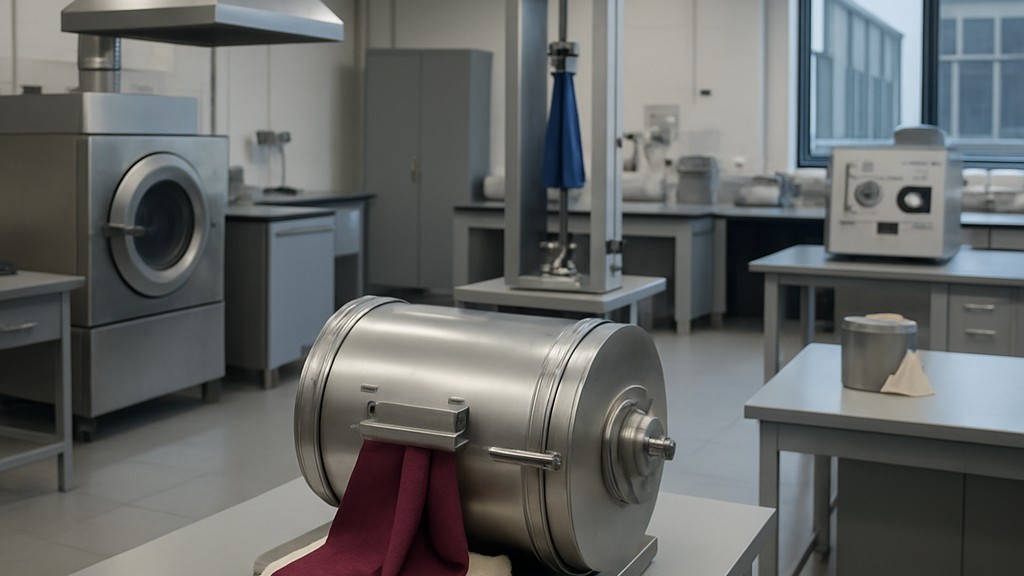
The equipment used in these tests includes:
If the textile to be tested is fabric, the following procedure is followed. A 100 mm plus/minus 2 mm x 40 mm plus/minus 2 mm specimen is attached to a piece of multifibre adjacent fabric also measuring 100 mm plus/minus 2 mm x 40 mm plus/minus 2 mm by sewing it along one of the shorter edges, with the multifibre adjacent fabric facing the front of the specimen. A 100 mm plus/minus 2 mm x 40 mm plus/minus 2 mm specimen is attached between two single-fibre adjacent fabrics also measuring 100 mm plus/minus 2 mm x 40 mm plus/minus 2 mm by sewing it along one of the shorter edges.
The yarn fabric can be made into fabric and tested as described above. If yarn or loose fibers are to be tested, a mass of yarn or loose fibers equal to approximately half the combined mass of adjacent fabrics is taken and placed as described below. It is placed between a 100 mm plus/minus 2 mm x 40 mm plus/minus 2 mm piece of multi-fiber adjacent fabric and a 100 mm plus/minus 2 mm x 40 mm plus/minus 2 mm piece of undyeable fabric and these are stitched along four edges (ISO 105-A01). It is placed between a 100 mm plus/minus 2 mm x 40 mm plus/minus 2 mm piece of each of two specified single-fiber fabrics and are stitched along four edges.
Prepare the mechanical apparatus by ensuring the water bath reaches an operating temperature of 30°C (+/- 2°C) during the test. Using undyed cotton twill fabric, sew two squares of this fabric together on three sides to create a bag with internal dimensions of 100 mm × 100 mm. The composite sample and 12 steel discs are placed inside the bag. The bag is sealed by any suitable means. The steel containers are removed from the apparatus. The interior of each container, including the lid and sealing gasket, must be dry. This is done by wiping the components of each container with a dry cotton cloth. The bag containing the composite sample and steel discs is placed inside the container.
Within the confines of the fume cupboard or hood, 200 ml of perchloroethylene solvent is added to each steel container at 30°C plus/minus 2°C. If another solvent is used, this must be stated in the test report. The container is closed and placed in the mechanical device. Rotation is started after all containers are placed in the mechanical device. The composite sample is processed in the mechanical device at 30°C plus/minus 2°C for 30 minutes. Within the confines of the fume cupboard or hood, the bag is removed from the container, the composite sample is removed, placed between white absorbent paper or cloth, and squeezed or centrifuged to remove excess solvent. The composite sample is opened, touching only the seam line. The sample is hung in the air at 60°C plus/minus 5°C in the fume cupboard or hood.
Colour change and staining of adjacent fabric are assessed based on the original sample and the adjacent fabric, respectively. A grey scale is used to assess colour change and a grey scale is used to assess staining.
Our organization, which has been supporting businesses across all sectors for years through a wide range of testing, measurement, analysis, and evaluation activities, boasts a strong team of employees who closely follow global developments in science and technology and are constantly improving themselves. In this context, we also provide testing services in accordance with the standard "EN ISO 105-D01 Textiles - Color fastness tests - Part D01: Color fastness to dry cleaning using perchloroethylene solvent."
To get an appointment, to get more detailed information or to request an evaluation, you can ask us to fill in our form and reach you.

