

The ISO 15797 Textiles - Industrial washing and finishing procedures for testing workwear, published by the International Organization for Standardization (ISO), describes the test procedures and equipment that can be used to evaluate workwear (including, where appropriate, some personal protective equipment) intended for industrial washing. These procedures provide a basis for testing relevant properties such as dimensional stability, color properties, wrinkle resistance, seam shrinkage, pilling, and general visual characteristics.
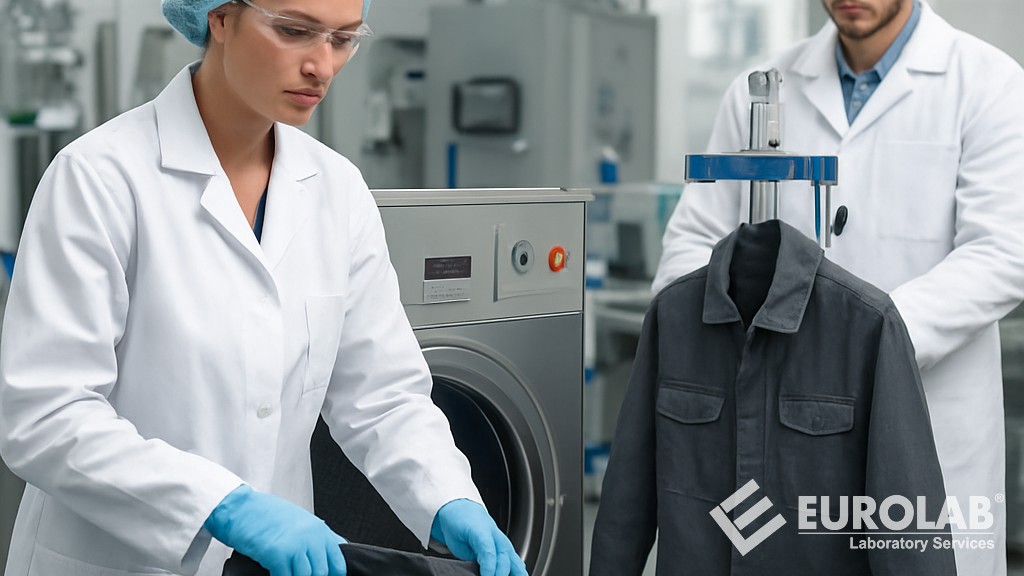
This standard does not provide instructions or specifications for procedures and equipment to be used by industrial laundry operators.
Since recreating industrial laundry processes (washing and drying/finishing) in a laboratory setting is often impractical, this standard offers an approach using defined medium-sized equipment and rigorous testing procedures that can be used in the evaluation of workwear intended for industrial washing.
Since the ISO 15797 standard reflects a simulation of real industrial laundry conditions, in some cases, it is recommended that work clothes be tested on actual industrial laundry equipment and processes when ultimately determining product and process compatibility.
It is not necessary to test using all eight washing procedures or both drying procedures. The washing and drying procedures most suitable to the properties of the fabric or fabric composition and its intended use are selected.
The ISO 15797 standard includes standard test methods for evaluating the performance of work clothing (such as overalls, jackets, trousers, high-visibility garments, and flame-retardant garments) when subjected to industrial washing processes.
Workwear used in industries such as oil and gas, welding, electricity, manufacturing, and chemicals typically possesses critical protective properties (such as flame retardant, antistatic, chemical splash resistance, and high visibility). Unlike home washing, industrial washing requires far more demanding conditions:
Manufacturers and end-users need to know whether protective clothing will retain its properties after repeated industrial cleaning. The ISO 15797 standard provides repeatable and comparable test methods, ensuring that claims such as “50 industrial washing cycles” actually mean the same thing worldwide.
This standard defines eight different industrial washing procedures, each simulating a specific industrial washing process. Garment manufacturers choose the method that best suits their customers' actual washing conditions.
After the garment has been subjected to the selected procedure (typically 25, 50 or more cycles), the relevant performance characteristics are retested (e.g., EN ISO 11612 standard for heat/flame, EN 1149-5 standard for electrostatic, EN ISO 20471 standard for high visibility, dimensional stability, tensile strength, color fastness).
The ISO 15797 standard is primarily used by:
The ISO 15797 standard is critical for anyone who relies on protective work clothing to stay safe in the workplace. Here are the main reasons why this standard is considered so important:
In conclusion, the ISO 15797 standard is a global benchmark proving that protective workwear can withstand the real-world rigors of industrial washing while maintaining critical safety features.
For many years, our organization, with its competent and experienced staff, has been understanding the needs of its clients, providing the advanced testing services they require, and assisting in the establishment, implementation, and improvement of management systems. Within this framework, we also provide testing services to businesses in accordance with the "ISO 15797 Textiles - Industrial washing and finishing procedures for workwear testing" standard.
To get an appointment, to get more detailed information or to request an evaluation, you can ask us to fill in our form and reach you.

