EN ISO 2411 Rubber or Plastic Coated Fabrics - Determination of Coating Adhesion
In the standard “EN ISO 2411 Rubber or plastic coated fabrics - Determination of coating adhesion”, which is based on a European standard and subsequently published by the International Organization for Standardization (ISO), a method for determining the coating adhesion strength of coated fabrics is described.
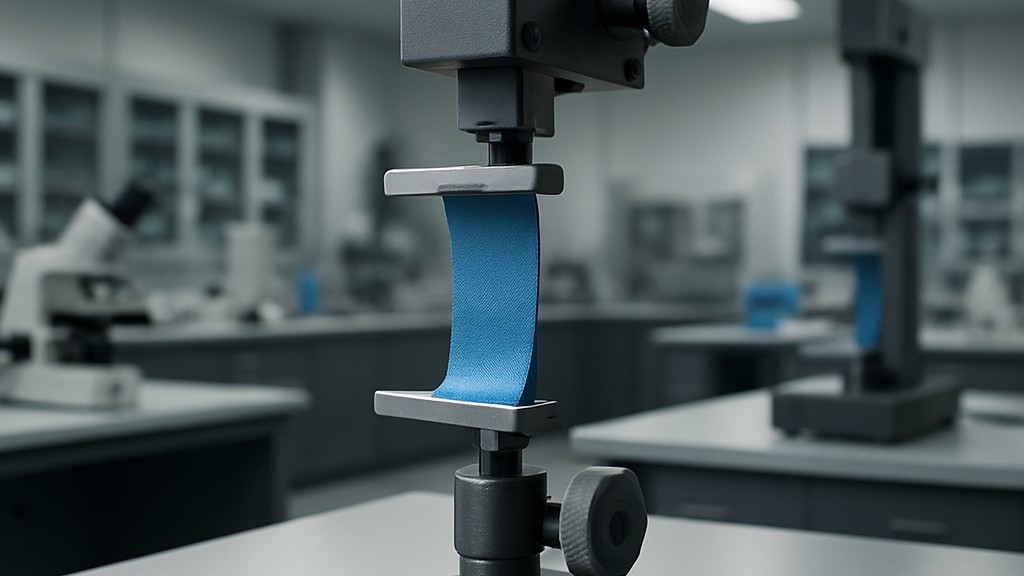
For the purposes of this standard, the following terms and definitions apply:
- Delamination is the partial or complete separation of two or more constituent layers of a coated fabric. This may be separation from the fabric into the polymer or separation within the actual polymeric layer.
- Peeling from the coating to the fabric is separation without leaving any coating polymer residue on the substrate.
- Partial film tearing is when delamination leaves patches of the coating polymer still adhered to the substrate.
- Non-separable refers to the coating's ability to resist peeling due to cracking during preparation or testing. It indicates that the coating's adhesion strength is greater than the coating's polymer strength.
- Coating or film delamination is the separation of a multi-layer coating, leaving one or more coating film residues on the substrate.
- Fabric failure is the failure of the substrate during testing. It indicates that the coating adhesion strength is greater than the substrate strength.
- Fabric delamination is the separation or detachment of the substrate, leaving a partial layer or full fabric laminate adhering to the coating. An example of this is the failure of the nonwoven element in the case of coated nonwoven laminates because the coating adhesion strength exceeds the interfiber cohesion of the nonwoven fabric.
- The substrate is the textile component of a coated fabric.
The atmosphere for conditioning and testing should be conditioning method “1” as specified in ISO 2231. A minimum of 16 hours of exposure is recommended for fabrics coated on one side only. A minimum of 24 hours of exposure is recommended for fabrics coated on both sides. The atmosphere for testing is selected from A to C as specified in ISO 2231. The temperature is 23 degrees Celsius, the typical test atmosphere in temperate countries, and 27 degrees Celsius, the typical test atmosphere in tropical and subtropical countries.
For all testing purposes, the minimum time between production and testing shall be 16 hours. For non-product testing, the maximum time between production and testing shall be 4 weeks, and for assessments intended to be comparable, testing shall be conducted after the same time interval whenever possible. For products, the time between production and testing shall not exceed 3 months unless otherwise agreed upon by the parties involved.
When preparing test samples, all samples for determining coating adhesion should be taken from the usable width of the coated fabric being tested, in accordance with ISO 2286-1. A total of 10 test samples should be tested. Each test sample should have at least 20 percent additional width to the cut test sample before being cut to width and a minimum length of 200 mm. Five test samples should be cut with their lengths parallel to the longitudinal direction of the coated fabric being tested, and five test samples should be cut with their lengths parallel to the transverse direction of the coated fabric being tested. For coated fabrics with a pile substrate, 10 test samples should be prepared in the longitudinal direction, five in the pile direction, and five against the pile direction. Both preparation methods can be used. If necessary, the preparation method to be adopted should be determined by preliminary testing. Generally, thick coatings are processed using Method 1, and thin coatings using Method 2.
- Preparation Method 1: When the strength of the coating layer exceeds the adhesive bond strength to the substrate, prepare the test specimen by carefully cutting the coating towards the substrate at right angles to the length of the test specimen. Carefully cut the coating film from the substrate to allow the ends of the test specimen to be mounted in the jaws of the test machine. Carefully cut the test specimen width to 50 mm plus/minus 0,5 mm or 20 mm plus/minus 0,5 mm, taking care not to damage the longitudinal teeth of the substrate. Test specimens are conditioned in accordance with this standard. After conditioning, the test specimen is mounted in the test machine, the coated end clamped in the fixed jaw and the coating film in the movable or movable jaw. When the adhesion is very strong and it is impossible to separate the coating film from the substrate by hand, preparation Method 2 should be used.
- Preparation Method 2: When the coating layer is not strong enough to peel continuously from the substrate, but the coating layer is clearly distinguishable from the substrate and can be cut separately, two test specimens of the same material are bonded or welded face to face using an adhesive system appropriate to the type of coating being evaluated, leaving the first 50 mm of adhesive free. It is important that the selected adhesive does not cause irreversible swelling of the coating or otherwise affect the coating/fabric bond strength. If the coating surface is treated in any way, such as siliconization, which could hinder the coating-to-coating bond, it is recommended that an adhesion test be performed before such treatment is applied. Alternatively, when testing PU-coated fabrics, a rubber sheet can be used in place of one of the coated specimens. The formulation of the rubber compound should be such that it produces a sheet with low hardness and low elongation. If necessary, it is possible to use a plain-woven cotton fabric, sized and bleached to ensure complete release of any remaining solvent. To ensure a good bond, the composite test specimen should be rolled at least twice with a roller with a face width of 76 mm and a mass of 2 kg.
In short, products using coated fabric must comply with the EN ISO 2411 standard for quality assurance, safety and global standardization.
Our organization, which has been supporting businesses across all sectors for years through a wide range of testing, measurement, analysis, and evaluation activities, has a strong team of employees who closely follow global developments in science and technology and are constantly improving themselves. In this context, we also provide testing services in accordance with the EN ISO 2411 "Rubber or plastic coated fabrics - Determination of coating adhesion" standard.



