

The standard “DIN 53800 Textiles - Determination of commercial mass”, published by the German Institute for Standardization (DIN), consists of the following sub-sections published under the same title:
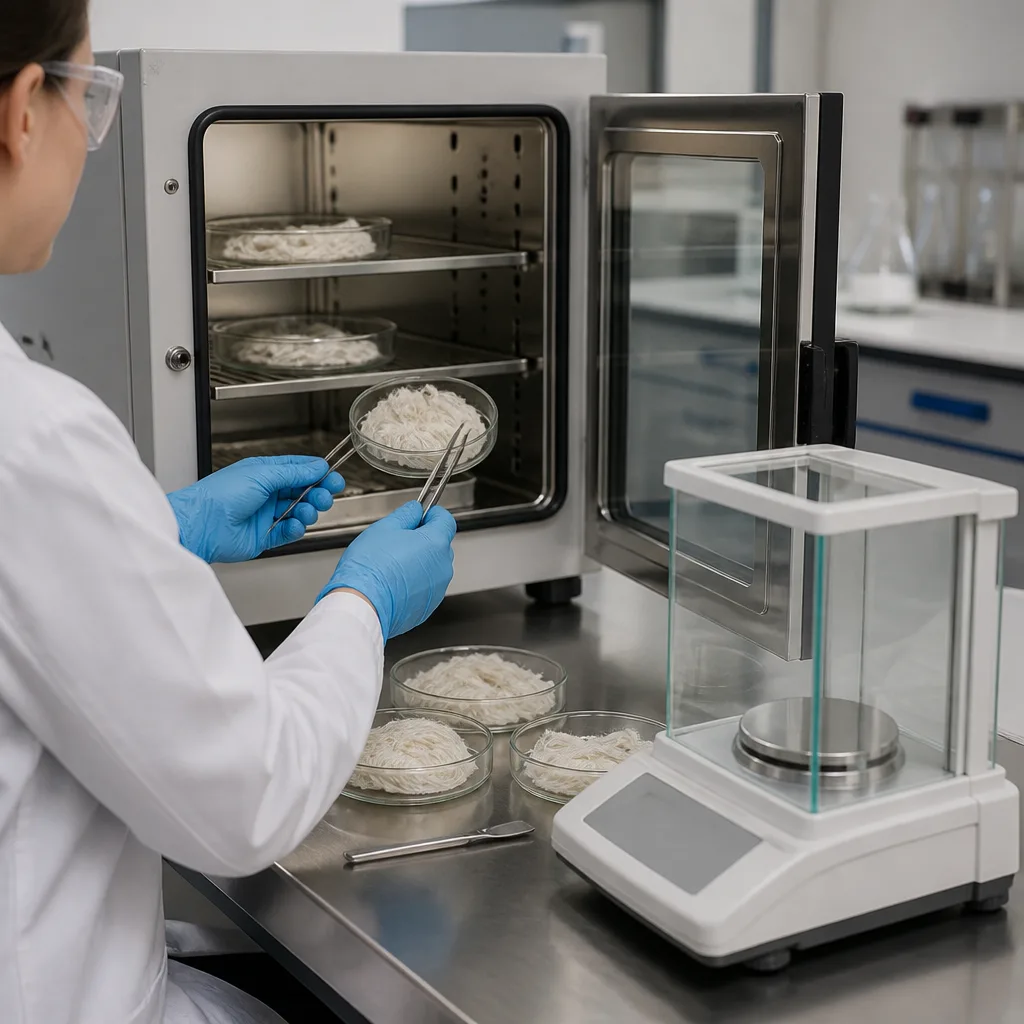
Textile materials naturally absorb moisture from the environment, therefore their weight as received includes moisture. Commercial bulk is a standardized, corrected weight used for trading, billing, and quality control. It is calculated by adding a specified moisture recovery (moisture allowance) specific to the fiber type to the dry bulk.
Accurate dry bulk determination ensures fair trade practices and consistent quality assessment in the textile industry (e.g., yarns, fabrics, fibers such as cotton, wool, synthetics).
This method is very similar to the international ISO 6741-1 standard, but it does not have a direct official equivalent.
The basic elements of this method are as follows:
This method is commonly used in laboratories for the following purposes:
Although the DIN 53800-1 standard has been repealed, it is still used as a reference in various technical publications, quality guidelines, and test protocols. Many laboratories continue to use its method or principles, often in conjunction with updated ISO or EN equivalents.
For those working in textiles, quality assurance, or material testing, this standard helps to obtain consistent and repeatable results when determining the true dry weight of hygroscopic materials.
This standard specifies the method for calculating the following:
Textile fibers are hygroscopic, absorbing or releasing moisture depending on ambient humidity. The actual weight of a shipment can vary significantly depending on air or storage conditions. To ensure fair trade, billing, and quality control, the industry uses a standardized commercial mass based on the following:
Commercial mass is then calculated according to the formula given in the standard.
The DIN 53800-2 standard also extends this principle to the commercial linear density required for yarns and filaments (e.g., commercial tex or denier).
This method is commonly applied in the following areas:
While the DIN 53800-1 standard allows for the experimental determination of dry mass (drying with hot air until a constant weight is reached), the DIN 53800-2 standard uses this dry mass to calculate commercial values and includes tables or references to standard recovery values for different fibers.
Technically, it is very closely related to the international ISO 6741 series of standards (specifically ISO 6741-1 for determining commercial mass). Many testing laboratories use DIN 53800-1 and DIN 53800-2 methods interchangeably or in parallel with ISO 6741 standard methods. Equivalent or similar methods are also found in ASTM standards (e.g., ASTM D2720, ASTM D2494 standards).
Although officially discontinued, the method described in the DIN 53800-2 standard continues to be used as a reference in industry quality guidelines and textile testing laboratories worldwide.
In modern practice:
DIN 53800 standards are still valid in regions where legacy contracts, outdated equipment calibration, and DIN norms have historical significance.
For many years, our organization, with its competent and experienced staff, has been understanding the needs of its clients, providing the advanced testing services they require, and assisting them in the establishment, implementation, and improvement of management systems. Within this framework, we also provide testing services in accordance with the DIN 53800 standard.
To get an appointment, to get more detailed information or to request an evaluation, you can ask us to fill in our form and reach you.

