

The standard “ISO 17694 Footwear - Test methods for uppers and linings - Flex resistance” published by the International Organization for Standardization (ISO) describes a test method to determine the flex resistance of uppers and linings, regardless of material, in order to assess their suitability for end use.
For the purposes of this standard, the following terms and definitions apply:
Test samples are cut from a shoe upper or shoe material, folded, and placed in a testing machine. The test simulates the damage caused by folding the upper inward, but does not readily reproduce the damage caused by folding outward. Tests are conducted in a humid, dry, or cold climate.
The main devices and materials used in the tests are:
When preparing the sample, the required number of rectangular test samples is cut with a press knife. Half of the required number of test samples are cut with the longest side parallel to the long direction of the material (the backbone direction for leather and warp, or the machine direction for non-leather materials), and half are cut perpendicular to it. For test samples cut from uppers, the long direction is the X-axis as defined in ISO 17709. For uppers, the test sample is cut through the center of the front so that the center of the test sample aligns with the point of greatest flex in the shoe. For materials, test samples are cut at a number of locations along the full usable width and length of the sheet material. For a woven material, this prevents any two test samples from containing the same warp or weft yarns.
It may be impossible to cut a sufficiently large test sample, especially from certain types of children's shoes. The test sample size can only be slightly reduced in width, not length (70 mm plus/minus 1 mm). However, it is preferable to test the materials themselves and, if necessary, add perforations, stitching, or other design features similar to those found on the front of the shoe.
In dry tests, all test samples to be tested are placed dry in a standard controlled atmosphere conforming to ISO 18454 standard for at least 24 hours before testing.
In wet tests, all test specimens are placed wet in a glass container. Distilled or deionized water is poured into the container to a depth of at least 10 mm. The container is placed in a desiccator. The pressure is reduced to less than 4 kPa for 2 minutes. Normal pressure should be restored after 2 minutes. This process is repeated twice. The test specimens are removed from the desiccator, any remaining water is removed with filter paper, and wet tests are immediately initiated.
For cold tests, the testing machine should be placed in a cold chamber. Test specimens are placed in the testing machine. The chamber is closed, and cooling is initiated until the desired temperature is reached. The test begins after 30 minutes in the cold atmosphere. After stretching, the cold chamber is slowly warmed to room temperature to prevent condensation. After replacing the specimens, the chamber is cooled, and the strain gauge is activated 30 minutes after the desired temperature is reached.
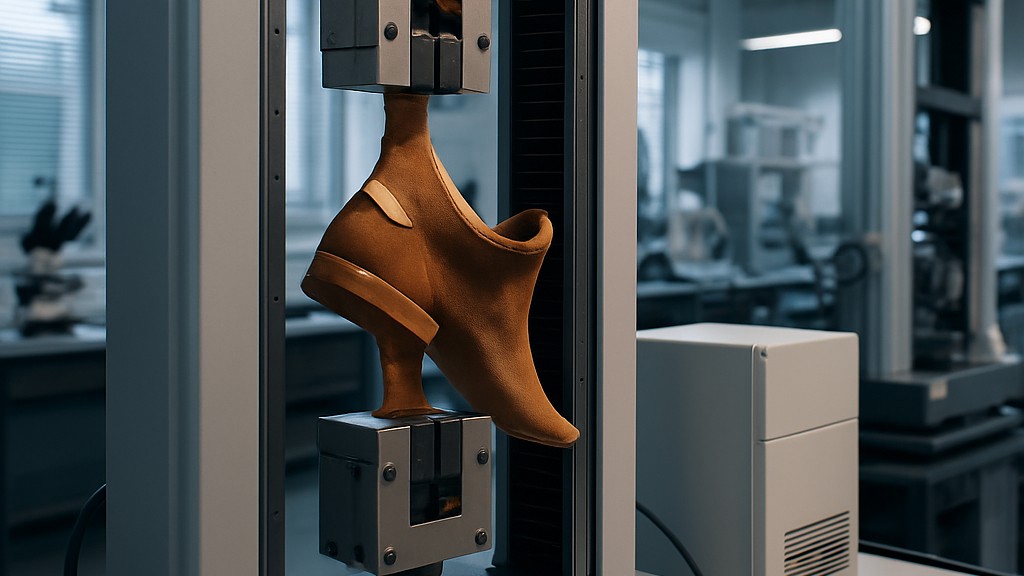
During testing, a rectangular test specimen is compressed in a stretching machine. One end of the test specimen is held in the upper clamp with its surfaces folded inward, so that these surfaces touch each other and the fold line is horizontal. It is then inverted and bent 90 degrees before being placed in the lower clamp. In the lower clamp, the test specimen is folded so that the back or flesh surface of the test specimen touches each other and the fold line is vertical. During the test, the clamps are released at a constant rate, causing the test specimen to be stretched repeatedly. Tests can be performed with wet or dry test specimens at room temperature or with dry test specimens at sub-zero temperatures. After a predetermined number of cycles, the tests are stopped and the test specimen is visually inspected for damage or signs of salt spray.
The ISO 17694 standard is considered essential because it provides a reliable and standardised method for assessing the slip resistance of protective footwear, reducing accidents, ensuring compliance with legislation and increasing confidence in product safety.
Our organization, which has been supporting businesses across all sectors for years through a wide range of testing, measurement, analysis, and evaluation activities, has a strong team of employees who closely follow global developments in science and technology and are constantly improving themselves. In this context, we also provide testing services in accordance with the "ISO 17694 Footwear - Test methods for uppers and linings - Flex resistance" standard.
To get an appointment, to get more detailed information or to request an evaluation, you can ask us to fill in our form and reach you.

