

The standard “DIN 53362 Testing of plastic films and textile fabrics (excluding nonwoven fabrics), coated or uncoated plastics - Determination of bending stiffness - According to the cantilever method”, published by the German Institute for Standardization (DIN), describes a test method for measuring the bending rigidity (bending stiffness) of thin, flexible materials. This standard is particularly applicable to:
However, this standard does not cover nonwoven fabrics, for which the EN ISO 9073-7 standard generally applies.
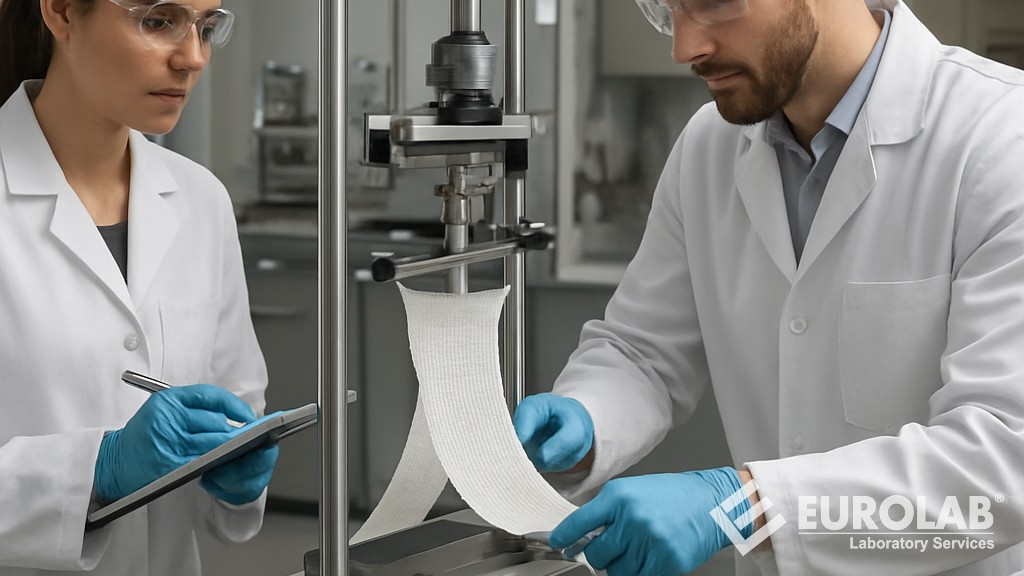
This test method is a cantilever-based method very similar in principle to ASTM D1388 or BS 3356 standards. It utilizes the classic cantilever principle. Accordingly, a strip-shaped specimen (typically 25 mm wide and 200 mm long, but dimensions may vary slightly depending on the material) is placed on a horizontal platform with a marked scale. One end is fixed while the free end hangs outwards. The specimen is slowly advanced until its leading edge bends under its own weight and touches a reference line or angle (typically when the end reaches 41,5 degrees from the horizontal, this is a standard critical angle in cantilever stiffness tests). The sag length at this point is measured in millimeters. From this length, the bending stiffness (bending rigidity) is calculated. Some devices directly provide the bending length, bending rigidity, or modulus of flexure.
The main features of this standard are:
This standard remains important in quality control for textiles, technical fabrics, packaging films and coated materials where tactile feel, drape or resistance to bending is an important performance characteristic.
Other standards related to this standard are as follows:
In short, the DIN 53362 standard defines a method used to determine the bending stiffness (flexural rigidity) of plastic films, sheets, coated fabrics, and textile materials. This test evaluates how resistant a material is to bending when subjected to its own weight under controlled conditions.
This standard is widely applied in industries such as textiles, synthetic leather, packaging films, and automotive interior materials, where flexibility and drape properties are critical to product performance and use.
The main purpose of the DIN 53362 standard is to provide a consistent and repeatable method for measuring the stiffness of thin, flexible materials. Bending stiffness is affected by:
For example, materials used in automotive upholstery, seat covers, and synthetic leather must strike a balance between flexibility and structural integrity, making stiffness testing crucial.
The cantilever method used to determine bending stiffness generally follows these steps:
Bending stiffness is calculated using the bending length obtained from the overhang measurement. The result is usually expressed as follows:
Bending rigidity depends on the following:
Higher values indicate harder materials, while lower values indicate more flexible materials.
This standard requires the following equipment:
This equipment enables precise measurement of bending length.
Typical sample requirements include:
Typical dimensions (may vary depending on material):
The DIN 53362 standard is used in various sectors:
Using the DIN 53362 standard offers several advantages:
Manufacturers rely on this testing to ensure materials meet functional and comfort requirements before being used in final products.
In conclusion, the DIN 53362 standard specifies a cantilever-based test method for determining the bending stiffness of plastic films and textile fabrics. By measuring how much a material can stretch before bending under its own weight, the test provides valuable information about the material's flexibility, drape, and mechanical behavior.
For many years, our organization, with its competent and experienced staff, has been understanding the needs of its clients, providing the advanced testing services they require, and assisting them in the establishment, implementation, and improvement of management systems. Within this framework, we also provide testing services in accordance with the DIN 53362 standard.
To get an appointment, to get more detailed information or to request an evaluation, you can ask us to fill in our form and reach you.

