Adhesion, Adhesion Friction, Flock Adhesion and Adhesion Tests
Adhesion refers to the tendency of different surfaces or materials to stick together due to intermolecular forces. It plays a critical role in materials science, tribology (the study of friction, wear, and lubrication), coatings, adhesives, and manufacturing processes. Adhesion arises from various intermolecular and mechanical interactions at the interface between two materials. No single theory can explain all cases; instead, often multiple mechanisms contribute simultaneously.
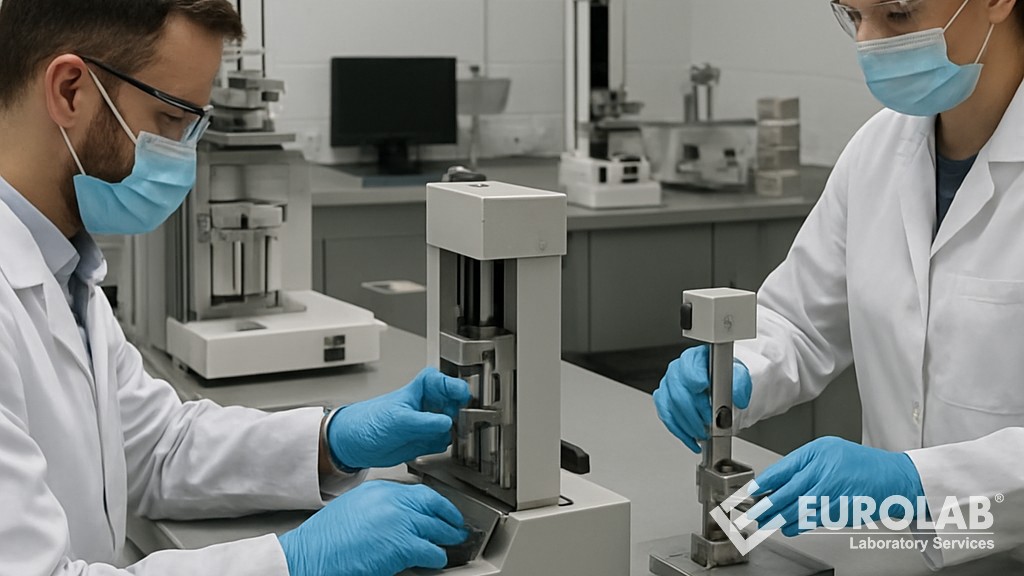
The basic theories are as follows:
- Mechanical locking: The adhesive penetrates into pores, voids, or irregularities in the substrate surface, creating a physical lock.
- Adsorption (thermodynamic/wetting): Involves intermolecular forces and leads to physical adsorption.
- Chemical bonding: The formation of ionic, covalent, or hydrogen bonds across an interface.
- Electrostatics: Charge transfer creates an electrical double layer that generates attractive forces.
- Diffusion: When both materials are compatible polymers, the polymer chains diffuse into each other across the interface.
- Acid-base: Interactions between regions that accept and donate electrons.
These mechanisms determine bond strength, which is influenced by surface roughness, cleanliness, and material compatibility.
In tribology, adhesion contributes significantly to friction, especially in dry or unlubricated contacts. The theory of adhesion friction suggests that friction results from strong adhesive bonds forming at the actual points of contact (protrusions) on rough surfaces. When surfaces slide, these bonds break, requiring a force equal to the friction.
Key features:
- Due to the roughness, the actual contact area is much smaller than the apparent area.
- During sliding, adhesive bonds form and break, leading to wear (adhesive wear).
- For soft materials like rubber, friction involves hysteresis (viscoelastic deformation) as well as adhesion.
On clean, smooth, or soft surfaces (e.g., tire friction on roads), adhesion friction is dominant, while on rough surfaces, deformation/hysteresis is dominant. Factors such as load, speed, temperature, and environment influence this balance.
Flock bonding is a surface treatment process that creates a velvety texture by bonding short fibers (flock) perpendicularly to a surface. It is widely used in textiles, automotive interiors, packaging, and decorative items for aesthetic, tactile, or functional benefits (e.g., light retention, insulation).
The process relies on the strong adhesion between the flock fibers and the adhesive layer:
- Surface preparation (cleaning, priming for better adhesion).
- Adhesive application (usually acrylic or polyurethane).
- Flock application: Fibers (nylon, rayon, polyester, 0,25-5 mm long) are electrostatically repelled into a wet adhesive, usually for vertical orientation.
- Drying / hardening.
- Removing excess fibers.
Electrostatic flocking charges the fibers, aligning them in an electric field for a dense and uniform coating.
Adhesion quality depends on the open time of the adhesive, surface energy, and curing conditions. Poor adhesion leads to fiber loss, while durability is determined through testing.
Adhesion strength is determined by standardized mechanical tests that measure the force required to separate bonded materials. Common methods include:
- Peel test: Measures the force required to peel a flexible material (e.g., tape or coating) from a substrate at a controlled angle (typically 90 degrees or 180 degrees). Ideal for pressure-sensitive adhesives.
- Overlap shear test: Two substrates bonded with adhesive are overlapped, and a tensile force parallel to the bond is applied until they break. This test evaluates shear strength.
- Tensile test: A mold is attached to the coating, and a perpendicular tensile force is applied to pull it, measuring its adhesion to the substrate.
- Cross-cut/tape test: Grid cuts are made in the coating, tape is applied and removed, and grading is done according to the removed material.
- Scratch test: The pencil scratches the surface under increasing load; the critical load for separation indicates adhesion.
Standards (e.g., ASTM D1002 standard for overlap cutting, ASTM D3359 standard for cross-cutting) ensure repeatability. Failure modes (adhesive, cohesive, substrate) provide insight into bond quality.
Adhesion standards have been developed by organizations such as ASTM and ISO to provide repeatable and comparable assessments of adhesion strength in coatings, adhesives, paints, varnishes, and related materials. These standards cover qualitative and quantitative testing for applications in industries such as manufacturing, automotive, aerospace, and construction. Many ASTM and ISO standards are similar, but not always identical.
The most frequently referenced standards focus on coatings and paints:
- Tape/cross-cut adhesion test:
- The ASTM D3359 Standard test methods for evaluating adhesion by tape testing includes two methods: Method A, X-cut for coatings thicker than 125 μm, and Method B, cross-scan for thinner coatings. It provides a qualitative rating from 0 (poor) to 5 (excellent) after the pressure-sensitive tape is applied and removed. It is commonly used for rapid field or laboratory assessments.
- The “ISO 2409 Paints and varnishes – Cross-cut test” standard is similar to, but not technically equivalent to, ASTM D3359 Method B. It allows testing on non-metallic surfaces such as wood.
- Tensile adhesion test:
- The standard “ASTM D4541 Standard method for determining the tensile strength of coatings using portable adhesion testing machines” provides a quantitative measurement of the tensile strength required to pull a doll from a coating. It is suitable for metal surfaces and provides numerical values in psi or MPa.
- The “ISO 4624 Paints and varnishes – Tensile test for adhesion” standard specifies methods using one or two dolls, useful for single or multi-layer systems. In international contexts, it is often used synonymously with the ASTM D4541 standard.
- Other important standards:
- “ASTM D6677 Standard test method for evaluating blade adhesion.”
- "ASTM D2197 Standard for adhesion testing of organic coatings by scraping method".
- “ASTM C633 Standard test method for adhesion or cohesion strength of heat spray coatings”.
- “ASTM B571 Standard practice for qualitative adhesion testing of metal coatings”.
- “ASTM D1002 Standard test method for determining the apparent shear strength of metal specimens bonded with single-layer adhesive by tensile loading (metal to metal)”.
- “ISO 4587 Adhesives - Determination of tensile, thrust and shear strength of rigid-rigid bonded assemblies” (similar to ASTM D1002 standard).
These standards enable reliable assessment of adhesion performance, helping to predict resistance to environmental factors such as humidity, temperature, and mechanical stress.
For many years, our organization, with its competent and experienced team, has been understanding the needs of its clients, providing the advanced testing services they require, and assisting in the establishment, implementation, and improvement of management systems. Within this framework, we also provide adhesion, adhesion friction, flock adhesion, and adhesion testing services to businesses.



