

The European standard “EN 12225 Geosynthetics - Method for determining microbiological resistance by burial test in soil” describes a method for determining the microbiological resistance of geosynthetics, including natural fibers and biodegradable polymers, by burial test in soil.
Experience with geosynthetics, some of which have performed successfully for over twenty years, and their extraction from soil, demonstrates that geosynthetics made from synthetic materials are generally resistant to microbial degradation. Therefore, most of these currently commercially available products can be expected to successfully pass the soil burial test, and it is probably not necessary for all of them to undergo this test, regardless of their function. However, if proof of microbiological resistance is required for geosynthetics to function properly, or if they are made from newly developed polymers whose resistance is questionable, the soil burial test may provide additional information.
For the purposes of this standard, the following terms and definitions apply:
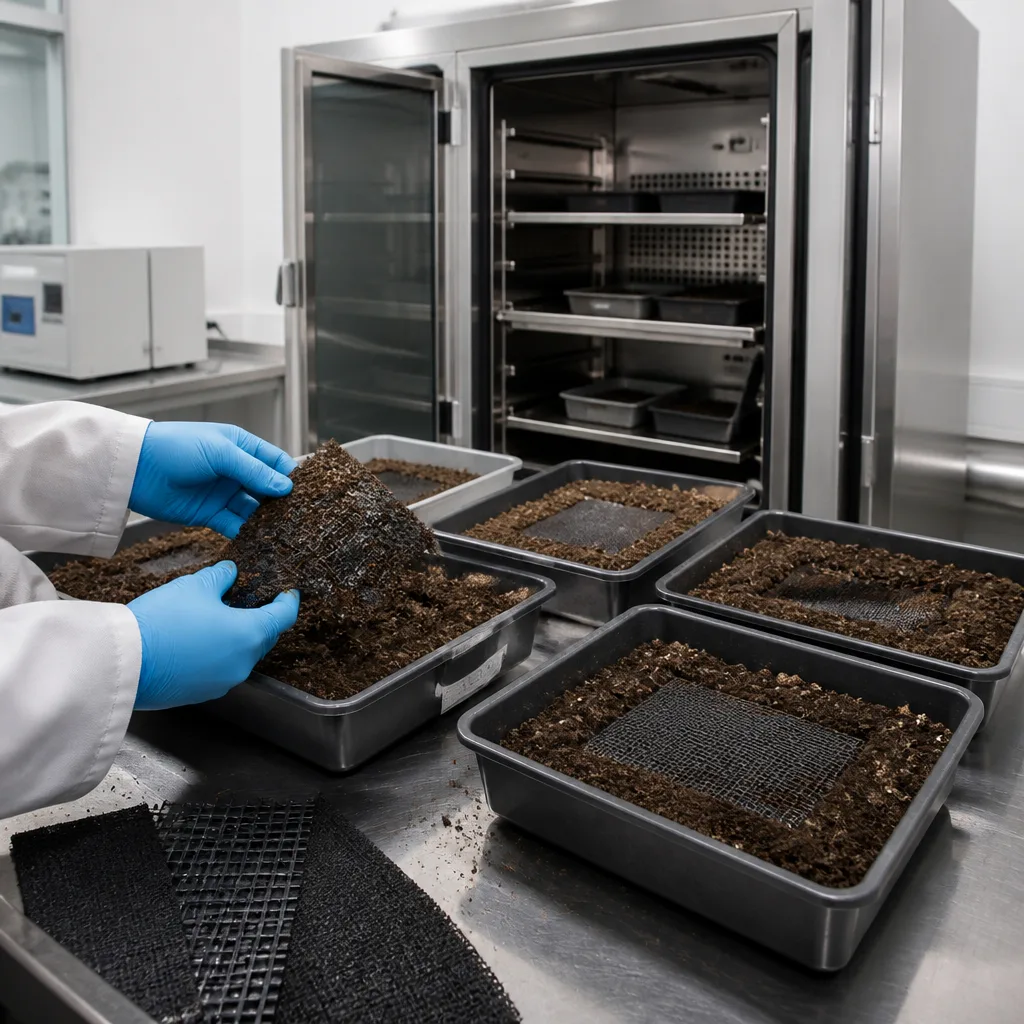
In principle, tensile test specimens are exposed to microbiologically active soil for a specified test duration. Following the specified test duration, the test specimens are visually evaluated both before and after cleaning, and tensile tests are performed. The test results are compared with those obtained from unexposed specimens.
For each direction to be tested (machine direction and direction perpendicular to the machine) and each set of conditions, five samples are prepared according to the EN 12226 standard. Control samples are stored in a standard atmosphere at a temperature of 23 degrees plus/minus 1 degree and a relative humidity of 50 percent plus/minus 5 percent, according to the EN ISO 291 (class 1) standard.
The container containing the test soil should be stored at room temperature (26 degrees plus/minus 1 degree Celsius) with adequate fresh air circulation. Soil and test samples should be kept away from direct or indirect sunlight. To ensure a homogeneous and constant moisture content of 60% plus/minus 5% saturation moisture content, the relative humidity in the gas phase in the container above the test soil should be controlled at least at 90%. During the test period of several weeks, drying or adding water to the test soil should not affect the performance of the microorganisms. The container should be designed to allow air exchange with the environment and therefore should not be tightly sealed.
In short, the EN 12225 standard is a standard that specifies the properties and performance requirements for geotextiles and related products used in erosion control applications. These materials are typically laid on slopes, riverbanks, shorelines, embankments, and other exposed soil surfaces where water or wind can cause soil erosion and instability.
The primary objective of this standard is to ensure that geotextile products used for erosion protection perform reliably under environmental and mechanical stresses. Erosion can weaken infrastructure, damage ecosystems, and increase maintenance costs; therefore, standardized performance criteria are crucial.
This standard helps manufacturers, engineers, and project owners verify a product's suitability for the following purposes:
The EN 12225 standard applies to geotextiles and geotextile-related products used in erosion control systems. These include:
This standard does not prescribe a specific product type; instead, it defines the characteristics that should be evaluated depending on the intended application.
Products tested according to the EN 12225 standard are typically evaluated in terms of the following characteristics:
Without standardized erosion control materials, projects can suffer from inconsistent product quality and premature failures. The EN 12225 standard is considered important for the following reasons:
In infrastructure projects such as highways, railways, landfills, drainage systems, and coastal protection, failures in erosion control can lead to costly structural damage. The EN 12225 standard minimizes this risk by defining minimum technical expectations.
The EN 12225 standard is widely used in the following areas:
In conclusion, the EN 12225 standard plays a crucial role in guaranteeing that geotextiles used for erosion control provide consistent mechanical strength, hydraulic behavior, and durability. Standardizing performance requirements supports safer infrastructure, better environmental management, and more reliable erosion protection systems across Europe.
For many years, our organization, with its competent and experienced staff, has been understanding the needs of its clients, providing the advanced testing services they require, and assisting them in the establishment, implementation, and improvement of management systems. Within this framework, we also provide testing services in accordance with the EN 12225 standard.
To get an appointment, to get more detailed information or to request an evaluation, you can ask us to fill in our form and reach you.

