

The standard “AATCC TM 197 Test method for vertical wicking rate of textiles to specified distances,” published by the American Association of Textile Chemists and Colorists (AATCC), describes a test method used to evaluate the ability of vertically aligned fabric samples to transport liquid along or through them and is applicable to woven, knitted, or nonwoven fabrics.
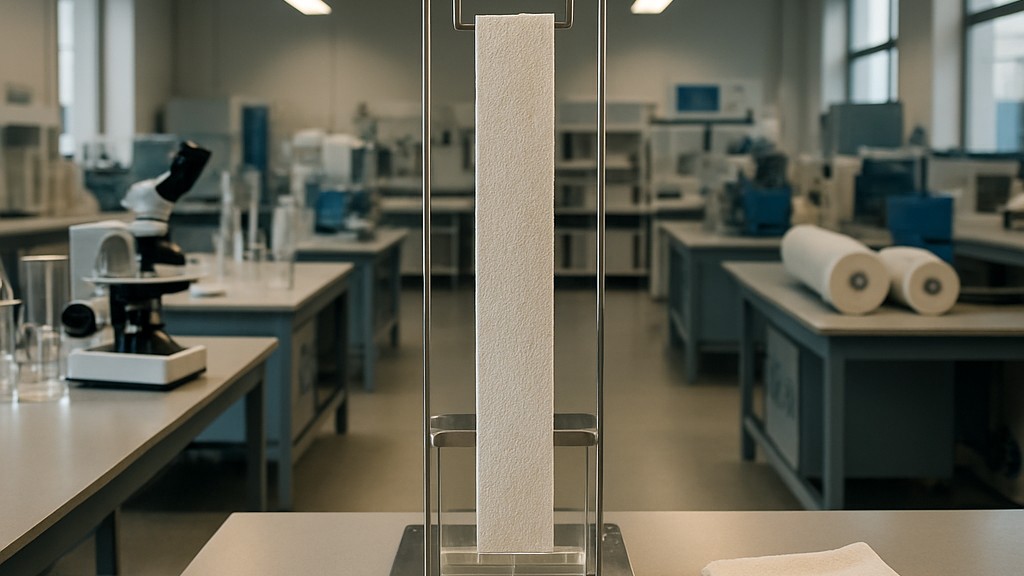
Historically, the textile industry has used many different testing procedures to determine the absorbency properties of textile fabrics, that is, the movement of water or liquid through them. Over the past decade, the industry has developed new technologies that have altered the water movement and absorbency responses of textiles, leading to the use of the term "moisture management" labeling to describe these phenomena. Numerous organizations, including textile manufacturers, chemical suppliers, retailers, and independent testing laboratories, are striving to standardize testing methods for measuring the vertical absorbency properties of fabrics with moisture management qualities.
In the test method described in this standard, in principle, the speed (distance per unit of time) at which liquid moves across or through a fabric sample is visually observed, manually timed and recorded at specified intervals.
For the purposes of this standard, the following terms and definitions apply:
The movement of liquid within a fabric can be affected by fiber content, fabric construction, mechanical or chemical treatment, or a combination of these. This test method is used to evaluate the absorbency of vertically aligned test specimens exposed to distilled or deionized water, where gravity affects absorbency.
Liquids other than distilled or deionized water (such as colored water, dye solutions) can be used in this test. If a liquid other than water is used, the surface tension should be measured and reported, as solutions with different surface tensions may yield different results.
Dark fabric colors or prints and designs can be difficult to test. Using a soluble ink in a contrasting color can help make marks more clearly visible.
The procedure measures the time and distance that water will migrate upward from the cut edge of a sample, but does not replicate the exposure of a final product during abrasion. The results obtained with this test are not a measure of comfort, which is beyond the scope of this method. The relationship between the results obtained with vertical and horizontal wicking tests is unknown.
It must be determined whether the fabric has a hydrophobic or hydrophilic side. Once the parties involved have agreed, it must be determined whether both fabric sides will be tested. If only one fabric side is to be tested, the selected side is marked. If the test is to be performed after washing, a permanent ink marker is used to indicate the fabric side selected for testing.
Because skin oils can affect moisture movement, handling of test samples should be minimized or gloves should be worn. All samples should be cut at least 100 mm plus/minus 5 mm from the edge. If garments are being tested, samples should be taken from different garment panels, away from seams, pockets, snaps, or other assembly features. Each sample should be taken with thread sets of different (fabric) lengths and widths present.
Three samples, each measuring at least 165 mm plus or minus 3 x 25 mm plus or minus 3 mm, are cut parallel to the fabric direction to be tested. For length-direction testing, the longitudinal direction of the template is aligned with the warp yarns; for width-direction testing, the longitudinal direction of the template is aligned with the filling yarns. Before starting the test, an additional sample is cut to determine the water level in the bottle or beaker. If testing surface durability after washing or evaluating wicking properties, samples are taken from fabric samples washed according to the selected conditions.
Before testing, samples are conditioned as specified in "ASTM D1776/D1776M 20 Standard Practices for Conditioning and Testing of Textiles." Samples are conditioned for at least four hours in an atmosphere of 21°C (plus/minus 2°C) and 65% (plus/minus 5%) relative humidity by placing each test sample individually on a screen or perforated shelf of a conditioning rack. All tests are conducted in a standard atmosphere.
In short, the AATCC TM 197 standard is a key test method used to measure the vertical wicking rate of textiles. This property is critical for evaluating how effectively fabrics wick moisture away from the body, which is crucial for comfort in activewear, medical textiles, and other performance applications.
The primary purpose of this standard is to determine the vertical moisture transport (wicking) behavior of textile materials. It evaluates how far and how quickly a liquid (usually water or simulated perspiration fluid) moves vertically through a fabric due to capillary action.
This method is particularly valuable for evaluating:
This standard is applicable to:
This standard is generally not suitable for highly hydrophobic textiles unless they are specifically designed to have moisture-wicking treatments.
AATCC TM 197 is important because moisture management is a key performance parameter in modern textiles. The ability to wick sweat or liquid away from the skin contributes to:
It is widely used by textile manufacturers and research institutions during product development, quality control and performance verification.
Our organization, which has been supporting businesses across all sectors for years through a wide range of testing, measurement, analysis, and evaluation activities, boasts a strong team of employees who closely follow global developments in science and technology and are constantly improving themselves. In this context, we also provide testing services in accordance with the "AATCC TM 197 Test Method for Vertical Wicking Ratio of Textiles at Specified Distances."
To get an appointment, to get more detailed information or to request an evaluation, you can ask us to fill in our form and reach you.

