

DIN 53892-2 Textile Tests - Part 2: Determination of Dimensional Changes of Heavy Fabrics Subjected to Repeated Humidity and Dry Air Exposure
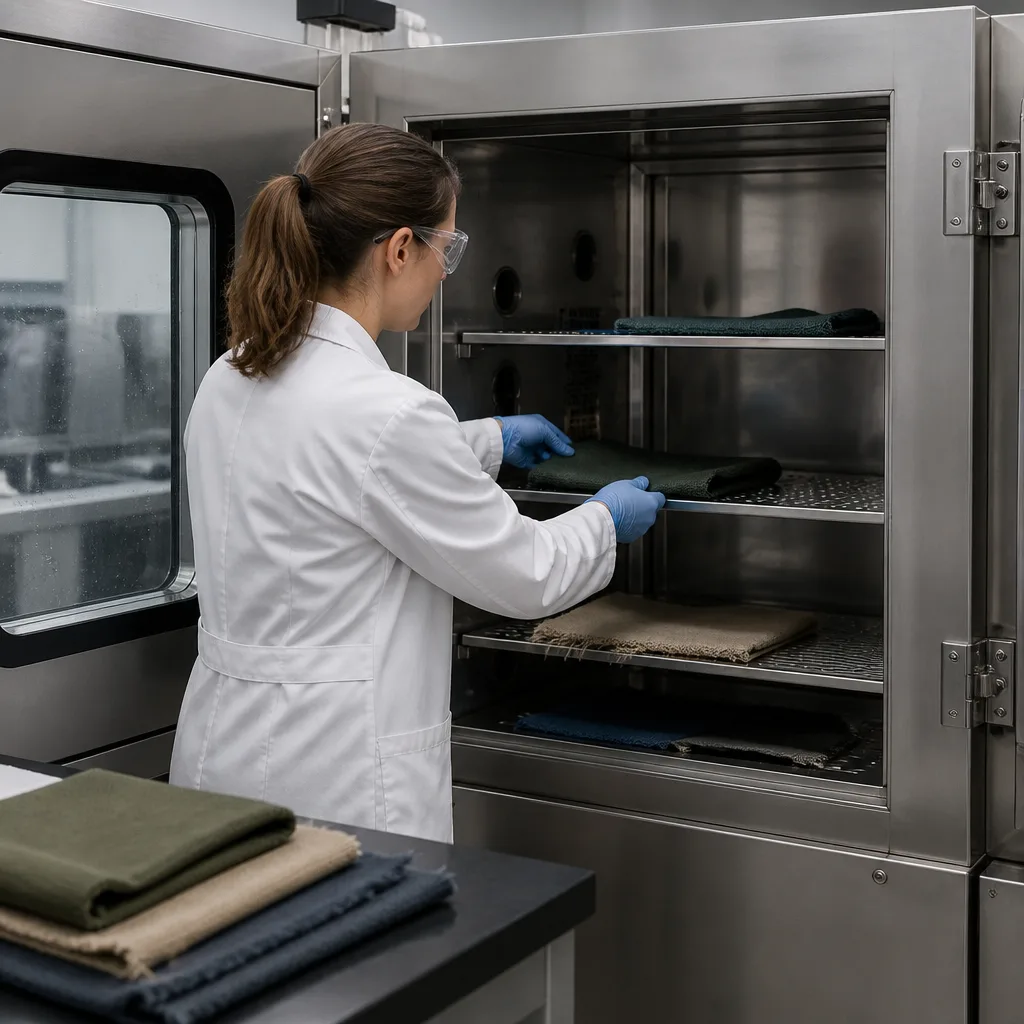
The German Standards Institute (DIN) standard “DIN 53892-2 Textile Tests - Part 2: Determination of dimensional change of heavy fabrics exposed to repeated exposure to moisture and dry air” describes a test method for determining the dimensional change (shrinkage or elongation) of heavy fabrics resulting from repeated wetting and drying processes during use. This test method is applicable to heavy fabrics with a weight per unit area exceeding 350 g/m² ( e.g., tarpaulin, tent and awning fabrics, and other fabrics exposed to external factors), provided that these fabrics are not generally intended for clothing use.
This standard focuses on measuring shrinkage or elongation caused by repeated wetting (moisture exposure) and drying cycles in heavy fabrics. These changes simulate real-world conditions where fabrics are exposed to weather, rain, dew, or moisture, and then dried.
Typical applications of this standard include:
Fabrics commonly used in clothing are clearly excluded.
Heavy-duty outdoor fabrics can undergo significant dimensional changes (shrinkage or stretching) when repeatedly wetted and dried. This can lead to problems such as:
The described test method provides a standardized, repeatable procedure for measuring these changes, helping manufacturers, suppliers, and users predict long-term behavior and ensure product quality and reliability.
In general, this method follows these steps:
This testing method, unlike single-cycle tests, emphasizes repeated exposure to better simulate long-term environmental stress.
DIN 53892-2 is part of a series of textile tests for dimensional changes and moisture effects. It complements other standards relating to fabric care, water resistance and weather resistance performance for technical textiles.
This testing method is particularly important for the technical textile industry, where dimensional stability directly affects the safety, functionality, and service life of products used in outdoor and industrial applications.
In short, the DIN 53892-2 standard includes a test method for determining dimensional changes (e.g., shrinkage or elongation) that occur in heavy textile fabrics when subjected to repeated moisture and drying cycles. This standard is particularly important for textiles exposed to outdoor or harsh environmental conditions, where alternating wet and dry states can significantly affect material performance.
This standard applies primarily to heavy fabrics such as tarpaulins, tents, awnings, and weather-exposed industrial and technical textiles designed for technical or outdoor uses, not clothing. It evaluates how these materials behave when exposed to repeated moisture (wetting) followed by dry air conditions, simulating real-life environmental cycles.
DIN 53892-2 was designed because heavy-duty textiles behave very differently from clothing fabrics when exposed to real-world environments. Without a standardized method for testing them, performance is unpredictable and often unacceptable in practical use. The main reasons why this standard was deemed necessary are as follows:
This enables engineers and buyers to make informed material choices.
In these sectors, performance failure can be not only inconvenient but also costly or even insecure.
The advantages of using the DIN 53892-2 standard are as follows:
In conclusion, the DIN 53892-2 standard is a specialized but highly important textile testing standard focusing on dimensional stability under cyclic moisture exposure. It plays a critical role in ensuring that heavy fabrics used in outdoor and technical applications maintain their shape, functionality, and durability over time.
For many years, our organization, with its competent and experienced staff, has been understanding the needs of its clients, providing the advanced testing services they require, and assisting them in the establishment, implementation, and improvement of management systems. Within this framework, we also provide testing services in accordance with the DIN 53892-2 standard.
To get an appointment, to get more detailed information or to request an evaluation, you can ask us to fill in our form and reach you.

