

The European standard “EN 12132 Feather and down - Testing methods for the down-proofing properties of fabrics” consists of the following sections published under the same title:
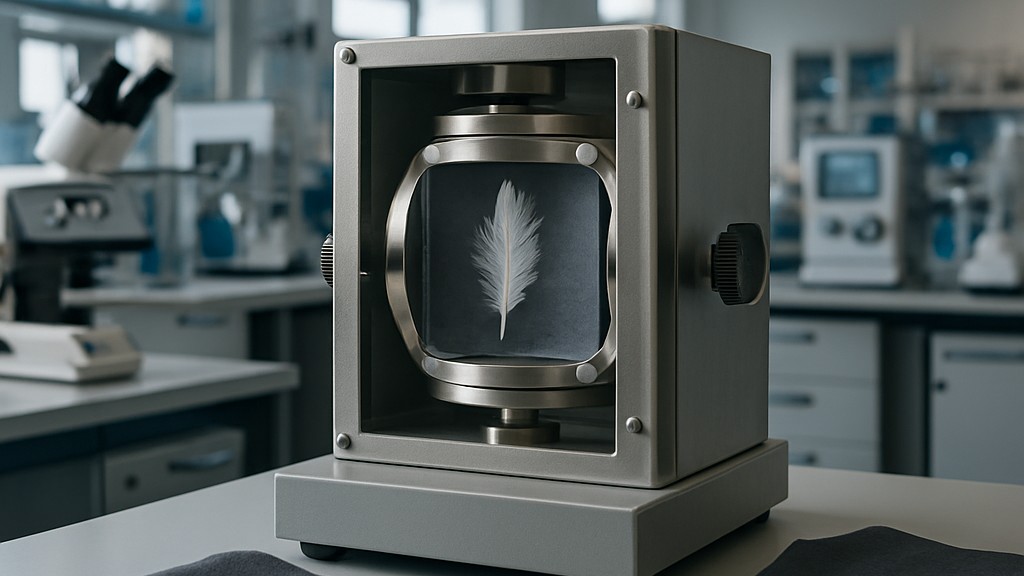
In principle, a pillow is made from the fabric to be tested for down-proofing properties, of specified dimensions, and filled with a specified amount of feather and down material or a blend of these. The pillow is mounted in a fixture and subjected to a specified number of strokes. The number of feather or down particles passing through or exiting the primary fabric is determined.
At least two fabric test samples measuring 140 mm plus/minus 5 mm x 420 mm plus/minus 10 mm are taken. One sample is taken with the long edge in the warp direction, the other with the weft direction. Two test mats are sewn from these samples (lockstitch). The stitch length is 1 mm. The fabric is folded in the center, parallel to the short edge, with the back facing outward. The long edge is sewn 10 mm from the edge. Then, the fabric is turned over with the back facing inward. The short edges are sewn 20 mm from the edge, leaving an opening at the sides for the filling. The resulting test mat is filled with the required weight of filling material according to the composition in the table titled "Rolling the Test Mat," and the stitching is completed along the short edge, leaving no filling material in this area. This results in a test mat measuring 120 mm x 170 mm.
Before testing, the pad is placed in a plastic bag. This ensures that all particles that pass through the pad's primary fabric are collected. The plastic bag containing the test pad is then secured to the clamps of the testing machine. The pad covers are placed in the clamps, and the pad is folded between these clamps. The counter is set to 2700 rpm. The device is turned on and automatically stopped by the counter after 2700 rpm (approximately 20 minutes).
The pad is then removed from the plastic bag. All filler particles in the plastic bag are counted. The test pad is placed under a suitable light source, and the number of visible particles protruding greater than 2 mm is counted. If the number of filler particles in the plastic bag and the number of filler particles protruding from the pad exceeds 50, the counting should be stopped.
The test report must include the following information for each test pad:
In principle, a cylindrical pillow is made from the fabric to be tested for down-proofing properties and filled with a specific amount of feather and down material or a mixture of these. This pillow, sliding on an inclined plane, is moved against a pinned plate by a pinned rod, compressing it. After the impact, the pillow is rewound and regained its shape by following the pinned impact rake as it moves backwards. This process is repeated continuously until a specific number of impacts are reached. When the impact of the pinned plate is greater or less than the circumference of the pillow, the pillow is compressed at different locations. The number of feather or down particles passing through or escaping the primary fabric is counted.
Conditioning and testing of the test sample is carried out in an atmosphere in accordance with the EN 20139 standard, and temperature and relative humidity are measured in accordance with the EN 20187 standard.
At least two test samples are taken from the fabric, each measuring 750 mm x the full width of the fabric. One sample is taken with the wide side facing the warp, the other facing the weft. Two cylindrical test pads are prepared from these samples. The surface area is 210 mm x 476 mm². The pad diameter is approximately 151,5 mm plus/minus 1 mm. The resulting test pad has an effective cylindrical surface area of 1000 cm².
To test the feather-proof properties, a different impact abrasion is applied:
After every 500 strokes, the number of feathers and down that pass through or protrude from the surface of the cushion cover is visually counted. Filling that passes through or protrudes from circular edges or seams is not taken into account. The down-proofing properties of fabrics are assessed based on the total number of feathers and down that pass through or protrude and fall out at the end of the test.
The test report should include the following information:
The EN 12132 standard addresses critical quality and performance issues in the bedding and textile industry, where feather and down fillings are valued for their insulation, comfort, and breathability. The main reasons for its necessity are:
Our organization, which has been operating for many years and meticulously follows global developments in science and technology, employs a team of experienced professionals and a broad infrastructure to conduct testing, measurement, and analysis in a wide range of areas for businesses across all sectors. In this context, we also provide testing services in accordance with the standard "EN 12132 Feather and Down - Methods for Testing the Down Resistance Properties of Fabrics."
To get an appointment, to get more detailed information or to request an evaluation, you can ask us to fill in our form and reach you.

