

For the purposes of this standard, pH expresses the chromatography of hydrogen ion concentration in an aqueous extract.
This test is based on the principle of electrometric measurement of the pH value of the aqueous extract of textiles at room temperature by means of a glass electrode.
All reagents used in these tests must be of recognized analytical reagent grade. Distilled or deionized water, at least Class 3 according to EN ISO 3696, should have a pH between 5,0 and 7,5. The pH value should only be verified the first time. If it is not within the specified range, the water should be redistilled using chemically resistant glassware. Acids or organic matter can be removed by distilling water from a solution of 1 g/l potassium permanganate and 4 g/l sodium hydroxide. Alkalinity (e.g., the presence of ammonia) can be suppressed by distilling water from a dilute sulfuric acid solution.
It can also be potassium chloride solution prepared using distilled or deionized water as the reagent.
Buffer solutions for calibration of the pH meter before measurement must comply with Annex A, having a pH value similar to the determined value.
The following equipment is generally used in tests:
When preparing test specimens, a laboratory sample is taken that represents the majority of the material and is sufficient to provide all the required test samples. The laboratory sample is cut into pieces with approximately 5 mm edges or large enough to allow for rapid wetting of the test specimens. Material is handled as little as possible to prevent contamination.
Three test samples of 2 g plus/minus 0,05 g are taken from the laboratory sample.
When preparing an aqueous extract, the extract is prepared in triplicate at room temperature. The test sample and 100 ml of extraction solution or potassium chloride solution are placed in a stoppered bottle. The bottle is briefly shaken by hand to ensure even wetting of the textile, followed by mechanical agitation for 2 hours plus or minus 5 minutes.
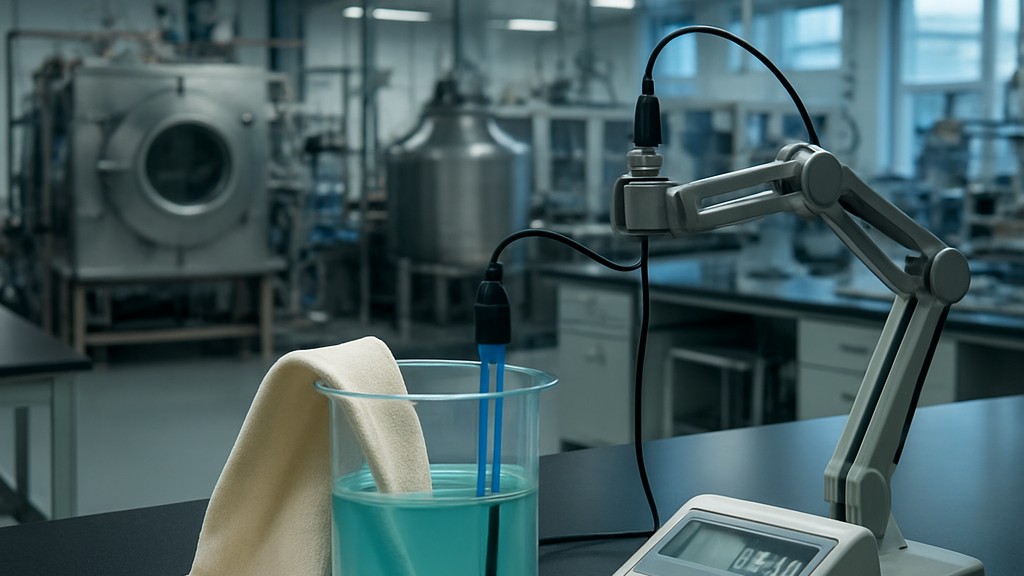
When measuring the pH of an aqueous extract, the pH meter is calibrated at the temperature of the extract to be measured. The pH meter's calibration is checked using two buffer solutions. The electrode is immersed several times in the same solution used to prepare the extract until the specified pH value stabilizes. The first extract is poured into a beaker, the electrode is immediately immersed to a depth of at least 10 mm and gently stirred with a stick until the pH value stabilizes (the value for this solution is not recorded). The second extract is poured into a beaker, the electrode is immediately immersed to a depth of at least 10 mm without rinsing, and the pH value is maintained without stirring until the pH value stabilizes. This value is recorded. The third extract is poured into another beaker. The pH value is determined as described above. The pH values of the second and third extracts are recorded as the first and second measurements.
If the difference between the pH values, expressed to the nearest 0,1 unit, is greater than 0,2, the procedure is repeated with the other samples. The average value of the two recorded measurements is calculated.
Determining the pH value of aqueous extracts is very important in the textile industry for several reasons:
In short, determining the pH of aqueous extracts in textiles is crucial for maintaining product quality, safety, and compatibility. It's a simple test that provides important information about chemical residues and processing conditions.
Our organization, which has been supporting businesses across all sectors for years through a wide range of testing, measurement, analysis, and evaluation activities, has a strong team of employees who closely follow global developments in science and technology and are constantly improving themselves. In this context, we also provide testing services in accordance with the EN 1413 Textile - Determination of pH of aqueous extract standard.
To get an appointment, to get more detailed information or to request an evaluation, you can ask us to fill in our form and reach you.

