

The International Organization for Standardization (ISO) standard "ISO 811 Textiles - Determination of resistance to water penetration - Hydrostatic pressure test" describes the hydrostatic pressure method for determining the water penetration resistance of fabrics. This method is applicable to all types of fabrics intended to be water-resistant, whether or not they have a water-resistant or water-repellent coating.
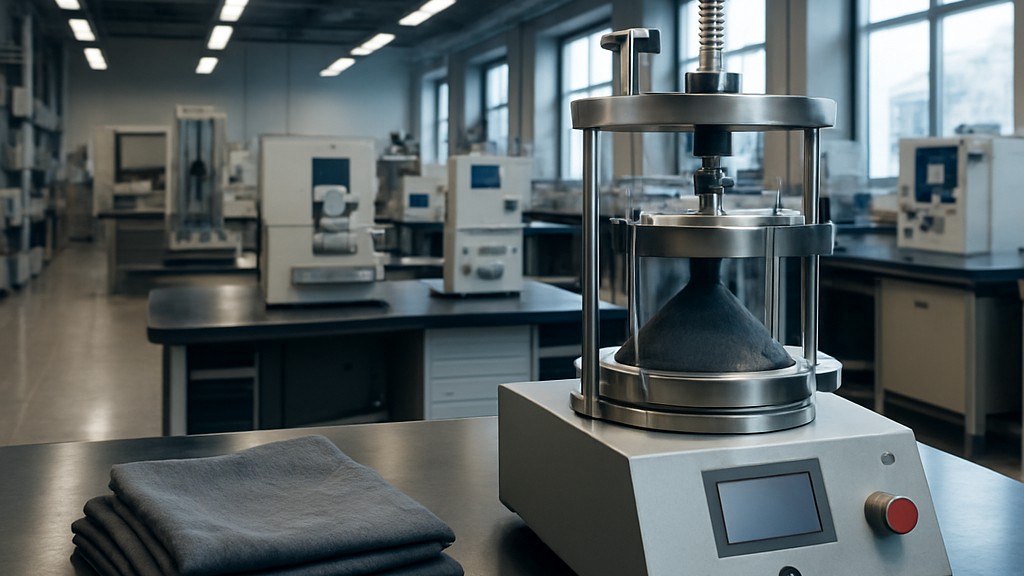
The hydrostatic pressure supported by a fabric is essentially a measure of the resistance to water passing through the fabric. Under standard conditions, a sample is subjected to a continuously increasing water pressure on one side of the fabric until penetration occurs at three locations. The pressure at which water penetrates the fabric at the third location is noted. Water pressure can be applied from above or below the test sample. The chosen alternative must be stated in the test report. The result is directly related to the behavior of fabric products subjected to short- or medium-term water pressure.
The water used in the tests is Class 3 water according to the ISO 3696 standard. The water is in contact with the test sample at 20°C plus/minus 2°C or 27°C plus/minus 2°C. The selected alternative must be stated in the test report. Using water at a higher temperature results in lower hydrostatic head values; the magnitude of this effect may vary from fabric to fabric.
In addition to conventional laboratory apparatus, the following equipment is used in these tests:
For some fixtures, it is recommended that the clamps be lined with a suitable quality rubber. It may be helpful to use sealing wax around the clamps to prevent water infiltration.
Conditioning and testing should be carried out in accordance with ISO 139. If agreed, conditioning and testing can be carried out at ambient temperature. The presence of volatile organic liquid vapors, such as diethyl ether, in the laboratory while performing this test may affect the results.
Upon receipt, the fabric should be handled as little as possible, sharp folding should be avoided, and it should not be processed in any way other than conditioning (e.g., ironing). At least five test samples should be taken from different parts of the fabric to ensure the sample does not contain identical fibers and the material is as completely representative as possible. The fabric can be tested without cutting the samples. Areas with deep wrinkles or fold marks should not be tested.
Fresh distilled water is provided for each sample tested. If the device used is of a type in which the water to be used for testing is contained in the test heads and rises to contact the sample, the surface of the water in the test heads may be cleaned by one of the following methods, listed in order of preference:
All water is wiped from the clamping surfaces. The conditioned sample is clamped to the test head with the fabric face in contact with the water. Compression must be such that water is not forced through the sample before the test begins. The sample is immediately subjected to increasing water pressure. Continuous monitoring is performed for evidence of water penetration.
The pressure at which water first appears in the sample for the third time is recorded in centimeters or millibars. If agreed upon by the parties, the appearance of the first drop may be reported and should be included in the test report. The accuracy of recording the pressure must be as indicated in the table.
Very fine droplets that do not grow after forming are not counted. Subsequent drops passing through the same location on the fabric are counted as a single drop. The presence of water penetration at the edge of the clamp is noted, and any test where such penetration occurs is rejected as inadequate. Further samples are tested until reproducible results are obtained.
If this procedure is used for quality control or to support broad product claims for barrier properties used in protective clothing, appropriate statistical design and analysis of data sets larger than those specified in this test method should be performed.
The average of the recorded pressures for the tested samples is calculated.
Our organization, which has been supporting businesses across all sectors for years through a wide range of testing, measurement, analysis, and evaluation activities, boasts a strong team of employees who closely follow global developments in science and technology and are constantly improving themselves. In this context, we also provide testing services in accordance with the "ISO 811 Textiles - Determination of Resistance to Water Penetration - Hydrostatic Pressure Test" standard.
To get an appointment, to get more detailed information or to request an evaluation, you can ask us to fill in our form and reach you.

