

The ISO 1763 Textile floor coverings - Determination of pile or loop count per unit length and unit area standard, published by the International Organization for Standardization (ISO), describes a method for determining the pile or loop count per unit length and unit area of textile floor coverings. This standard applies to pile textile floor coverings composed of pile or loops.
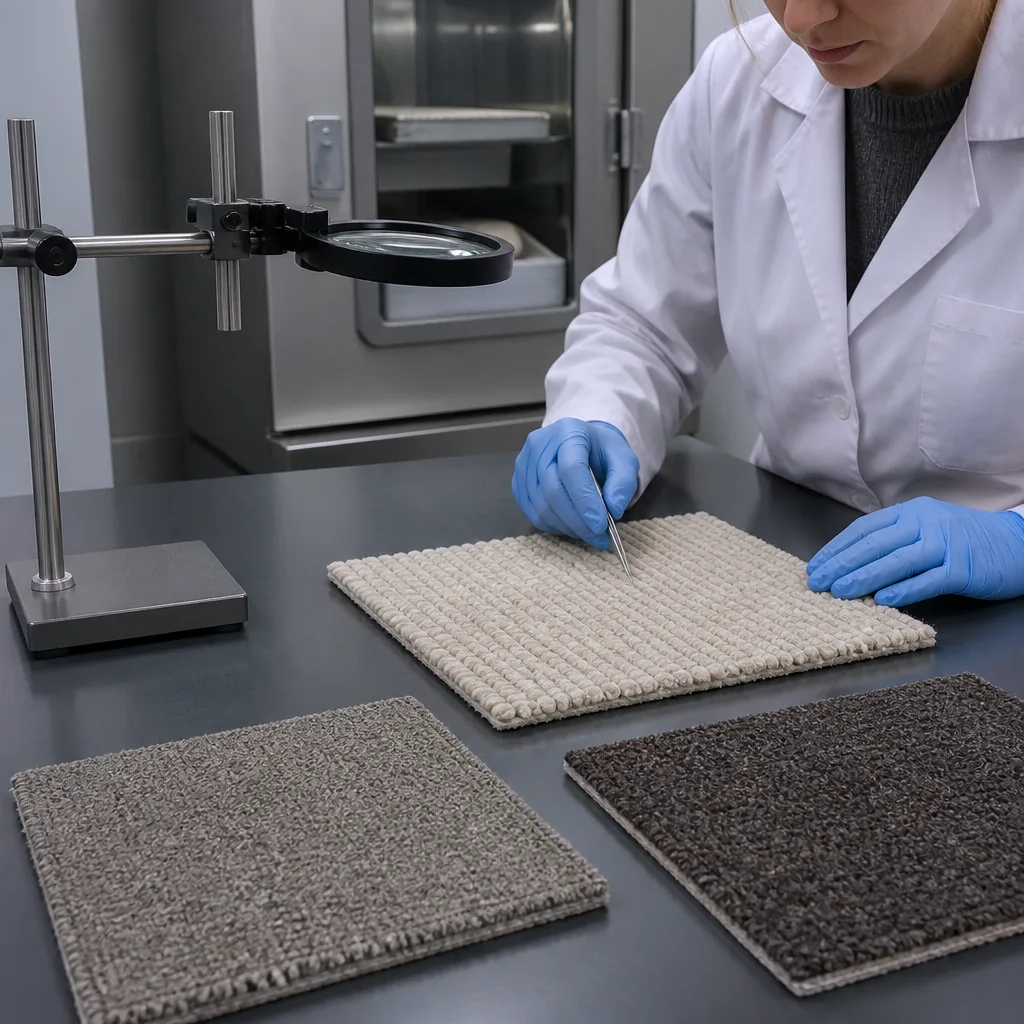
In principle, the number of complete strands or loops is counted along a distance of at least 100 mm in length and containing at least 41 complete strands or loops. The number of strands or loops is counted in directions parallel and perpendicular to the edge, and the number per unit area is calculated.
Samples are placed individually and flat, with the work surface facing upwards, in an environment with a temperature of 20 degrees plus/minus 2 degrees and a relative humidity of 65 percent plus/minus 4 percent for at least 24 hours. The samples are measured in the same environment.
Four areas representing the sample are selected for testing; each edge must contain at least 41 knots or loops and be no less than 100 mm in length. It is necessary to avoid selecting an area closer than 100 mm to any boundary of the sample. For machine-made products, the procedure described in ISO 1957 standard applies. Samples must be clearly marked in directions parallel and perpendicular to the edge.
In short, this standard defines a laboratory method for measuring pile or loop density in textile floor coverings of the following types:
This method is used to determine how many feathers or loops are present:
These measurements are important for evaluating carpet manufacturing quality and production consistency.
The ISO 1763 standard helps manufacturers and testing laboratories evaluate the following:
Higher loop or feather density usually indicates the following:
The ISO 1763 standard applies specifically to textile floor coverings whose pile consists of the following:
This standard includes a method for counting these airborne elements over a defined distance and calculating the corresponding density values.
For the purposes of this standard, the following definitions apply:
In principle, the procedure involves the following:
These standard tests require relatively simple laboratory equipment, including:
Measurements are usually taken to the nearest 0,5 mm.
Before testing, samples are conditioned under controlled atmospheric conditions. Typical conditions include:
Conditioning minimizes errors caused by:
The testing method generally follows these steps:
The ISO 1763 standard is important for the following reasons:
Low-density carpets generally wear out faster and show marks more easily.
The ISO 1763 standard is widely used in the following areas:
The ISO 1763 standard is often used in conjunction with other textile flooring standards, such as:
Together, these standards provide a complete assessment of flooring performance.
In conclusion, the ISO 1763 standard is a key international standard for determining loop and pile density in textile floor coverings. By providing a consistent measurement method, it helps manufacturers, laboratories, and customers assess carpet build quality, durability, and production consistency.
For many years, our organization, with its competent and experienced staff, has been understanding the needs of its clients, providing the advanced testing services they require, and assisting them in the establishment, implementation, and improvement of management systems. Within this framework, we also provide testing services compliant with the ISO 1763 standard.
To get an appointment, to get more detailed information or to request an evaluation, you can ask us to fill in our form and reach you.

