

The standard "EN ISO 17696 Footwear - Test methods for uppers, linings and sock liners - Tear resistance", which has its basis in a European standard and was subsequently published by the International Organization for Standardization (ISO), describes a test method to assess the tear resistance of uppers, linings and sock liners or the complete upper, regardless of material, and to assess their suitability for end use.
For the purposes of this standard, the following terms and definitions apply:
Test samples can be cut from materials likely to be used in uppers or inner socks, or from constructed uppers or finished shoes. When the lining material is permanently bonded to the upper, test pieces are prepared from completed upper assemblies. Six test samples are cut from sheet material or from shoe uppers. If fabric shoe uppers are being tested, the test sample dimensions shown in the figure should be considered minimum dimensions, and a larger test sample should be cut, if possible, to prevent yarn slippage.
For sheet materials, test samples are cut from a series of locations along the full usable width and length of the sheet material. For a woven material, this prevents any two samples from containing the same warp or weft yarns.
When preparing test specimens for leather and shoe uppers, three test specimens are cut with the slit parallel to the longitudinal direction of the material (the warp direction for leather and non-leather materials, or the machine direction) and three test specimens are cut with the slit perpendicular to it. For woven fabrics, the warp direction is used as the longitudinal direction and the weft direction as the crosswise direction, even if they are not at 90° to each other. For shoe uppers, the longitudinal direction is the X-axis, as defined in EN 13400.
For shoe uppers, six test specimens are cut from the entire thickness of the upper, taking care not to displace any lining or interlining laminated to the outer material. Similarly, care is taken to avoid displacing any lining material throughout the test procedure. Three are cut with slits parallel to the longitudinal direction (X-axis), and three are cut with slits perpendicular to it. The longitudinal direction is marked on all test specimens. The test specimens are conditioned in a standard atmosphere specified in EN 12222 for 24 hours prior to testing.
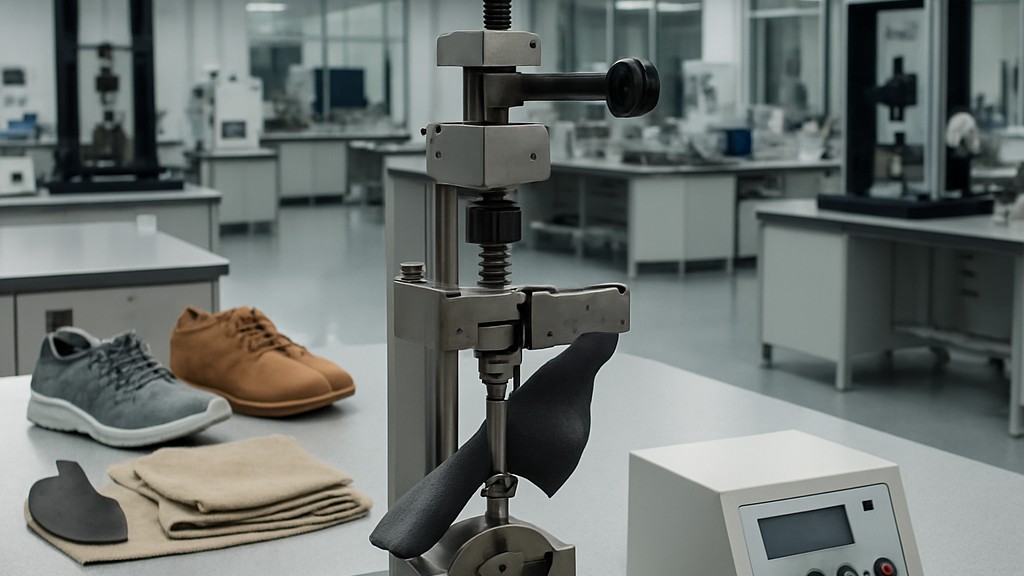
In principle, when performing the test, a test specimen with a single slit to produce two legs is loaded into a tensile testing machine, with the slit parallel to the machine's axis and one leg clamped in each jaw. The jaws are then separated to tear the material until the tear spreads to one edge of the test specimen. The initial force required to initiate the tear, the median force required to sustain the tear, the maximum force required to sustain the tear, and the type of tear are recorded.
All tests must be carried out in a conditioned atmosphere as specified in EN 12222. When this is not possible, tests must be carried out within 15 minutes of removing the samples from the conditioned atmosphere.
The tensile testing machine's force measurement system is zeroed, and the jaws are brought closer together to ensure the test specimen is inserted. The test specimen is held flat between the jaws of the tensile testing machine, with the slit aligned and parallel to the machine's axis. One leg is clamped in the lower jaw, and then the other leg is folded upwards 180 degrees and clamped in the upper jaw. In all cases, it is important to ensure that the end of the leg is parallel with the clamping edge of the jaw and that the slit is positioned along the axis of the tensile testing machine.
The tensile testing machine is operated with the jaws separated at a speed of 100 mm/min plus/minus 10 mm/min and the type of tear produced is noted as follows:
The test is stopped when the tear extends to the edge of the test specimen.
From the force and elongation trace produced by the tensile testing machine:
The above procedure is repeated for the remaining test specimens. If a test specimen in either test direction exhibits an abnormal failure and sufficient material is available, the test is repeated until one more specimen exhibits a normal failure, and the results for the abnormal failures are ignored. If two or more specimens in either test direction exhibit an abnormal failure type, the test is stopped when all six original specimens have been tested, and the results for the abnormal failure types are recorded.
Our organization, which has been supporting businesses across all sectors for years through a wide range of testing, measurement, analysis, and evaluation activities, has a strong team of employees who closely follow global developments in science and technology and are constantly improving themselves. In this context, we also provide testing services in accordance with the EN ISO 17696 Footwear - Test methods for uppers, linings, and sock linings - Tear resistance standard.
To get an appointment, to get more detailed information or to request an evaluation, you can ask us to fill in our form and reach you.

