

The ASTM D4491/D4491M-17 standard, published by the American Society for Testing and Materials (ASTM) , defines test methods for determining the hydraulic conductivity (water permeability) of geotextiles in an uncompressed state under standard test conditions. This standard describes three different test methods:
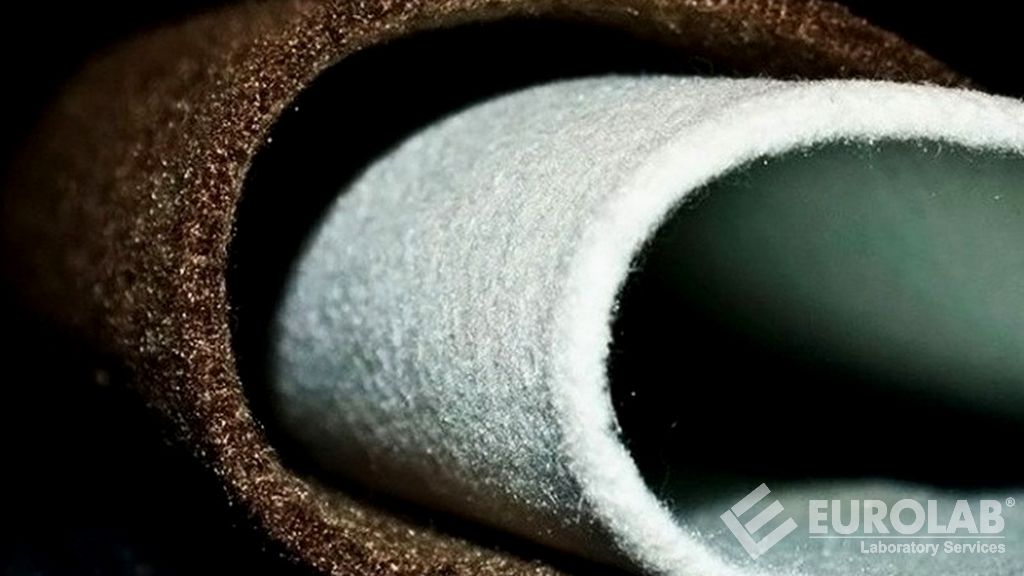
The hydraulic performance of geotextiles mainly depends on the following properties: porosity, percentage of open area, permeability and apparent aperture size.
The permeability of a geotextile is the volumetric water flow per unit area through a geotextile perpendicular to the plane. In short, permeability is the volume of water passing through a geotextile. The porosity of a geotextile is the ratio of the void volume to the total volume. Usually this value is not measured directly, but calculated from other inputs.
Percent open area is a measure by which the total open area of a geotextile sample is compared to the total area of the sample. This criterion only applies to woven geotextiles where the open area can be determined and directly measured. In a non-woven geotextile, the openings are random and the threads overlap.
Permeability is the hydraulic conductivity or the rate of flow of water as it passes through a geotextile. The permeability of a geotextile is the volumetric water flow per unit area through a geotextile perpendicular to the plane.
The apparent pore size is a property that specifies the approximate largest particle that will effectively pass through the geotextile. The effective pore size is determined using the dry sieve method described in ASTM D4751-16 standard.
For the purposes of this standard,
Among the numerous tests, measurements, analyses, and evaluations our organization provides for businesses in various sectors, we also offer standard testing services for the water permeability of geotextiles according to the ASTM D4491/D4491M-17 standard, utilizing a trained and expert staff and advanced technological equipment.
To get an appointment, to get more detailed information or to request an evaluation, you can ask us to fill in our form and reach you.

