

The standard “DIN 53864 Textile tests - Determination of bending strength - according to the Schlenker method”, published by the German Institute for Standardization (DIN), describes a test method for determining the bending stiffness (bending strength or bending rigidity) of textiles. The Schlenker method is a suitable and deformation-controlled approach for a variety of fabrics, including thicker or stiffer fabrics where gravity methods (such as the cantilever test in the DIN 53362 standard) may be less practical.
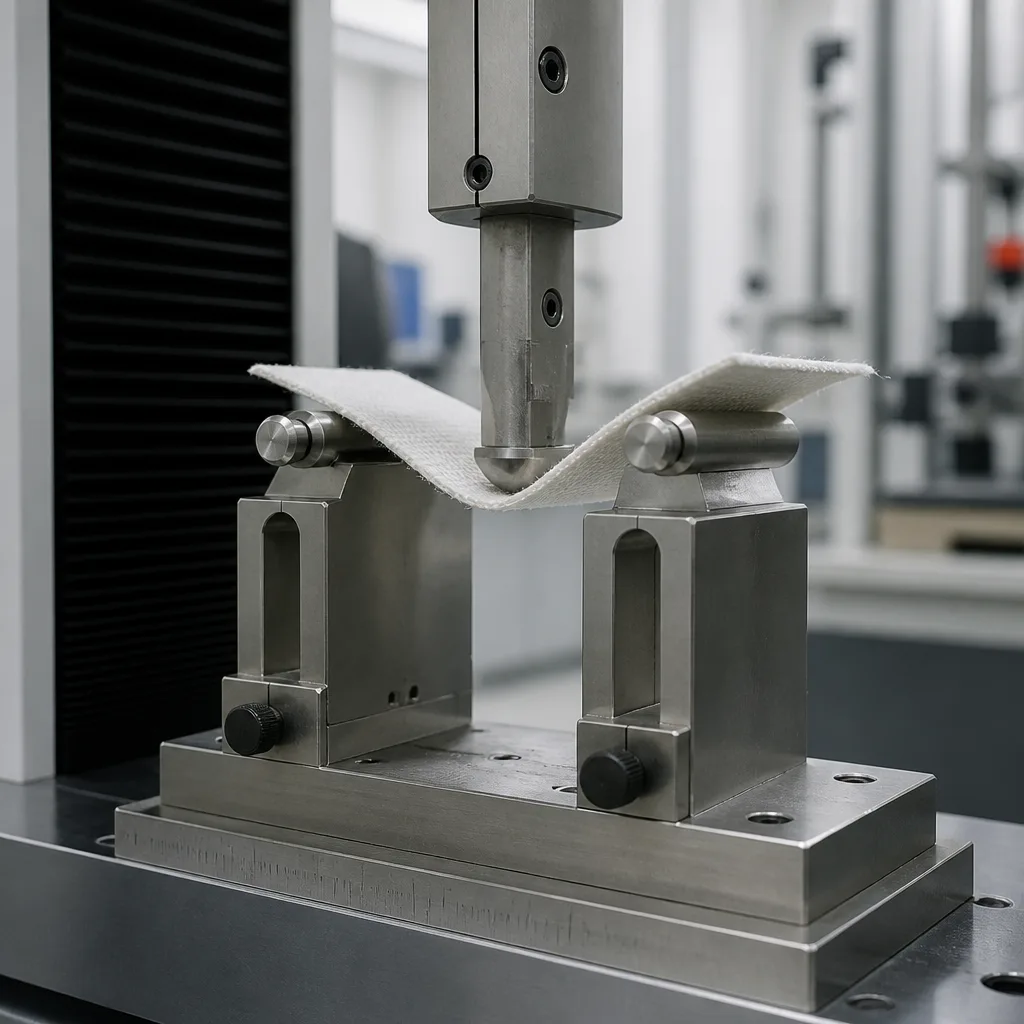
This method is particularly useful for evaluating how resistant a textile is to twisting, which in turn affects the following properties:
It is generally applied to woven or knitted fabrics (sometimes excluding nonwoven fabrics which use relevant standards such as EN ISO 9073-7 for twist length). The test can be performed in both the machine direction (longitudinal) and the transverse direction (transverse).
The Schlenker method is a deformation-controlled bending test (also known as a two-point bending test). Unlike purely gravity methods (such as the cantilever method where the fabric is bent under its own weight), this approach compresses the sample and actively bends it to a defined angle or curvature while measuring the required force or bending moment.
This method generally follows these steps:
This method is grouped with other deformation-controlled techniques such as pure bending testing. It is suitable for harder or multilayered materials because it does not depend solely on the sample's own weight.
The main parameters obtained within the scope of the standard are as follows:
This standard is generally applied in the following areas:
This standard is generally compared to or used in conjunction with standards such as DIN 53362 (cantilever method), ISO 2493-1 (paper/cardboard bending), EN 22313/ISO 2313 (wrinkle removal), or ASTM D1388 (fabric stiffness).
In short, the DIN 53864 standard is a German standard within the scope of textile testing, specifically designed to determine the mechanical properties of yarns and fibers. This standard provides a reliable method for quality control, product development, and comparative analysis by examining how textile materials behave under specific loads.
The primary purpose of the DIN 53864 standard is to measure the following characteristics:
These measurements are particularly critical for understanding the resistance of the yarns to the stresses they will encounter during use.
This standard generally covers the following materials:
The main reason the DIN 53864 standard is considered necessary is that the described method yields better results with stiffer or thicker textiles. The cantilever (gravity) method relies on the bending of the fabric under its own weight. For very stiff, thick, heavy, coated, or multi-layered fabrics (common in technical textiles, composites, nonwovens, geotextiles, automotive interiors, or reinforced materials), the cantilever test becomes impractical.
The key advantages that necessitate this standard are as follows:
In the textile and composite industry, fabric bending behavior is a crucial mechanical property. Without a specific standard like DIN 53864 for stiffer materials, tests rely on random methods, leading to low repeatability between laboratories or companies. In short, the DIN 53864 standard is necessary to fill a gap in standardized testing: it provides a reliable, controlled way to precisely measure bending stiffness where gravity methods are insufficient.
In conclusion, the DIN 53864 standard is an important reference standard for evaluating the mechanical performance of yarns in the textile industry. The repeatable and reliable test methods it provides constitute a critical quality assurance tool for both manufacturers and users.
For many years, our organization, with its competent and experienced staff, has been understanding the needs of its clients, providing the advanced testing services they require, and assisting them in the establishment, implementation, and improvement of management systems. Within this framework, we also provide testing services in accordance with the DIN 53864 standard.
To get an appointment, to get more detailed information or to request an evaluation, you can ask us to fill in our form and reach you.

