

The European standard "EN 29073-1 Textiles - Test methods for non-woven fabrics - Part 1: Determination of mass per unit area" describes a method for measuring the area and mass of a test piece and calculating the mass per unit area in grams per square meter. To meet the specific needs of non-woven fabrics, this standard includes the following requirements as alternatives to those listed in ISO 3801:
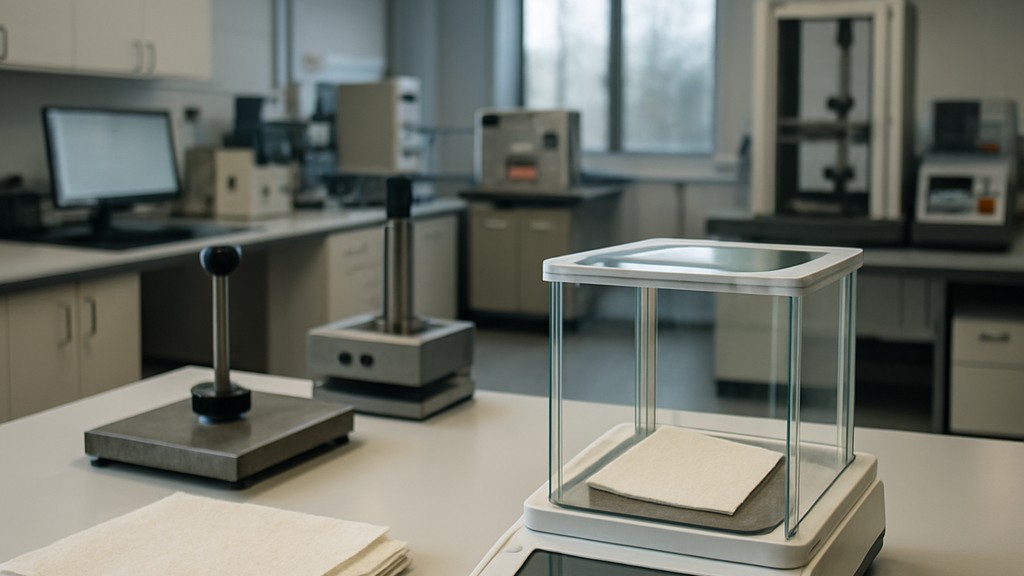
Although nonwoven fabrics are classified within the textile industry, it should be recognized that they share technological characteristics not only with textile products but also with paper or plastic products. There is an international textile testing standard, IS0 3801, on this subject. However, to meet the specific needs of nonwoven fabrics, EN 29073-1 specifies alternative requirements to those listed in ISO 3801.
The principle of this standard is based on measuring the area and mass of a test piece and calculating its mass per unit area in grams per square metre.
The main equipment used in the tests are:
Sampling is carried out in accordance with ISO 186. The optimal sample size may vary for different nonwoven fabrics and should be agreed upon between the buyer and seller. Due to the anisotropy of various nonwoven fabrics, the size should preferably not be smaller than the size specified above. It should be noted that the sampling error for nonwoven fabrics can be greater than the initial error.
This sampling method recognizes anisotropy (differences in properties in various directions, particularly in the machine and cross-sectional directions) in the final samples and takes measures accordingly. However, these samples are randomly representative of the material, and in some cases, it may be desirable to examine systematic variations in properties, including anisotropy at specific locations along the width or length of a given reel. In all such cases, specific provisions must be agreed upon between the buyer and seller and recorded in the test report.
A procedure for a more detailed examination of variability within a given group of substances is included in the TAPPI T 11-06-74 standard.
In the textile world, nonwovens have become indispensable due to their versatility, affordability, and wide range of applications. From hygiene products to industrial filters and medical supplies, their quality must be controlled and consistent. One of the key metrics of quality is mass per unit area, which directly affects strength, durability, and suitability for various uses.
The compatibility of EN 29073-1 with ISO 9073-1 makes it globally applicable. For practical purposes, these standards are often used interchangeably unless a specific certification or regulatory body requires compliance with a standard.
Mass per unit area is a fundamental property that affects:
Manufacturers, quality control laboratories and end users rely on this standard to:
During test preparation, the sample should be conditioned in a standard atmosphere (typically 20°C plus/minus 2°C and 65% plus/minus 4% relative humidity). Several samples are cut using templates of known area (e.g., 100 cm² or 500 cm²) to ensure accuracy. Each sample is weighed on a precision balance with an accuracy of at least 0,001 g. Mass per unit area is calculated by dividing the mass of each sample by its area and multiplying by a scaling factor to obtain a weight in grams per square meter. The mean value is reported with the standard deviation to indicate consistency or variability among samples.
Industries using this standard include:
The main reasons why the EN 29073-1 standard is considered important are as follows.
By following a standardized method, manufacturers can reduce defects and increase customer satisfaction by ensuring each batch meets required specifications.
This standard ensures that products are fit for purpose by verifying a critical physical parameter.
This optimizes material usage and controls production costs.
In short, the EN 29073-1 standard is important because it supports quality, safety and performance, ensures compliance and reliability, reduces errors and communication failures, and builds trust between suppliers, manufacturers and end users.
The method described in this standard is quite simple, but is essential for high-risk industries that rely on consistent nonwoven fabrics.
Consequently, the EN 29073-1 standard plays a crucial role in the quality assurance of nonwoven textiles. By providing a precise and standardized method for measuring mass per unit area, it supports product consistency, regulatory compliance, and material optimization across various industries. For manufacturers and quality assurance teams, compliance with this standard is not only good practice but also essential.
Our organization, which has been operating for many years and meticulously follows global developments in science and technology, employs a team of experienced professionals and a broad infrastructure to conduct testing, measurement, and analysis in a wide range of areas for businesses across all sectors. In this context, we also provide testing services in accordance with the standard "EN 29073-1 Textiles - Test methods for nonwoven fabrics - Part 1: Determination of mass per unit area."
To get an appointment, to get more detailed information or to request an evaluation, you can ask us to fill in our form and reach you.

