EN ISO 17700 Footwear - Test for Colour Fastness to Rubbing and Running for Upper Components and Sock Liners
The standard "EN ISO 17700 Footwear - Test methods for upper components and sock linings - Colour fastness to rubbing and running", which has its basis in a European standard and was subsequently published by the International Organization for Standardization (ISO), describes three test methods (method A, method B and method C) to assess the degree of transfer of a material's surface colour during dry or wet rubbing and one method (method D) to determine the possibility of colour running.
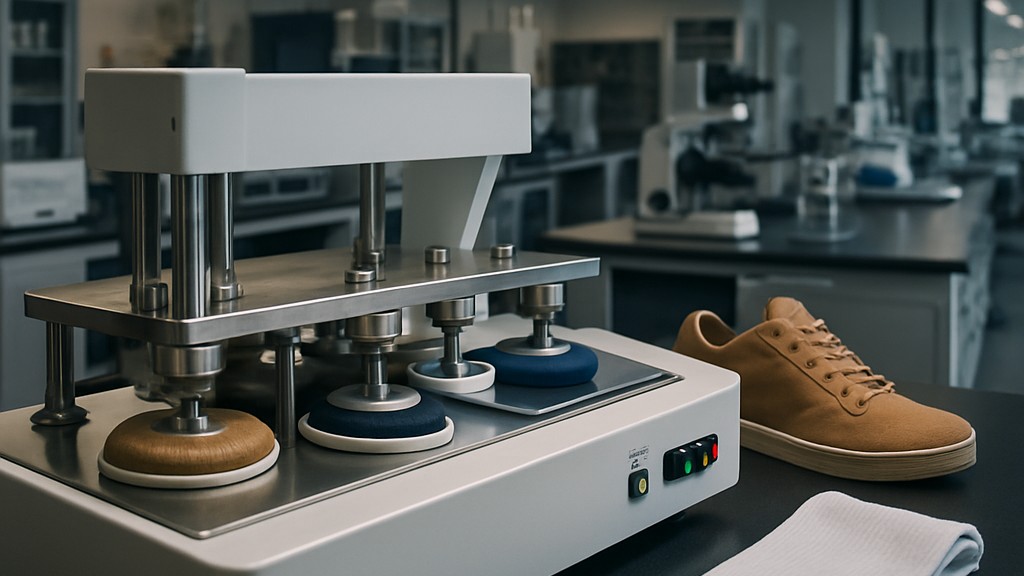
The methods are applicable to all shoe uppers, linings, and inner socks, regardless of material. Method D also applies to sewing threads and shoelaces.
The methods are:
- Method A: Back and forth square rubbing finger fastness testing machine
- Method B: Rotary friction finger fastness testing machine
- Method C: Back and forth circular friction finger fastness testing machine
- Method D: Color fastness to bleeding
For the purposes of this standard, the following terms and definitions apply:
- Color fastness refers to the ability of a shoe material or component to maintain its color after being affected by various factors.
- Thick skin refers to skin that is more than 2 mm thick.
Sampling and conditioning procedures are as follows according to the methods:
- Method A: Rectangular test specimens of sufficient size to be firmly fixed to the test platform are required. Test specimens can be cut from the material in any direction. Typically, test specimens should have a minimum dimension of 100 mm x 25 mm. In the case of flexible materials, the test specimen should be cut from the less elastic direction. For testing machines with 25 mm wide test platforms, separate test specimens are required for each friction number or test condition to be used. For testing machines with wider test platforms and the ability to position the test toe at different positions across the width of the platform, wider test specimens can be used to accommodate separate friction paths. Test specimens are placed in a conditioned atmosphere as specified in ISO 18454 for 24 hours before testing. Test specimens can be cut from materials likely to be used in footwear, uppers made of materials likely to be used in footwear, or finished footwear.
- Method B: Test specimens should be of sufficient size to allow them to be firmly fixed to the test platform. Typically, test specimens should be 60 mm x 60 mm squares or 60 mm diameter circles. Alternatively, a 60 mm wide strip can be used for several tests. For materials, test specimens are cut at a number of locations along the full usable width and length of the sheet material. For materials with a woven structure, this should prevent any two specimens containing the same warp or weft yarns. For shoe uppers, it is necessary to avoid seams, holes, and other areas where a flat test specimen cannot be cut. Test specimens are placed in a conditioned atmosphere as specified in ISO 18454 for 24 hours prior to testing.
- Method C: Two representative test specimens, each measuring at least 140 mm x 50 mm, are required. One for dry friction and one for wet friction. For flexible materials, the test specimen should be cut from the less elastic side. Place the test specimens in a conditioned atmosphere as specified in ISO 18454 for 24 hours before testing.
- Method D: Test specimens may be taken from materials likely to be used in uppers, linings, and hosiery, or from manufactured uppers, linings, and hosiery, or from finished products. The instructions given in this standard for sheet material or for shoe uppers, linings, and hosiery specimens are to be followed. For each method of testing to be performed, one rectangular test specimen is cut to 110 mm plus or minus 10 mm x 55 mm plus or minus 5 mm. If sufficient material is not available, several smaller test specimens are cut that can be joined together to produce a rectangle of this size. If the material to be tested is patterned, sufficient additional specimens are cut to ensure that all colors of the pattern contact all six sections of the multifibre fabric. The test specimen is assembled by placing the multifibre fabric pieces in contact with the surfaces of the samples to be tested, so that this surface of the specimen is in contact with all six components of the multifibre fabric. If both surfaces of the test specimen are to be tested, the test specimen is placed between two multifibre fabric pieces. For yarn, shoelaces, or loose fibres, the instructions given here are to be followed. For each test method, sufficient thread, shoelace, or fiber is laid down to completely cover the surface of a piece of multifibre fabric. If more convenient, the thread, shoelace, or fiber can be cut into lengths of 100 mm plus or minus 5 mm. The thread, shoelace, or fiber is placed between two pieces of multifibre fabric so that approximately equal amounts of the thread, shoelace, or fiber are in contact with each of the six components of the multifibre fabric. It is likely that the thread, shoelace, or fiber will overlap to some extent.
Our organization, which has been supporting businesses across all sectors for years through a wide range of testing, measurement, analysis, and evaluation activities, has a strong team of employees who closely follow global developments in science and technology and are constantly improving themselves. In this context, we also provide testing services in accordance with the standard "EN ISO 17700 Footwear - Test methods for upper components and sock linings - Color fastness to abrasion and bleeding."



