

Developed by the German Institute for Standardization (DIN) and subsequently published as a European standard, DIN EN 1876-2 Rubber or plastic coated fabrics - Low-temperature tests - Part 2: Impact test on cycle" describes a method for determining the low-temperature properties of coated fabrics. This method is considered suitable for materials that can be easily bent to the configuration required for testing at room temperature without damaging the sample.
For the purposes of this standard, the brittleness temperature limit refers to the lowest temperature at which not more than one in 20 specimens fractures under test conditions.
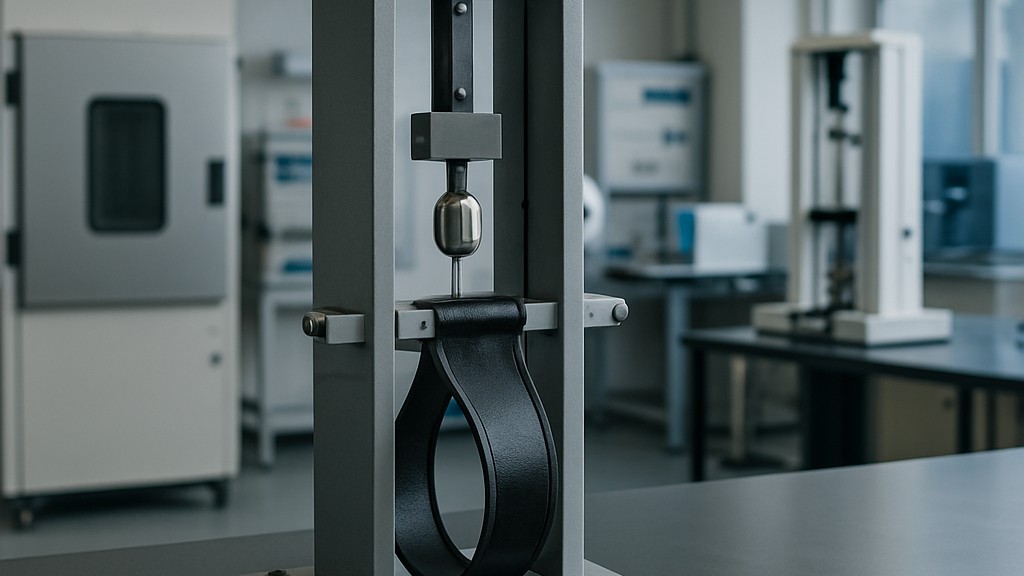
In principle, rectangular test specimens are placed in a low-temperature chamber, bent into a ring, and rapidly folded by impact from a falling hammer. Tests are continued at decreasing temperatures, starting with multiples of 5 and continuing in 5-degree steps, until multiple fractures are observed.
Two sets of test specimens shall be cut from each laboratory sample, one longitudinal and one transverse. Test specimens shall be selected within the full length of the coated fabric and its usable width as defined in EN 22286. Test specimens shall be 15 mm plus/minus 0,5 mm wide and 60 mm plus/minus 1 mm long. At least 10 test specimens shall be tested for each test temperature (five in the horizontal direction and five in the transverse direction).
During the test, the ends of the sample are bent to form a loop and secured to the test sample holder. The test sample holder is placed in the cold chamber. After 120 minutes plus/minus 15 minutes, when the test samples have equilibrated to the test temperature, the hammer is dropped onto the test samples. The test samples are removed from the cold chamber and examined with a lens.
A test sample is considered broken if it shows a complete or partial rupture (cracks, fissures) through the thickness of the coating, visible through the lens, and does not show a surface deformation such as a white line or crack.
The initial test temperature must be such that fracture does not occur. It must be a multiple of 5°C unless otherwise agreed upon by the parties. At any test temperature, the test is performed as follows:
The DIN EN 1876-2 standard is important because it specifies the safety requirements and test methods for low-temperature protective clothing, designed to protect against cold environments, typically below -5°C. This standard is considered important for the following reasons:
In short, DIN EN 1876-2 is a European standard that specifies the requirements and test methods for clothing designed to protect against cold environments. It focuses on ensuring that clothing provides adequate thermal insulation, wind resistance, and water vapor permeability to protect workers from cold stress, hypothermia, and frostbite. This standard specifically addresses the performance of materials and clothing in low-temperature conditions.
This standard outlines several critical performance criteria that protective clothing must meet to be certified. These include:
The DIN EN 1876-2 standard replaces the standard “Testing of plastic films DIN 53372 - Determination of low-temperature fracture of non-rigid polyvinyl chloride (PVC) films”.
Our organization, which has been supporting businesses across all sectors for years through a wide range of testing, measurement, analysis, and evaluation activities, has a strong team of employees who closely follow global developments in science and technology and are constantly improving themselves. In this context, we also provide testing services in accordance with the ISO 2286 "Rubber or plastic coated fabrics - Determination of roll properties" standard.
To get an appointment, to get more detailed information or to request an evaluation, you can ask us to fill in our form and reach you.

