

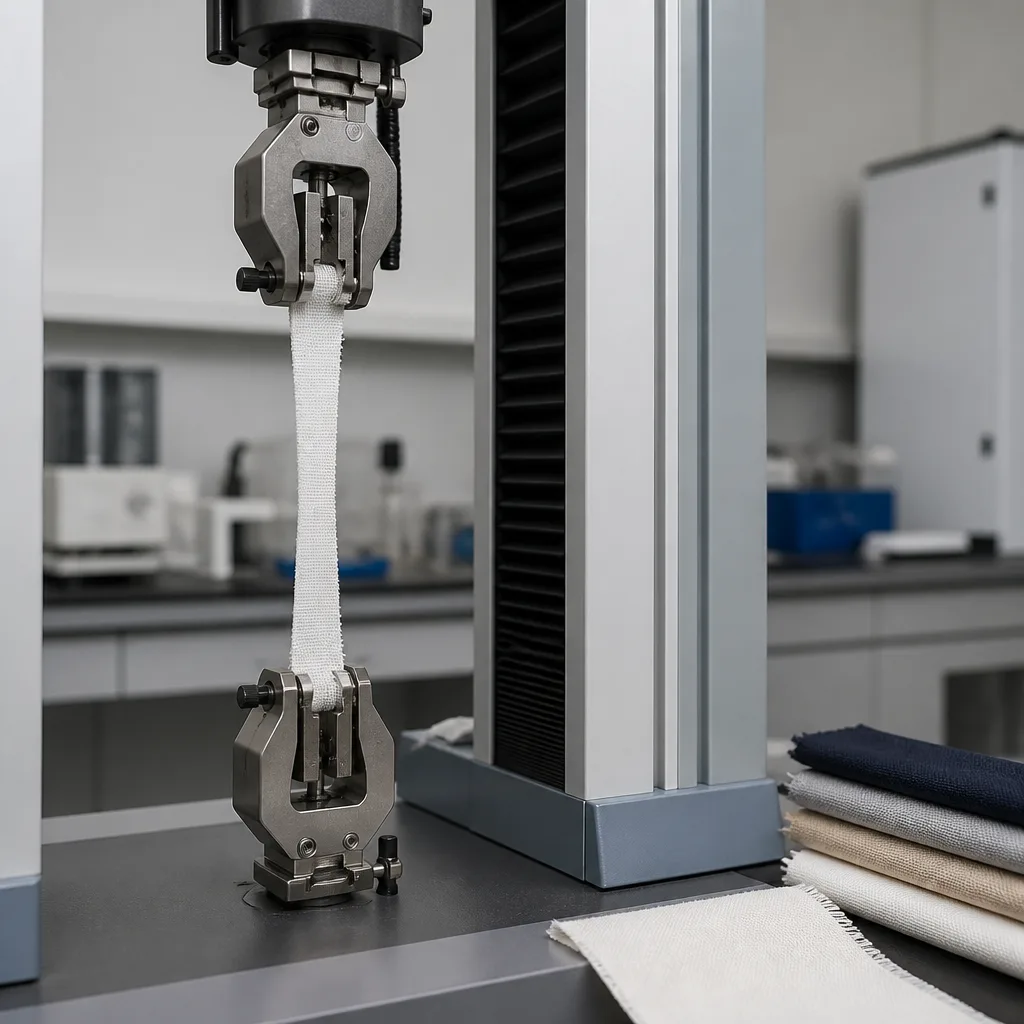
The ASTM D5035 Standard Test Method for Breaking Strength and Elongation of Textile Fabrics (Strip Method), developed by the American Society for Testing and Materials (ASTM), describes the stripped and cut-strip test procedures used to determine the breaking strength and elongation of most textile fabrics. This standard also includes provisions for wet testing. The stripped test is applicable to woven fabrics, while the cut-strip test is applicable to nonwoven fabrics, felt fabrics, and dipped or coated fabrics.
This test method is not recommended for knitted fabrics or other textile fabrics with high elongation (greater than 11%). The ASTM D5034 standard, which describes the test method for determining the breaking strength and elongation of textile fabrics using hold test and modified hold test procedures, is applicable. For determining the breaking strength and elongation of certain specific fabric types using the strip test, the ASTM D579 and ASTM D580 standards are applicable.
The cut strip test, as described in this standard, is considered satisfactory for acceptance testing of commercial shipments of woven textile fabrics, as this method is widely used for acceptance testing in trade. The same applies to the cut strip test for felted or nonwoven textile fabrics.
If there are differences between test results reported by two or more laboratories, a comparative test should be performed to determine if there is a statistically significant discrepancy between them.
The ASTM D5035 standard defines procedures for measuring the tensile strength (breaking strength) and elongation at break of textile fabrics using the strip method. These properties are fundamental indicators of a fabric's ability to withstand tensile loads during manufacturing, transportation, and end-use.
The ASTM D5035 standard is widely used by textile manufacturers, apparel companies, automotive suppliers, industrial fabric producers, research laboratories, and quality assurance organizations to evaluate the mechanical performance of woven and nonwoven textiles.
The primary objectives of the ASTM D5035 standard are as follows:
This standard provides repeatable laboratory procedures that enable meaningful comparisons between textile materials.
The ASTM D5035 standard is applicable to most textile fabrics using a two-strip test procedure:
Removing edge threads minimizes stress concentrations and improves measurement accuracy.
This standard also includes wet test provisions that allow laboratories to evaluate tensile properties after exposure to moisture. This standard is not recommended for knitted fabrics or highly stretchable fabrics exhibiting elongation greater than approximately 11 percent. Other standards, such as ASTM D5034, are more suitable for such fabrics.
In principle, when the test is administered,
The following equipment is typically required for testing:
Proper gripper selection is crucial to prevent sample displacement or premature gripper failure.
The ASTM D5035 standard specifies the following requirements for sample preparation:
Samples are typically tested separately in both main fabric directions to account for anisotropic mechanical behavior.
In general, the testing process follows these steps:
To increase statistical reliability, results are calculated by averaging across multiple samples.
Typically reported values are as follows:
This data provides a comprehensive assessment of pulling performance.
ASTM D5035 standard is widely used in the evaluation of the following:
The following industries rely on the ASTM D5035 standard:
The ASTM D5035 standard is important because tensile strength is one of the most critical performance characteristics of textile materials. Fabrics with insufficient breaking strength may fail during production or use, while elongation data helps designers understand the behavior of fabrics with elasticity and deformation. This standard provides a consistent and repeatable method for evaluating these properties for quality control, material development, supplier qualification, and conformity testing.
In conclusion, the ASTM D5035 standard is one of the primary standards used to determine the breaking strength and elongation of textile fabrics using the strip method. This standard enables manufacturers and laboratories to obtain reliable tensile strength data for woven, nonwoven, felted, and coated fabrics. By supporting consistent quality assessment and material comparison, this standard plays a vital role in ensuring the durability, reliability, and performance of textile products in apparel, automotive, industrial, and technical applications.
For many years, our organization, with its competent and experienced team, has been understanding the needs of its clients, providing the advanced testing services they require, and assisting them in the establishment, implementation, and improvement of management systems. Within this framework, we also provide testing services in accordance with the ASTM D5035 standard.
To get an appointment, to get more detailed information or to request an evaluation, you can ask us to fill in our form and reach you.

