

The ASTM D4595 Standard Test Method for Determining the Tensile Properties of Geotextiles by Wide Strip Method, developed by the American Society for Testing and Materials (ASTM), describes a test method for measuring the tensile properties of geotextiles using the wide strip sample tensile method. This test method is applicable to most geotextiles used in geotextile applications, including woven fabrics, nonwoven fabrics, layered fabrics, knitted fabrics, and felts.
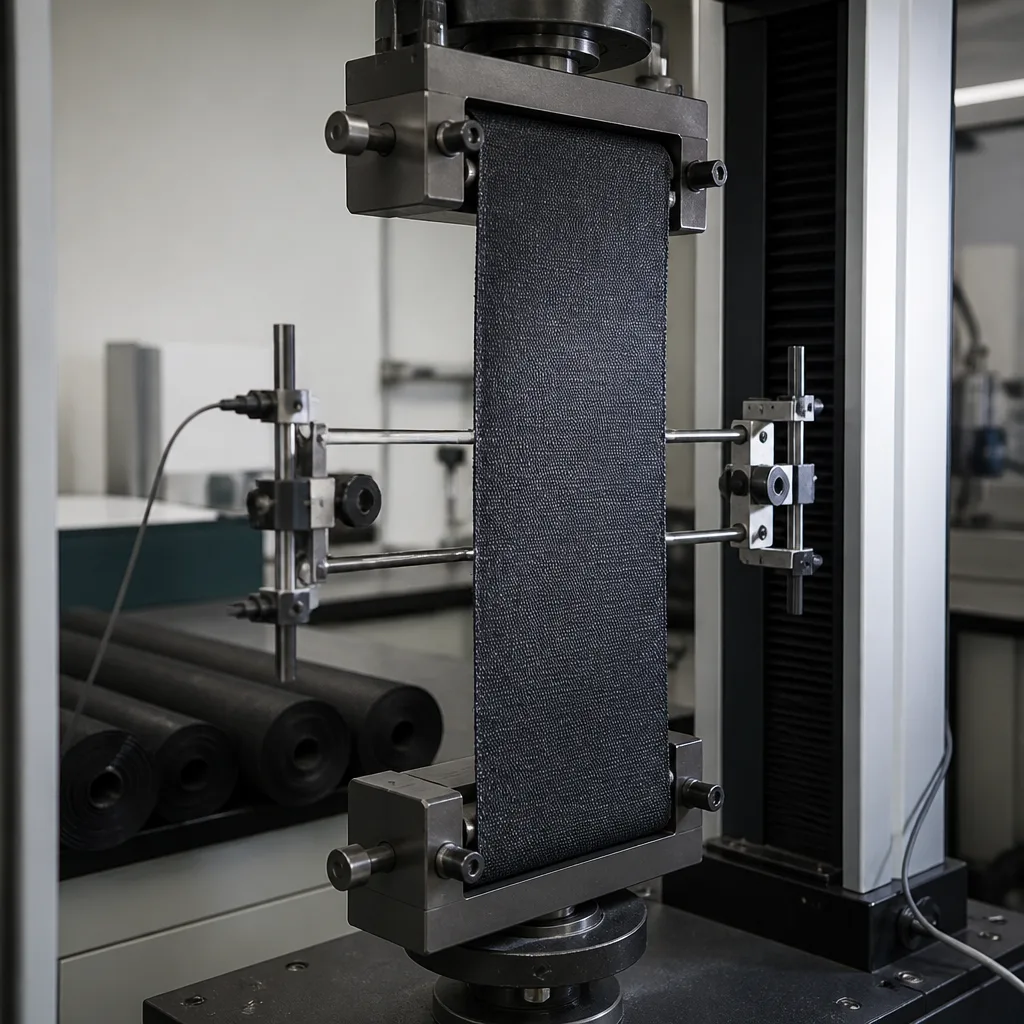
This testing method involves measuring the tensile strength and elongation values of geotextiles and includes instructions for calculating the initial modulus, offset modulus, secant modulus, and fracture toughness.
This standard also includes procedures for measuring the tensile properties of both conditioned and wet geotextiles using the wide-strip method.
The key difference between this test method and other methods used to measure strip tensile properties is the width of the sample. Some fabrics used in geotextile applications tend to shrink (neck constriction) when subjected to a force in the measurement length region. The wider sample specified in this test method minimizes the shrinkage effect of these fabrics and provides a closer relationship and standard comparison with the expected geotextile behavior in the field.
Determining the broad-band tensile strength properties of geotextiles provides design parameters for reinforcement type applications, such as reinforced fills on soft soils, reinforced earth retaining walls, and slope reinforcement. Where strength is not necessarily a design element, an alternative test method can be used for acceptance testing. The test method described here for determining the broad-band tensile strength properties of geotextiles can be used for acceptance testing of commercial geotextile shipments, but caution is advised due to a lack of information regarding inter-laboratory accuracy.
In short, the ASTM D4595 standard is one of the most important testing standards used in the geotextile industry to determine the tensile properties of geotextile materials. This standard establishes a uniform procedure for measuring the tensile strength, elongation, modulus, and toughness of geotextile materials using a wide-width sample configuration that more accurately reflects field performance than narrow-strip tensile tests.
Geotextiles are widely used in the following types of civil engineering applications:
Because these materials are often subjected to tensile loads during use, engineers need reliable data on their mechanical behavior. This standard provides a standardized method for obtaining these design parameters.
This standard applies to most geotextile products, including:
The test can be performed on both conditioned (dry) and wet samples. This test measures the following:
Unlike traditional strip tensile tests, the ASTM D4595 standard uses a specimen significantly wider than its length. The specimen is compressed along its entire width in a constant elongation rate tensile testing machine. Tensile force is applied until fracture occurs, and force and elongation data are continuously recorded.
Typical sample sizes, according to the publication application, are as follows:
These dimensions help minimize the neck constriction effect frequently observed in geotextiles during tensile loading.
Many geotextiles, especially nonwoven materials, shrink laterally when subjected to tensile forces. Narrow-width tensile tests can exaggerate this behavior and produce results that do not accurately represent field performance. The ASTM D4595 standard addresses this problem by using a wider sample. In this way,
The measured properties are:
The equipment required for the test is as follows:
For high-strength woven geotextiles or fiberglass geotextiles, special retainer configurations may be required to prevent premature retainer failures.
The results obtained by applying the ASTM D4595 standard are generally used in the following areas:
The advantages of the ASTM D4595 standard include:
In conclusion, the ASTM D4595 standard is the reference test method used to evaluate the tensile behavior of geotextiles. Thanks to the use of wide-width samples, this standard provides more realistic and reliable measurements of tensile strength, elongation, modulus, and toughness compared to narrow-strip methods. Consequently, it plays a crucial role in geotechnical engineering and helps designers, manufacturers, and project owners ensure that geotextile materials will perform safely and effectively in demanding field applications.
For many years, our organization, with its competent and experienced team, has been understanding the needs of its clients, providing the advanced testing services they require, and assisting them in the establishment, implementation, and improvement of management systems. Within this framework, we also provide testing services in accordance with the ASTM D4595 standard.
To get an appointment, to get more detailed information or to request an evaluation, you can ask us to fill in our form and reach you.

