

The standard “DIN 53323 Leather tests - Determination of stress-strain behavior during bounce and burst testing”, published by the German Institute for Standardization (DIN), describes a standardized method for evaluating the mechanical behavior of leather under specific stress conditions. This method is particularly important in the context of quality control in the leather industry, including natural leather, leather fiber boards, and sometimes related materials such as coated textiles or artificial leather.
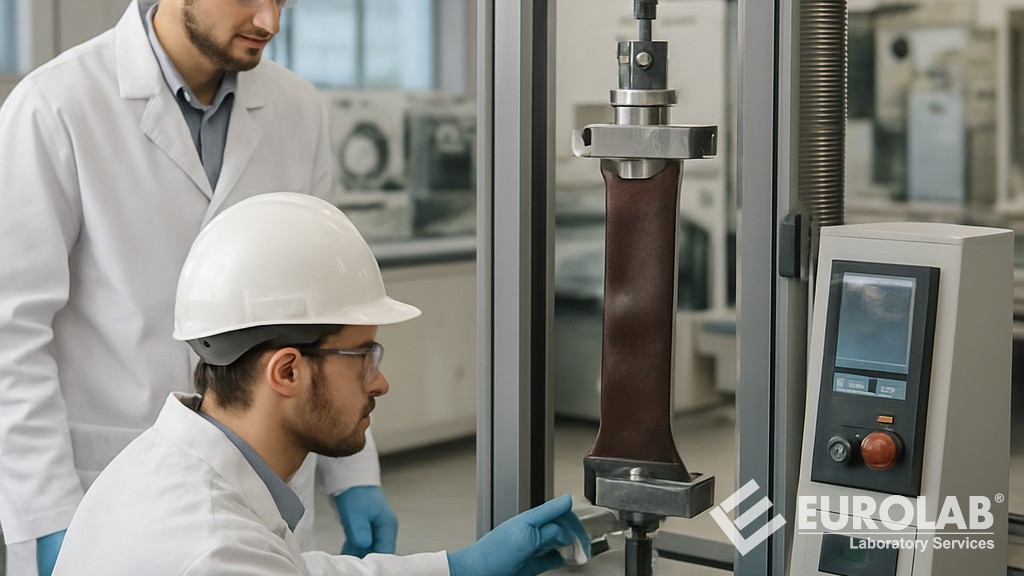
Leather is a flexible, viscoelastic material used in footwear, upholstery, automotive interiors, clothing, and accessories. Its performance against deformation and compression is critical. It must withstand stretching, dome-shaped swelling (bulging), and ultimately bursting without premature failure.
Dome blasting and burst testing is a specialized mechanical test method used primarily for leather, and sometimes artificial leather or related sheet materials, to evaluate how a material behaves under dome-shaped deformation and pressure.
The DIN 53323 standard provides a repeatable method for the following:
These properties help evaluate leather quality, durability, suitability for specific applications, and compliance with industry specifications.
The described test method uses a device known as a lastometer or similar blasting device (sometimes also called a cannon blasting or dome blasting tester).
The testing process generally follows these steps:
The data obtained generate a stress-strain diagram or compression-strain curve that shows the following:
This method simulates real-world stresses such as those found in shoe uppers (toe area), upholstery (buttoning or deep seats), or automotive leather under load.
Common applications of this standard include:
The international standard related to DIN 53323 is “ISO 3379 Skin - Determination of surface tensile strength and durability (blasting method)”. This standard is, in principle, a very similar or overlapping method.
In short, the DIN 53323 standard includes a test method for determining the mechanical behavior of leather. This method describes how leather deforms under pressure.
This standard defines how to measure the tensile-strain behavior of leather. Essentially, it determines how the material stretches and deforms when subjected to compression, using a dome/burst test (typically performed with a tensometer). During the test, a circular leather sample is compressed and then pressure is applied until it swells like a dome. The relationship between the applied pressure and the deformation (height of swelling) is recorded to evaluate elasticity, deformation characteristics, and sometimes the finishing effect under load.
This method is widely applicable to lightweight leathers, including both full-grain and velvet types, and helps compare leather performance for uses such as upholstery, footwear, and materials research.
The DIN 53323 standard provides a standardized approach for manufacturers, testers, and researchers. Therefore, it is considered important. This standard is also considered important for the following reasons:
In practice, the DIN 53323 standard is one of several leather testing standards. Others cover aspects such as tensile strength, tear resistance, and elongation, and are sometimes referenced in quality specifications or used in conjunction with other tests to evaluate overall leather performance.
In conclusion, the DIN 53323 standard remains a fundamental mechanical testing method for leather, focusing on realistic deformation and fracture behavior under dome-shaped pressure. Despite being outdated, it continues to be used in quality assurance, product development, and conformity testing in the leather and related industries.
For many years, our organization, with its competent and experienced staff, has been understanding the needs of its clients, providing the advanced testing services they require, and assisting them in the establishment, implementation, and improvement of management systems. Within this framework, we also provide testing services in accordance with the DIN 53323 standard.
To get an appointment, to get more detailed information or to request an evaluation, you can ask us to fill in our form and reach you.

