

The “AATCC TM 16 Color fastness to light” standard published by the American Association of Textile Chemists and Colorists (AATCC) consists of the following subsections published under the same title:
The use of these test options does not imply, expressly or otherwise, accelerated testing for a specific application. The relationship between any lightfastness test and actual in-use exposure must be determined and agreed upon by the contracting parties.
The use of these test options does not imply, expressly or otherwise, accelerated testing for a specific application. The relationship between any lightfastness test and actual in-use exposure must be determined and agreed upon by the contracting parties.
The AATCC TM 16 standard provides general principles and procedures for determining the colorfastness of textiles to light outdoors and in sunlight. The test options described are applicable to all colorants, coatings, and treatments applied to textile materials.
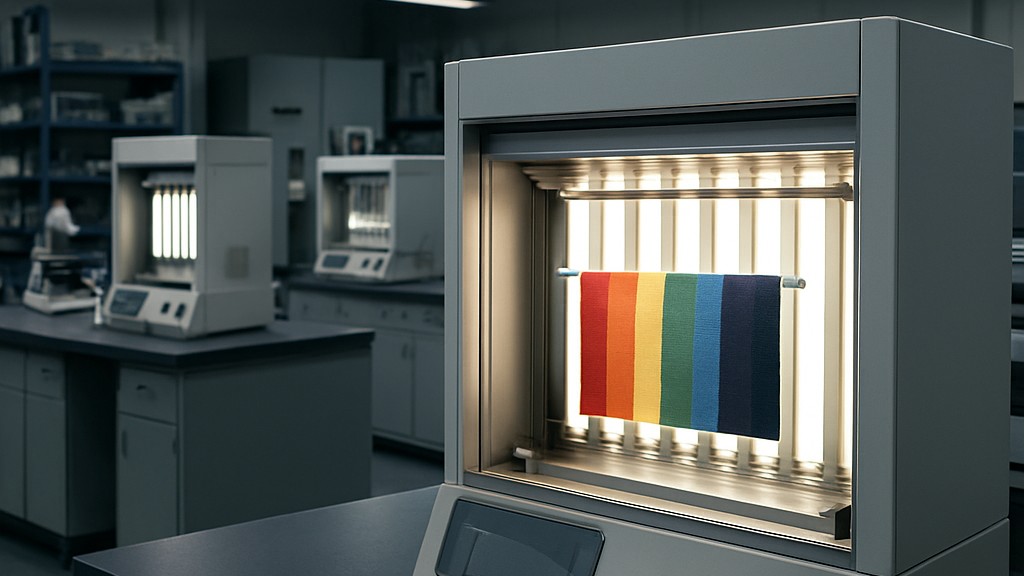
In principle, samples of the textile material to be tested and the agreed-upon standards are simultaneously exposed to sunlight under specified conditions. The color fastness of the sample to light is assessed by comparing the color change of the exposed portion of the test sample or the original material with the masked control portion, using a color change scale or instrumental color measurement. Light fastness classification is achieved by evaluating a series of similarly exposed AATCC white wool light fastness standards.
Not all materials are affected equally by the same light source and ambient conditions. Results obtained using any test option may not necessarily represent the results of any other test option or any final application unless a mathematical correlation has been established for a specific material or application. Sealed carbon arc, xenon arc, and daylight have been widely used in acceptance testing of textile materials. Significant differences in spectral power distribution, air temperature, and humidity measurement locations can occur. Test chamber sizes among test equipment from different manufacturers may result in differences in reported test results. Data obtained from equipment from different manufacturers, different test chamber sizes, or different light source and filter combinations cannot be used interchangeably. However, a technological correlation has not yet been established.
Xenon-arc results for all materials should be in good agreement with those obtained with daylight-resistant glass due to the spectral distribution of xenon-arc. Since the alternating light and dark conditions with the specified filter glass closely approximate the average or typical daylight behind window glass, the results are expected to be in good agreement with those obtained with the daylight, daylight-behind-glass method.
The two carbon arc options, continuous and alternating light and dark, produce results that, under the specified conditions, match those obtained with the daylight method behind glass, provided the material being tested is not adversely affected by differences in the spectral characteristics of the sealed carbon arc and natural light.
When using this test method, it is preferable to consider the effects of light, humidity, and heat based on statistical data and experience. The test method option is selected based on the end-use conditions associated with the material being tested.
When using this test method, a comparison standard is used that has a small change in light taste after a given exposure compared to the material being tested. AATCC Blue wool light quality standards have been commonly used for this purpose.
For acceptance testing, at least three replicate samples of both the material to be tested and the acceptance standard are used. This ensures accuracy, unless otherwise agreed upon between the tester and the supplier. One test and two control samples are used for practical purposes. While this type of procedure may be unacceptable in some adverse circumstances, it may be sufficient for routine testing.
Each sample is identified by a label that is resistant to the environment to which it will be exposed during the test. The test sample surface and the reference sample are mounted at the same distance from the light source. Blankets are used to prevent the sample surface from being compressed, especially when testing pile fabrics. The test sample and reference standards must be the same size and shape. The test sample is cut and prepared as follows:
Our organization, which has been supporting businesses across all sectors for years through a wide range of testing, measurement, analysis, and evaluation activities, has a strong team of employees who closely follow global developments in science and technology and are constantly improving themselves. In this context, we also provide testing services to businesses in accordance with the "AATCC TM 16 Color Fastness to Light" standard.
To get an appointment, to get more detailed information or to request an evaluation, you can ask us to fill in our form and reach you.

