

The “AATCC™ 42 Water Resistance Test Method: Impact Permeability” standard, published by the American Association of Textile Chemists and Colorists (AATCC), describes a test method applicable to all types of textile fabrics, whether or not they have undergone waterproofing treatment. This standard measures the resistance of fabrics to water permeability upon impact and can therefore be used to estimate the potential resistance of fabrics to rain permeability. The results obtained with this test method depend on the water resistance of the fibers and yarns and the structure of the fabric.
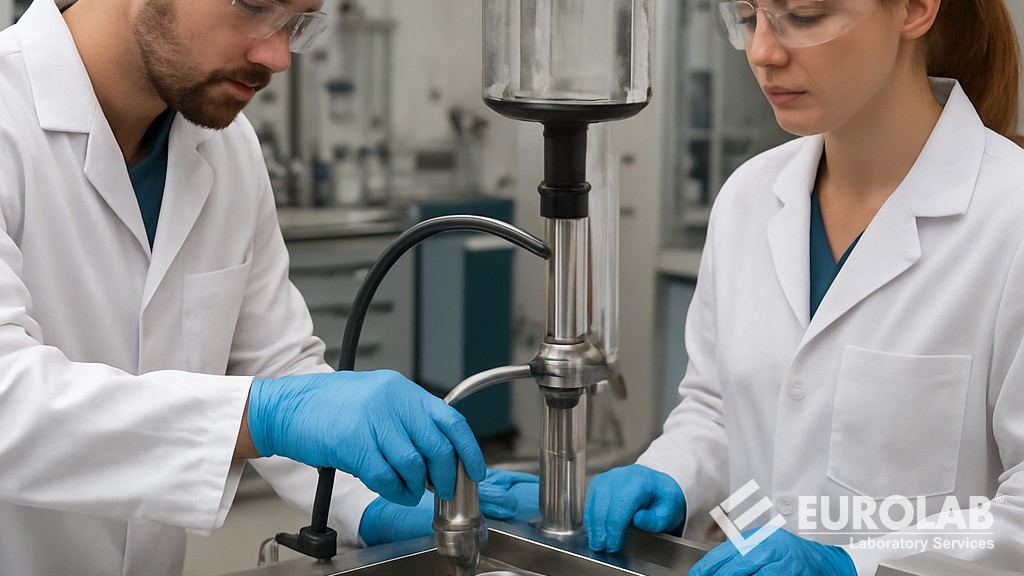
The AATCC™ 42 standard evaluates how well textile fabrics resist water when subjected to impacts that simulate conditions such as rain hitting a garment.
This testing method can be applied to any textile fabric, regardless of whether it has a waterproof coating. By measuring the fabric's resistance to water through impact, it provides insights into its potential performance against rain penetration in real-world use. Results depend on factors such as fiber and yarn waterproofness and fabric structure.
Originally designed to estimate rain penetration resistance in clothing, the AATCC™ 42 standard has gained significant importance in the evaluation of protective clothing, particularly nonwoven fabrics used in medical personal protective equipment such as surgical gowns and drapes.
This test method begins with mounting the test specimen in a frame and placing a weighed absorbent paper underneath. A specific volume of water (typically 500 mL of distilled or ionized water at a controlled temperature) is poured into a funnel or spray nozzle positioned at a specific height and angle above the specimen.
Water strikes the taut fabric surface and is absorbed by the penetrating absorbent paper. After the test, the absorbent paper is weighed again, and the increase in mass (in grams) indicates the amount of water penetration. Lower values represent better water resistance.
Two types of testing equipment are used in the tests:
This test method measures sensitivity down to 0,1 g, but alternative methods may require higher sensitivity.
The AATCC™ 42 standard plays a significant role in the classification (Levels 1-3) of protective clothing for fluid barrier performance in healthcare settings, according to ANSI/AAMI PB70 standards. These classifications are based on:
The AATCC TM 42 standard is technically equivalent to the “ISO 18695 Textiles - Determination of water resistance - Impact penetration test” standard. For nonwoven fabrics, it is generally compared to or used instead of the “NWSP 80.3 Water permeability of nonwoven fabrics (spray impact test)” standard.
It also meets the following standards:
This method remains a fundamental element in textile testing for both everyday wear and critical medical applications, guaranteeing reliable protection of fabrics against liquid penetration.
In short, the importance of the AATCC™ 42 standard stems from its ability to reliably measure a fabric's resistance to water penetration under impact by simulating real-world conditions such as rain or liquid splashes. This standard is considered important for the following reasons:
This classification ensures that gowns provide adequate protection against fluid exposure during procedures and reduce infection risks for healthcare workers. For ANSI/AAMI PB70 standard compliance, a special absorbent paper should be used, as it provides more accurate results for nonwoven fabrics commonly used in disposable personal protective equipment.
In conclusion, the AATCC™ 42 standard combines consumer apparel needs with vital healthcare applications, ensuring fabrics reliably perform against liquid penetration and supporting public health and safety.
For many years, our organization, with its competent and experienced staff, has been understanding the needs of its clients, providing the advanced testing services they require, and assisting in the establishment, implementation, and improvement of management systems. Within this framework, we also provide testing services to businesses in accordance with the "AATCC TM 42 Water resistance test method: impact permeability" standard.
To get an appointment, to get more detailed information or to request an evaluation, you can ask us to fill in our form and reach you.

