

The standard “ASTM C99/C99M-18 Standard test method for modulus of rupture of dimension stone” published by the American Society for Testing and Materials (ASTM) describes a test method for determining the modulus of rupture of all types of dimension stone except slate.
For the purposes of this standard, the terms and definitions given in the "ASTM C119-20 Standard Terminology for Dimensional Stone" standard are valid.
This test method is useful in demonstrating differences in modulus of rupture between stones of various sizes. This test method also provides an element of comparison of stones of the same type.
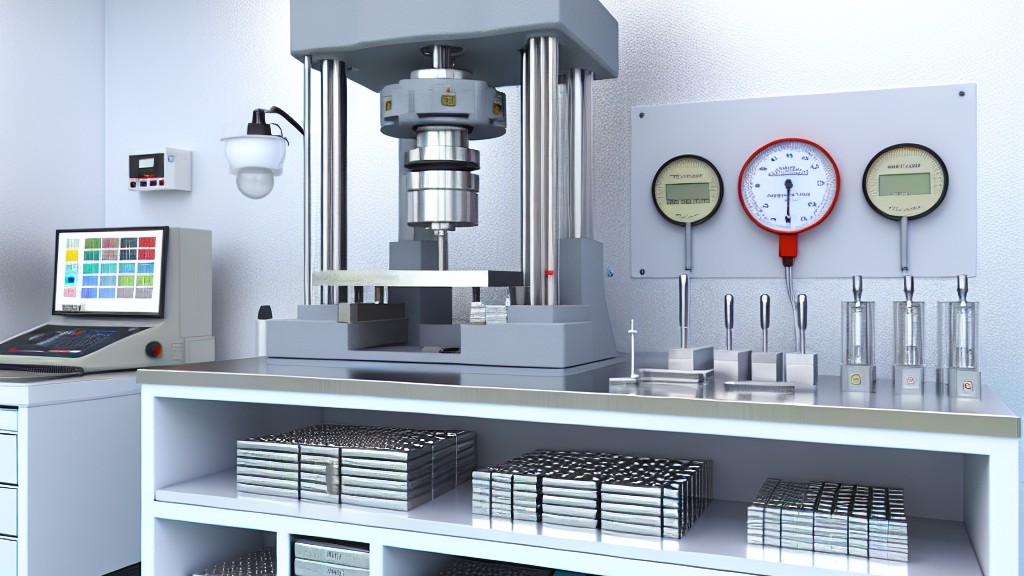
The accuracy of the testing machine used in these tests should be within 50 percent in the range of 5000 to 1 N. The load application and supports for the specimens should be of the rocker type with sides at least as long as the width of the specimen. The load application block may be of the rocker or rigid type. The parts of the load application and support blocks that come into contact with the stone should be rounded and have a nominal radius of 13 mm.
The sample is selected to represent the true mean of the type or grade of stone in question and of the quality offered on the market under the type description to be tested. The sample may be selected by the purchaser or his authorized representative from quarried stone or natural outcrop and shall be of sufficient size to permit the preparation of the desired number of test specimens. When perceptible changes occur, the purchaser may select as many specimens as are necessary to determine the changes in modulus of rupture.
Additional information on selecting, preparing, and conditioning test specimens is included in “ASTM C1799/C1799M-22 Standard Guide for Dimension Stone Test Specimen Sampling and Preparation.”
The specimens shall be 100 mm x 200 mm x 60 mm in size and manufactured with tolerances of plus/minus 2 mm. They are cut from the specimen and finished by grinding until their surfaces are smooth. The 100 mm x 200 mm surfaces shall be as flat and parallel as possible. For loading perpendicular to the slit, five 100 mm x 200 mm specimens are prepared with their surfaces parallel to the slit planes, and for loading parallel to the slit, five 100 mm x 60 mm specimens are prepared with their surfaces parallel to the slit.
The term fissure is used here to indicate the direction in which the stone splits most easily. In bedded stones it is assumed to coincide with the bedding or stratification. The direction of the fissure should always be marked on the sample by the quarryman, as it is usually not possible to determine it on a small block.
Another loading condition may occur in structures when the crack planes are vertical and parallel to the length of the beam. The strength of the stone can be obtained by cutting specimens 60 mm x 200 mm with the face parallel to the crack. The scanty data available for this loading condition suggest that the strength is at least as high as when the load is applied perpendicular to the crack as shown in the figure.
When tests are required on stone in both wet and dry conditions, ten specimens should be prepared for each loading direction, i.e., five specimens for dry and perpendicular to the crack tests and five specimens for wet and perpendicular to the crack tests.
When marking and measuring specimens, draw the centre line on the 100 mm x 200 mm surface, perpendicular to one edge (60 mm x 200 mm surface) and extend both edges perpendicular to the 100 mm x 200 mm surface. Two sets of similar lines are drawn at a distance of 90 mm in each direction from the centre line. Each specimen is marked to indicate the direction of the slit and labelled with appropriate numbers or letters for identification during measuring and testing.
The samples are dried at 60 degrees plus/minus 2 degrees for 48 hours before testing in a dry condition. At 46, 47 and 48 hours, the samples are weighed to ensure that the weight is the same. If the weight continues to fall, the samples are dried until three consecutive hourly readings are taken at the same weight. After removing the samples from the oven, they are cooled to room temperature in a desiccator before testing. Before testing the samples in a wet condition, they are immersed in water at 22 degrees plus/minus 2 degrees for 48 hours. Immediately after removal from the bath, the samples are tested by wiping off the surface water.
The specimen is placed flat on the support blocks, equidistant from the load application block and 178 mm apart, with the three load application and support blocks parallel. When all three load application and support blocks are of the rocker type, care should be taken to adjust all three until the top face of the specimen is horizontal when loaded. When the 44 N load is applied, the loading is stopped and all load application and support blocks are aligned with the marks on the specimen by centering the specimen under the load application block and moving the support blocks under the clearance marks. The loading is applied at a rate not exceeding 4450 N/min until the specimen breaks. The modulus of rupture of each specimen is calculated according to the formula given in the standard.
Our organization, which has been trying to support businesses from every sector with its testing, measurement, analysis and evaluation studies carried out in a wide range for years, has a strong staff that closely follows the developments in the world in the field of science and technology and constantly improves itself. In this context, testing services in accordance with the "ASTM C99/C99M-18 Standard test method for rupture modulus of dimension stone" standard are also provided to businesses.
To get an appointment, to get more detailed information or to request an evaluation, you can ask us to fill in our form and reach you.

