

The “ASTM C170/C170M-15 Standard test method for compressive strength of dimensioned stone” standard, developed by the American Society for Testing and Materials (ASTM), describes a test method for sampling dimensioned stone, preparing samples, and determining compressive strength.
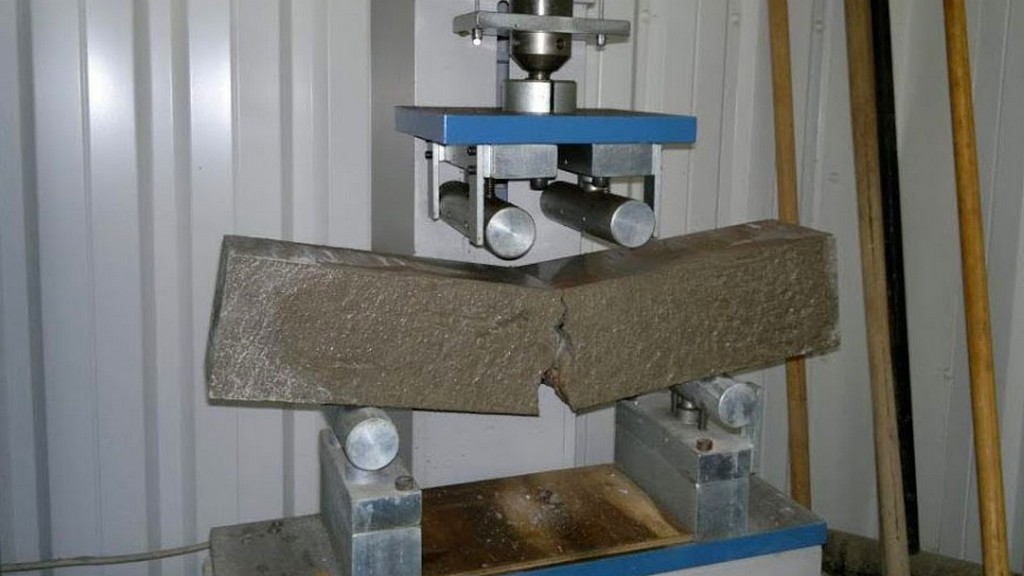
For the purposes of this standard, all valid definitions are included in the "ASTM C119-22 Standard Terminology for Dimensional Stone" standard.
This test method is useful in showing differences in compressive strength between stones of various sizes. This test method provides an element of comparison of stones of the same type.
The testing machine used in these tests must comply with the requirements of the “ASTM C4/C24M-39 Standard test method for compressive strength of cylindrical concrete specimens” standard, including the calibration requirements of the “ASTM E39-04 Standard practices for strength calibration and verification of testing machines” standard.
The testing machine used shall be capable of applying the required load at a uniform rate as specified in this standard and shall be capable of applying the load steadily to prevent sudden or rapid load changes. The spherical bearing block of the testing machine shall be suspended from the top head so that the contact plate remains in a central position (the spherical surfaces in full contact) when unloaded. The spherical surfaces shall be well lubricated and the centre of curvature shall be aligned within the contact surface with the specimen. The figure given in the standard shows the correct alignment of a specimen and the typical components of a testing machine complying with these requirements.
The sample shall be selected to represent a true average of the type or grade of stone in question and shall be of a quality marketed in finished form under the type description to be tested. The sample may be taken from a quarried stone or natural outcrop by the purchaser or his authorized representative and shall be of sufficient size to permit the preparation of the desired number of test specimens. When perceptible changes occur, the purchaser may select as many specimens as necessary to determine the change in compressive strength. ASTM C1799/C1799M-14 Standard Guide for Sampling and Preparation of Dimensional Stone Test Specimens applies to the selection, preparation, and conditioning of test specimens.
Test specimens may be cubes or upright cylinders and shall be cut from the specimen by sawing or core bits. The diameter or lateral dimension (distance between opposing vertical surfaces) shall not be less than 50 mm to accommodate changes in grain size or composition of the specimen. The ratio of height (distance between surfaces in contact with the test apparatus) to diameter or lateral dimension shall be between 0,9:1,0 and 1,1:1,0. The edges of the specimen shall be smooth and flat within 0,5 mm over the entire height of the specimen.
The two surfaces in contact with the test apparatus shall have a fine abrasive surface and the other surfaces shall have a fine saw surface. The surfaces in contact with the test apparatus shall be ground to a flatness tolerance of plus/minus 0,1 mm and shall not deviate more than 0,25 degrees from the perpendicular to the longitudinal axis of the specimen.
A minimum of five specimens shall be prepared for each test condition. The final test conditions shall be determined by the project conditions and shall be specified in the test request. Typically, the test shall include wet and dry conditions both perpendicular and parallel to the stone cleavage (the plane of easiest cleavage, usually consistent with the bedding plane orientation) and shall require a minimum of 20 specimens. The figures provided in the standard show the proper placement of test specimens in a test fixture for the two most common cleavage orientations. Load-bearing surfaces shall be finished by grinding to true and parallel planes whenever possible.
The load bearing surfaces and the direction of the cleavage shall be marked on each specimen. The use of coating materials or end surface treatments other than grinding is not permitted.
The samples are conditioned for 60 hours at 2 degrees plus/minus 48 degrees before being tested in a dry condition. At hours 46, 47 and 48, the samples are weighed to ensure the weight is the same. If the weight continues to decrease, the samples are dried until three consecutive hourly readings are obtained with the same weight. After the samples are removed from the oven, they are cooled to room temperature in a desiccator before testing.
Before the samples are tested in a wet condition, they are immersed in water at a temperature of 22 degrees plus/minus 2 degrees for 48 hours. The samples are tested immediately after being removed from the bath, by wiping off the surface water.
Among the numerous testing, measurement, analysis and evaluation studies that our organization has provided for businesses in various sectors, it also provides testing services defined in the “ASTM C170/C170M-15 Standard test method for compressive strength of dimensional stone” standard with its trained and expert staff and advanced technological equipment.
To get an appointment, to get more detailed information or to request an evaluation, you can ask us to fill in our form and reach you.

