

The standard “DIN 53572 Testing of flexible cellular materials - Determination of compressive deformation after constant stress”, published by the German Institute for Standardization (DIN), describes a test method for determining the compressive deformation of flexible cellular (foam) materials such as polyurethane foams, polyethylene foams, rubber foams, and other elastomeric cellular products.
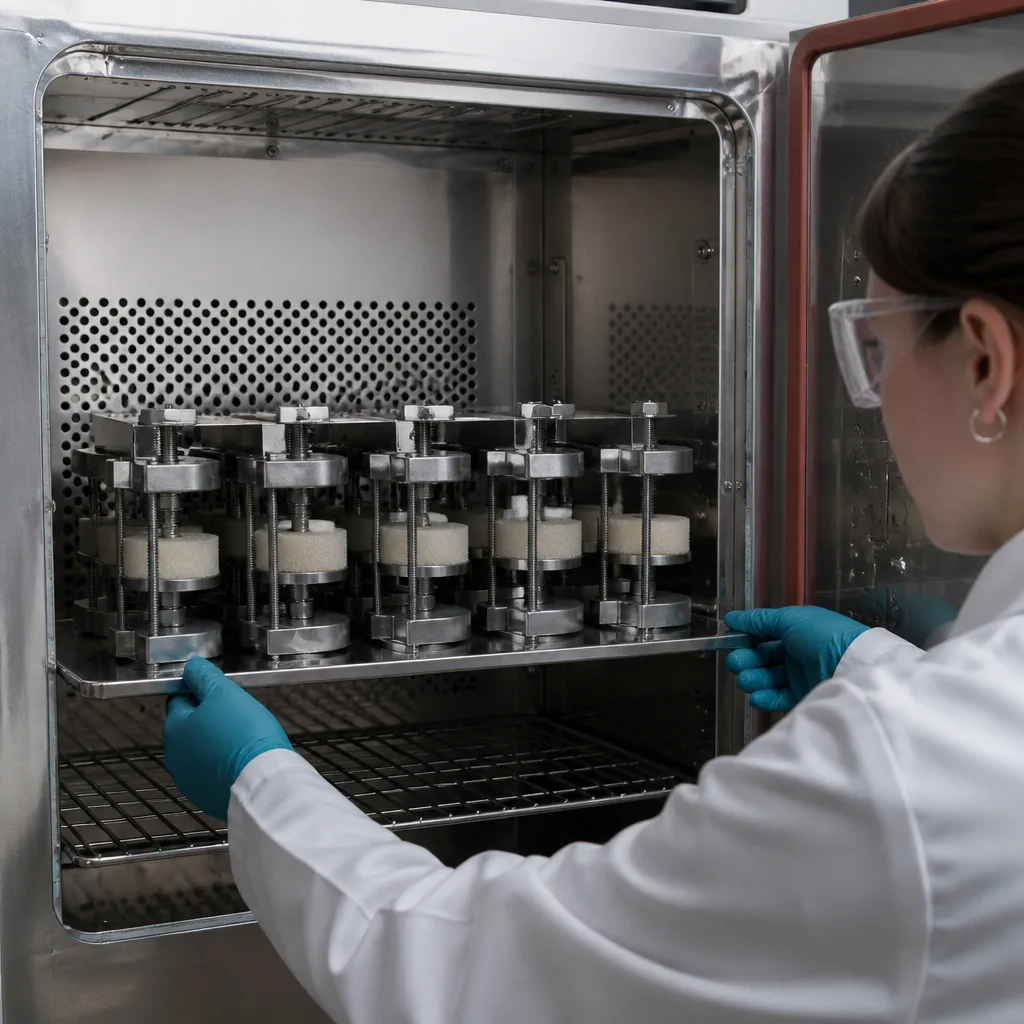
Compressive permanent deformation measures how well a material recovers its original thickness after being compressed under constant stress (constant percentage of deformation) for a specific period of time. This process is typically performed at room temperature or at high temperatures. A lower compressive permanent deformation value indicates better elastic recovery and long-term performance, which is critical for applications such as:
This test method evaluates a material's resistance to permanent deformation (shape change) when used under compressed conditions over time.
The basic test principles of this standard are as follows:
Values typically range from a maximum of 5 percent (excellent recovery) to 10-30 percent or higher, depending on the foam type and conditions.
This method involves compressing standardized test specimens between parallel plates to a constant tension, holding them for a specified time and temperature, releasing the compression, allowing for recovery, and measuring the remaining thickness difference.
Today, the DIN 53572 standard has been replaced by the “DIN EN ISO 1856 Flexible cellular polymeric materials - Determination of permanent compression deformation” standard. However, in technical data sheets for foams (e.g., polyethylene, PVC, or recycled rubber foams), one frequently encounters expressions such as “Permanent compression deformation - DIN 53572 standard” specifying particular test conditions. This helps engineers and buyers compare flexibility and durability.
In short, DIN 53572 is a German industry standard that specifies methods for determining the tear propagation resistance of rubber materials. This property measures how well a rubber sample resists the growth of an existing cut or crack under mechanical stress. It is particularly critical in applications where rubber components are subjected to repeated loading, deformation, or harsh environments.
The primary aim of the DIN 53572 standard is to provide a uniform and repeatable method for evaluating tear resistance. Unlike simple tensile tests, this standard focuses on how cracks form and propagate, providing a more realistic representation of real-world failure modes.
The described test method generally includes the following:
Tear resistance is calculated based on the maximum force applied and the sample thickness.
The DIN 53572 standard typically defines different sample shapes, which include:
Each sample type is designed to simulate different stress distributions and crack propagation behaviors.
To ensure consistency, the standard specifies the following:
The DIN 53572 standard is widely used in the following sectors:
The DIN 53572 standard is considered important for the following reasons:
The main advantages of this standard are:
However, this standard has some limitations:
In conclusion, the DIN 53572 standard plays a crucial role in evaluating the durability and reliability of rubber materials by focusing on tear propagation behavior. It complements other mechanical tests and is indispensable for industries where material failure due to tearing can lead to significant safety or performance issues.
For many years, our organization, with its competent and experienced staff, has been understanding the needs of its clients, providing the advanced testing services they require, and assisting them in the establishment, implementation, and improvement of management systems. Within this framework, we also provide testing services in accordance with the DIN 53572 standard.
To get an appointment, to get more detailed information or to request an evaluation, you can ask us to fill in our form and reach you.

