

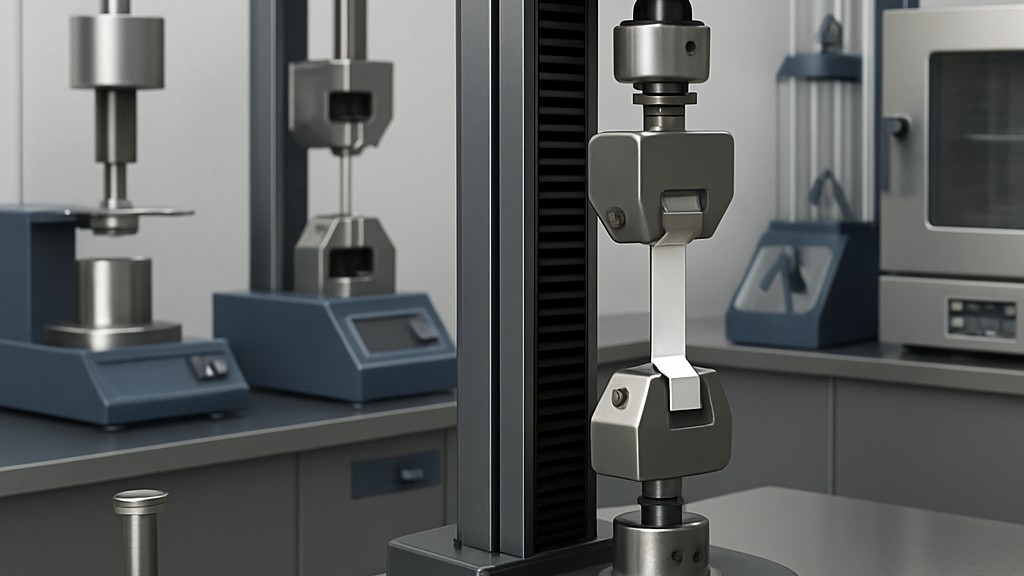
The standard “ASTM D1876 Standard Test Method for Peel Resistance of Adhesives (T-peel test)” developed by the American Society for Testing and Materials (ASTM) describes a test method designed to determine the relative peel resistance of adhesive bonds between flexible adhesives by means of a T-type specimen.
For the purposes of this standard, in addition to the terms and definitions given in ASTM D907, the following definitions apply:
The tension testing machine used in these tests is one that can apply a tensile load with the following anticipated conditions:
These tests also utilize conditioning chambers or dryers. The chambers or dryers must be capable of maintaining a temperature of 23 degrees Celsius plus or minus 1 degree Celsius and a relative humidity of 50 percent plus or minus 2 percent. A saturated calcium nitrate solution gives a relative humidity of approximately 51 percent at the test temperature.
Laminated test panels, as test specimens, consist of two flexible adhesives prepared and bonded together according to the adhesive manufacturer's recommendations. The specially prepared test panels, measuring 152 mm wide and 305 mm long, are bonded along only approximately 229 mm of their length. Test panels of the same dimensions can also be cut from larger, fully laminated panels.
Direct comparisons of different adhesives can only be made when the sample structure and test conditions are the same.
Coated aluminum alloy, 0,81 mm thick, conforming to ASTM B209, has been found to be satisfactory as an adhesive for structural adhesives. Canvas, coated fabrics, plastic films, and metal foils have also proven satisfactory adhesives for use with certain adhesives. The two adhesives do not need to be identical in material or thickness. However, they must be able to bend to any angle up to 90 degrees without breaking.
Glued panels are cut into 25 mm wide test specimens using a method that does not damage the bond. The 76 mm long, unglued ends are bent perpendicular to the glue line to engage the testing machine grips. A minimum of ten test specimens are tested for each adhesive. Within the limitations noted above, other specimen widths can be used, as long as the testing machine grips are wide enough to apply the load evenly across the width of the bonded pieces. To achieve a grip area on fully bonded specimens, one end of the glued specimen can be chilled in dry ice until the adhesive becomes brittle, and then the adhesive can be carefully removed. This technique does not work for all adhesives and adhesives.
Condition samples for 7 days at 23°C plus/minus 1°C and 50% plus/minus 2% relative humidity, except where the adhesive manufacturer may specify that such an aging period is unnecessary or that a shorter period is sufficient. Conditioning is not required for laminate assemblies containing only metal adhesives unless specified by the adhesive manufacturer as part of the bonding procedure.
In short, this standard is essential because it provides a consistent and reliable method for measuring the peel strength of adhesive bonds, especially on flexible substrates. This method is critical for several reasons:
Without this standard, variability in testing methods can lead to inconsistent results, unreliable products, and increased risk of failure in applications where adhesive performance is critical. Therefore, demand for the ASTM D1876 standard test method is increasing.
Our organization, which has been supporting businesses across all sectors for years through a wide range of testing, measurement, analysis, and evaluation activities, boasts a strong team of employees who closely follow global developments in science and technology and are constantly improving themselves. In this context, we also provide testing services in accordance with the "ASTM D1876 Standard Test Method for Peel Resistance of Adhesives (T-Peel Test)" standard.
To get an appointment, to get more detailed information or to request an evaluation, you can ask us to fill in our form and reach you.

