

The standard “ASTM F1223-20 Standard Test Method for Determining Total Knee Prosthesis Constraint”, developed by the American Society for Testing and Materials (ASTM), describes a test method used to compare the constraint properties of total knee prostheses in order to compare new designs with existing clinically successful designs or to determine differences in constraint between two similar or different designs.
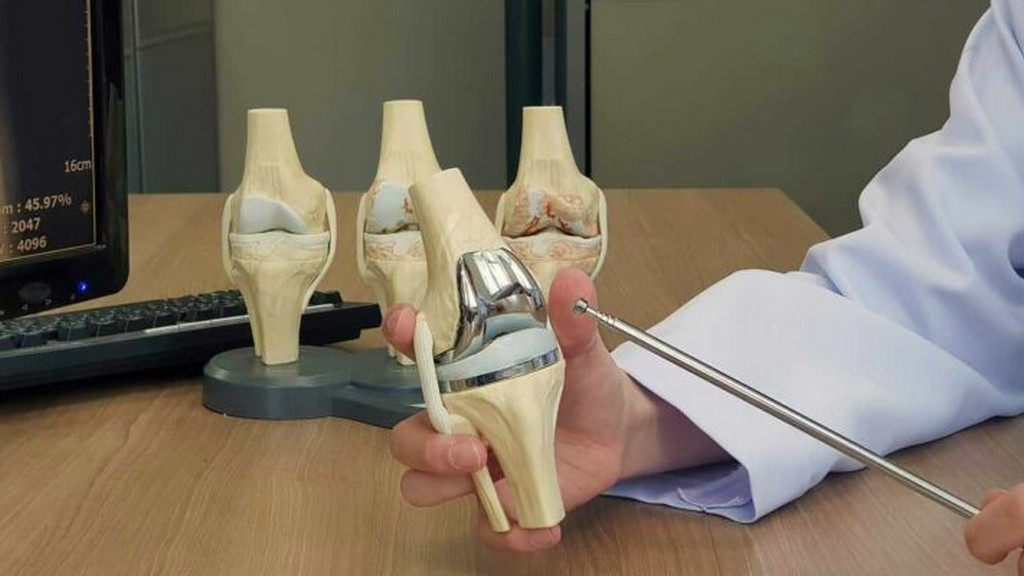
This test method covers the means of quantifying the restriction of a total knee prosthesis to motion determined by the intrinsic joint design under specified loading conditions in vitro.
Tests considered applicable to the determination of restraint are antero-posterior traction, medio-lateral shear, rotary laxity, valgus-varus rotation, and distraction, as applicable. Also included are means of defining the geometric parameters of the contacting surfaces that will affect this movement and reporting the test results. The requirements of the ASTM E4-13 Standard Practices for Force Verification of Testing Machines apply here.
By the way, this test method is not an abrasion test.
When applied to existing products and proposed prototypes, this testing method is intended to provide a database of product functionality capabilities that will hopefully assist the physician in making a more informed total knee replacement selection.
Appropriate matching of the functional restorative capabilities of the total knee replacement and the needs of the recipient (patient) is more likely to be achieved by a rational testing protocol of the implant in an effort to uncover specific device features relevant to the selection process.
Total knee replacement product designs are diverse and offer a wide range of restraints (stability). The restraint of a total knee replacement in vitro depends on various geometric and kinematic interactions between the components of the implant that can be identified and quantified. The degree of kinematic interactions of a total knee replacement should correspond to the needs of the recipient as determined by the physician during clinical examination.
For mobile bearing knee systems, the constraint of the entire implant structure must be characterized. The constraint of mobile bearings is determined by design features at both the superior and inferior joint interfaces.
The methodology, utility, and limitations of constraint/laxity testing are discussed. It is recognized that evaluation of isolated implants (i.e., without soft tissues) does not directly predict in vivo behavior, but allows comparisons between designs. Constraint testing has also been found useful for characterizing implant performance across extreme ranges of motion that may be encountered in vivo at different frequencies depending on the patient's anatomy, preoperative ability, and postoperative activities and lifestyle.
When testing, the fixed component should only be able to move in directions parallel to the z-axis and should not be allowed to rotate about this axis except during the distraction test. It is completely fixed during the distraction test. Meanwhile, for asymmetric designs that may be asymmetric about the sagittal or frontal planes, it may be necessary to allow additional degrees of freedom. For example, the anterior ridge of the tibial bearing insert may be thicker than the posterior ridge. Also, the medial and lateral surfaces may not be the same. If additional degrees of freedom are allowed, these changes in the test method should be included in the report.
The moving component is the element that is displaced when under the loads specific to the test in question and is suitably arranged to obtain data relevant to that test.
Displacement sensing devices are arranged to measure the relative motion between components in accordance with the prescribed coordinate system.
Among the numerous testing, measurement, analysis and evaluation studies that our organization has provided for businesses in various sectors, it also provides testing services defined in the "ASTM F1223-20 Standard Test Method for Determining Total Knee Prosthesis Restriction" standard with its trained and expert staff and advanced technological equipment.
To get an appointment, to get more detailed information or to request an evaluation, you can ask us to fill in our form and reach you.

