

The ASTM D2794 Standard Test Method for the Resistance of Organic Coatings to Rapid Impact Deformation, developed by the American Society for Testing and Materials (ASTM), describes a test method for rapidly deforming a coating film and substrate by impact and evaluating the effect of this deformation. This test method, when using numerical values, should be limited to testing in a single laboratory due to its low repeatability. Inter-laboratory consistency is improved when sequencing is used instead of numerical values.
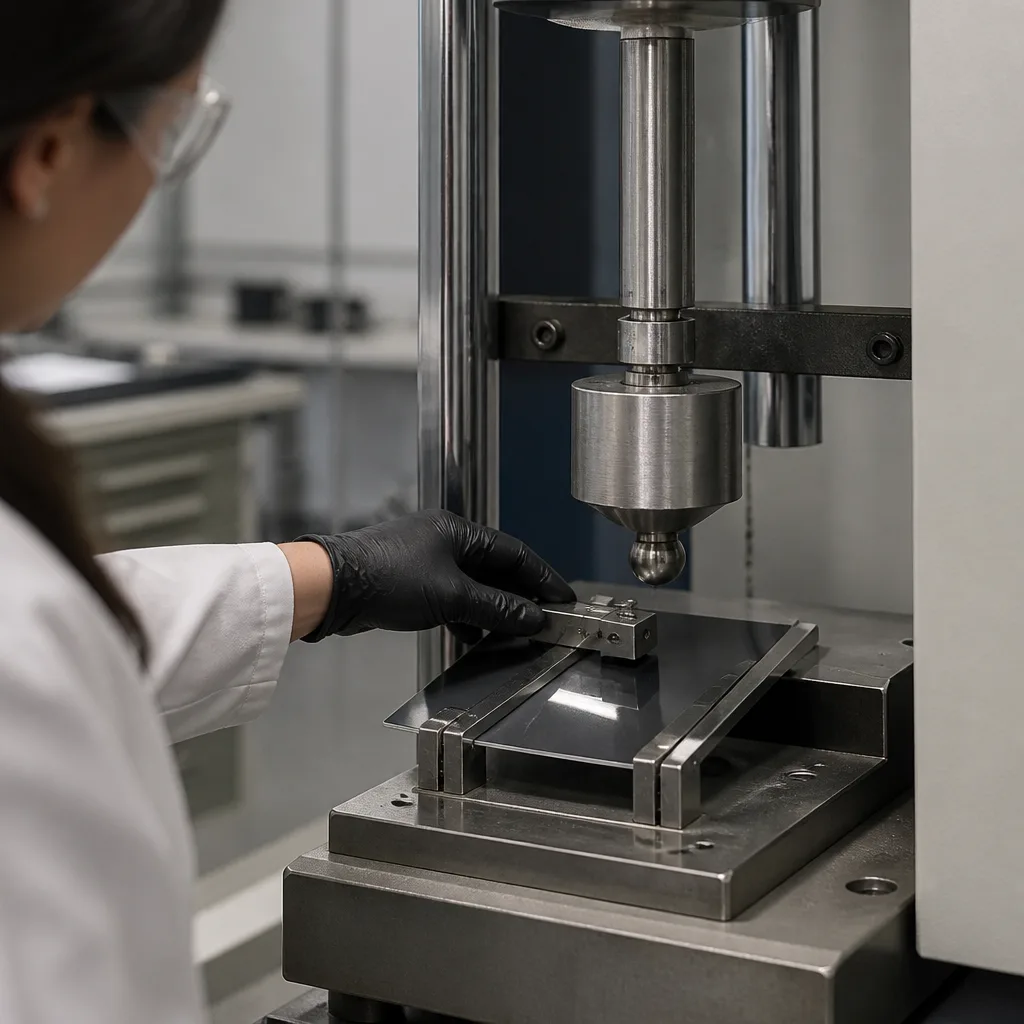
Coatings applied to surfaces are subjected to damaging impacts during product manufacturing and use. This impact resistance testing method, used for many years, has proven useful in predicting the resistance of organic coatings to cracking caused by impacts.
The method described in ASTM D2794 is particularly relevant to paints, varnishes, lacquers, and other organic coatings applied to metal surfaces. It is used to determine whether a coating can withstand sudden mechanical impact without cracking or other visible damage.
The ASTM D2794 standard provides a controlled laboratory procedure in which a coated test panel and its substrate are rapidly deformed due to impact. The resulting coating damage is then evaluated.
The basic principle is simple: a coated metal panel is subjected to a controlled impact, and the coating is examined for cracking or other failures. This method is described as a way to assess the effect of rapid deformation of the coating film and substrate as a result of impact. For organic coatings, the test is generally referred to as a drop-weight impact test or impact resistance test.
The primary purpose of the ASTM D2794 standard is to evaluate the ability of an organic coating to resist cracking when the coated substrate is subjected to sudden impact. Coated components may be subjected to impacts during manufacturing, assembly, transportation, installation, and servicing. A coating that appears satisfactory under normal conditions may crack when the underlying metal is suddenly deformed.
This method has been used for many years to help predict the ability of organic coatings to resist impact cracking.
The test, in principle, uses a coated metal panel, a punch, and a cylindrical weight dropped through a vertical guide tube. The testing process generally follows these steps:
The test apparatus is a vertical tube that directs a cylindrical weight onto a punch resting on a test panel.
The ASTM D2794 standard defines the impact resistance of a coating in terms of the amount of impact energy required to cause cracking in the deformed coating. A higher impact resistance generally indicates that the coating can withstand a greater degree of sudden deformation before cracking. Therefore, the test is useful for comparing the following:
Impact testing can produce different types of deformations depending on how the coated panel is positioned. Inward impact occurs when the impact causes the coated surface to deform inwards. Extrusion, on the other hand, involves deformation in the opposite direction. The condition of the coating after deformation is examined for cracking, flaking, or other forms of failure. This distinction can be important because a coating may behave differently depending on whether it is placed on the impact-bearing side or the opposite side of the panel.
The main test equipment includes an impact testing machine consisting of the following:
A guide tube, approximately 0,6 to 1,2 m long, controls the path of the falling weight, while the punch transfers the impact to a specific area of the coated panel.
The ASTM D2794 standard is generally implemented using organic coatings applied to suitable thin metal panels. The ASTM D609 standard is applicable for the preparation of cold-rolled steel panels, and the ASTM D823 standard is used for producing films of uniform thickness.
Proper sample preparation is important because several factors can significantly affect impact performance:
Following the impact, the deformed coating is examined for signs of failure. Typical failure characteristics may include:
The test can be used to determine the impact level at which cracking occurred. The resulting value is related to the energy of the impact.
Impact resistance is important because coatings do not always degrade under gradual loading. A sudden impact can cause the substrate to deform extremely rapidly and the coating to be subjected to severe local stress. A coating with insufficient impact resistance can lead to:
The ASTM D2794 standard provides a standardized way to investigate these types of coating failures. This standard is applicable to many types of coated metal products, including:
For automotive applications, impact resistance is particularly important for painted metal parts that may be subjected to handling shocks, assembly loads, stone chips, or localized deformation.
In automotive manufacturing, coating systems must withstand various mechanical stresses throughout the production and vehicle lifespan. For example, a painted metal part may experience impacts during these stages: manufacturing, assembly, transportation, and vehicle use. If the coating cracks after an impact, the exposed surface can become more vulnerable to corrosion and environmental effects.
In conclusion, the ASTM D2794 standard is valuable for coating development, quality control, material comparison, and performance evaluation.
For many years, our organization, with its competent and experienced team, has been understanding the needs of its clients, providing the advanced testing services they require, and assisting them in the establishment, implementation, and improvement of management systems. Within this framework, we also provide testing services in accordance with the ASTM D2794 standard.
To get an appointment, to get more detailed information or to request an evaluation, you can ask us to fill in our form and reach you.

