PSA D41 1015 Trim Materials - 180 Degree Peeling
The standard “PSA D41 1015 Trim materials - 180 degree peeling”, developed by the French automobile company Renault, describes a test method aimed at defining the process construction that allows to measure the load required to separate several flexible or semi-flexible layers from a complex. This standard applies to upholstery materials (such as textiles, coated leathers, textiles, acoustic insulations, acoustic absorbers and foams).
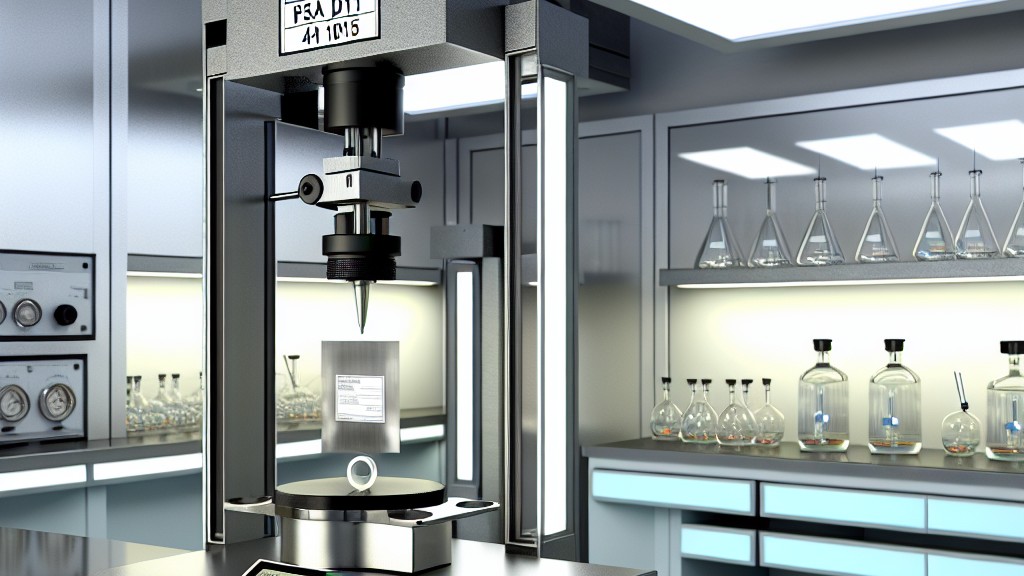
In principle, a tensile test is used to evaluate the resistance of a complex to peeling.
The equipment used in these tests includes:
- Dynamometer. It is a device with the following features:
- Recorder of curve load - elongation.
- Load sensor adapted to the measuring range of the tested materials.
- Movement speed of the mobile jaw at 100 mm/min plus/min 10 mm/min or any other speed specified in the documentation.
- The jaws allow the test specimen to be fixed without possible slipping and tightening of the jaws does not involve applying a preload to the test specimen (e.g. screw-tightened jaws and striped jaws). The width of the jaws should be of a high order with the width of the test specimen.
- Conditioned room. Temperature of 23 degrees plus/minus 2 degrees and relative humidity of 50 percent plus/minus 5 percent.
- Stove. 70 degrees plus/minus 2 degrees temperature.
- Acetone. Or any solvent that allows separation between layers.
Test samples should be representative of the size to be characterized. To ensure this representation, it is necessary to find the basic characteristics of the population under study. Selection criteria for test samples should be stated in the test report in accordance with the PSA A10 0156 standard. In case of doubt about sampling, PSA should be contacted for the rules to be followed.
While preparing test samples,
- Textile and coated textile case: 200 test samples of dimensions 50 mm minimum x 1 mm plus/minus 10 mm, 5 test samples in the longitudinal direction and 5 test samples in the transition direction are taken. Sampling shall be carried out over 150 mm from the edges and cutting ends and at least 3 m from the display end and the end of the piece, as specified in the annex to the standard. At one end, two layers are manually removed from the test sample over the entire width and approximately 100 mm in length. In textiles, if the separation is not very easy, it is facilitated by chemical pinning while proceeding as follows:
- The textile substrate is moistened using solvent at a distance of not more than 30 mm.
- Approximately 100 mm long is immediately left in this area of the test sample.
- The test sample is dried in the oven for at least one hour.
- After the test samples are conditioned for at least 24 hours in the same atmosphere, the tensile test is applied in the conditioned room.
- Leather condition: 200 test samples of 50 mm minimum x 1 mm plus/minus 5 mm are taken. At one end, two folds are manually removed to separate the test sample along the entire width and approximately 100 mm in length. The samples are subjected to tensile testing in a conditioned room after being kept in the same atmosphere for at least 24 hours.
- Condition of foam-bonded mats, acoustic insulation, acoustic absorbers and covers: 200 test samples of dimensions 50 mm minimum x 1 mm plus/minus 10 mm, 5 longitudinal test samples and 5 transverse test samples are taken. The areas sampled are indicated. At one end, two layers are manually removed from the test sample along the entire width and approximately 100 mm in length. If separation proves too easy, the test is not carried out. The result is considered satisfactory. The test samples are subjected to a tensile test in a conditioned room after being kept in the same atmosphere for at least 24 hours.
- Automatic change systems case: 200 test samples are taken in width and length of automatic grip tape at 2 mm plus/minus 5 mm limit for length. At one end, two layers are manually removed to separate from the test sample along the entire width and approximately 100 mm length. If separation proves too easy, the test is not performed. The result is considered satisfactory. The test samples are conditioned in the same atmosphere for at least 24 hours and then subjected to a tensile test in the conditioned room.
The displacement speed of the mobile jaw is regulated while the test is being applied. The two jaws are placed 100 mm plus/minus 1 mm apart. The specimen is placed on the dynamometer by fixing the hardest tongue to the upper jaw. The load scale is set to 0. The lower part of the specimen is fixed to the lower jaw, avoiding any preload greater than 0,2 N. Since the test specimen is fixed in this way, the axis of symmetry must coincide with the axis of traction.
The test is started and the curve load and displacement of the mobile jaw are recorded. Peeling is performed over a minimum length of 150 mm corresponding to a minimum displacement of 75 mm between the jaws. The recorder gives a curve in the saw teeth, following the curve pattern due to the unequal grip between the layers.
Our organization has a strong staff that closely follows the developments in the world in the field of science and technology and constantly improves itself. Among the numerous test, measurement, analysis and evaluation studies provided for businesses in various sectors, there are also test services in accordance with the "PSA D41 1015 Trim materials - 180 degree peeling" standard.



