

The standard "ASTM D5334-22 Standard test method for determining thermal conductivity of soil and rock by thermal needle probe procedure" published by the American Society for Testing and Materials (ASTM) describes a test method for determining the thermal conductivity of soil and rock using a transient heat method. This test method can be applied to both intact soil and rock samples and reconstituted soil samples and is effective in the laboratory and field. This test method is most suitable for homogeneous materials, but can also give a representative average value for inhomogeneous materials.
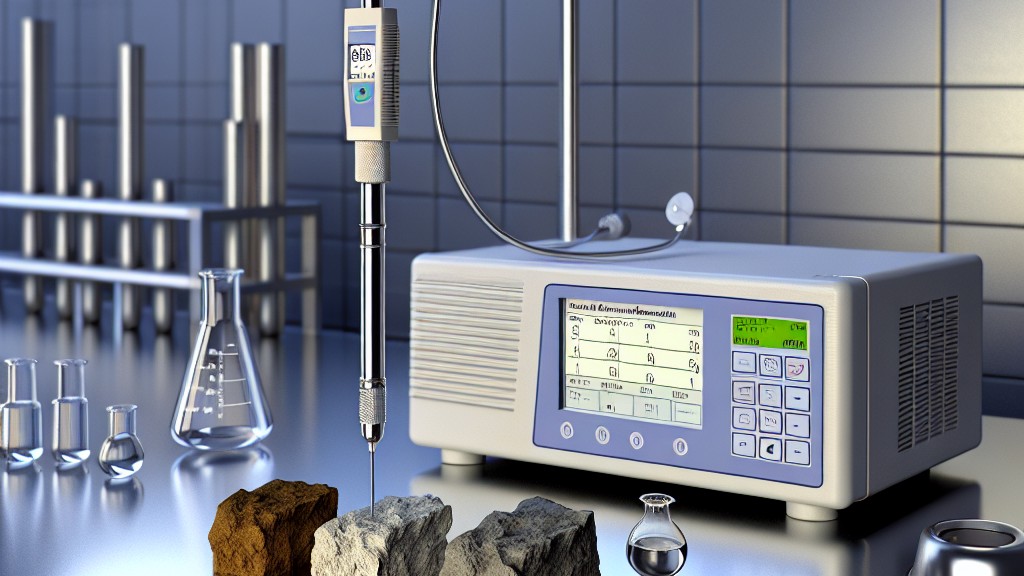
This test method can be applied to dry, unsaturated or saturated materials that can hold a hole for the sensor. It is valid for temperatures between 0 and 100 degrees depending on the conformity of the thermal needle probe structure to the temperature ends. However, care should be taken to avoid significant errors caused by:
All observed and calculated values shall conform to the significant digits and rounding instructions specified in ASTM D6026. The procedures used in this standard to specify how data are collected, recorded, or calculated are considered industry standards. They also generally represent the significant digits that should be retained. The procedures used do not take into account material change, the purpose for which the data are obtained, special purpose studies, or any considerations related to the user's objectives, and it is common practice to increase or decrease the significant digits of reported data commensurate with these considerations. Consideration of significant digits in analytical methods for engineering design is beyond the scope of this standard.
This test method is also applicable and widely used to determine the thermal conductivity of various engineering porous materials of geological origin, including concrete, fluidized thermal backfill and thermal mortar.
For the purposes of this standard, in addition to the terms and definitions given in ASTM D653, the following definitions apply:
Thermal conductivity is determined by a variation of the line source test method using a needle probe with a large length-to-diameter ratio to simulate conditions for an infinitely long, infinitely thin heating source. The probe consists of a heating element and a temperature measuring element and is inserted into the sample. A known current and voltage are applied to the probe heating element for a specified time and the temperature rise is recorded. The temperature drop with time after cessation of heating may also be included in the analysis. Thermal conductivity is obtained from the analysis of temperature time series data during the heating cycle and optionally the cooling cycle by comparison with a theoretical curve using a nonlinear least squares inversion technique.
Thermal conductivity of intact soil samples, reconstituted soil samples, and rock samples is used to analyze and design systems such as underground transmission lines, oil and gas pipelines, radioactive waste disposal, geothermal applications, and solar energy storage facilities. Measurements can be made on-site or samples can be tested in a laboratory environment.
When performing the test, the mass of the sample is adjusted to the nearest 0,01 gram and recorded. The length and diameter of the sample are adjusted to 0,1 mm and recorded. At least three length measurements are taken at 120-degree intervals and at least three diameter measurements are taken at quarter points of the height. The average length and diameter of the sample are determined. The probe is pushed into the sample and the thermal needle probe is inserted down the axis of the sample. If the sample is dense, the needle is inserted into a pre-drilled hole to a depth equal to the length of the probe. It is necessary to ensure that the thermal probe shaft is completely embedded in the sample and not partially exposed.
If a hole needs to be drilled in the sample, the hole is drilled after measuring the mass. The diameter of the hole should be equal to the diameter of the needle probe to ensure a tight fit. The probe can be coated with a thin layer of thermal grease to provide better thermal contact between the sample and the probe. A device such as a drill press can be used to drill the hole and place the probe in a straight line, thus increasing contact between the sample and the probe and reducing gaps. The sample is stabilized at the selected test temperature and the probe is allowed to equilibrate in the sample. Stability and equilibrium can be estimated by observing the temperature for a certain period of time. The heating wire of the thermal probe is connected to a constant current source.
The temperature measuring element ends are connected to the readout unit. A known constant current is applied to the heater wire. Record the current and voltage across the heater as necessary to calculate the power. Record the scale and temperature readings for at least 20-30 steps during the heating period. The constant current source is turned off. If cooling data are to be included in the analysis, record the time and temperature readings for at least 20-30 steps during a period equivalent to the heating cycle. A suitable method is used to determine the thermal conductivity. The initial gravimetric water content is determined and recorded in accordance with the ASTM D2216 standard test method, and the dry density (or unit weight) of a representative sample of the sample is calculated.
Theoretically, if a constant amount of heat is applied to a zero-mass heater for a certain period of time, the temperature response is calculated according to the formula given in the standard. After the heat input is turned off, the change in temperature is calculated according to the formula given in the standard.
Our organization, which has been trying to support businesses from every sector with its testing, measurement, analysis and evaluation studies carried out in a wide range for years, has a strong staff that closely follows the developments in the world in the field of science and technology and constantly improves itself. In this context, testing services in accordance with the "ASTM D5334-22 Standard test method for determining the thermal conductivity of soil and rock by thermal needle probe procedure" standard are also provided to businesses.
To get an appointment, to get more detailed information or to request an evaluation, you can ask us to fill in our form and reach you.

