

The International Organization for Standardization (ISO) standard, "ISO 1926 Rigid cellular plastics - Determination of tensile properties," describes a method for determining the behavior of rigid cellular plastic materials when subjected to tensile stress. This method is primarily applicable to cellular materials with sufficient compressive strength to allow adequate gripping of test specimens. If gripping of the test specimen is not possible, the method is modified to reinforce the ends of the specimen with metal plates. The relationship between cell size and test specimen size should be such that the test is realistic.
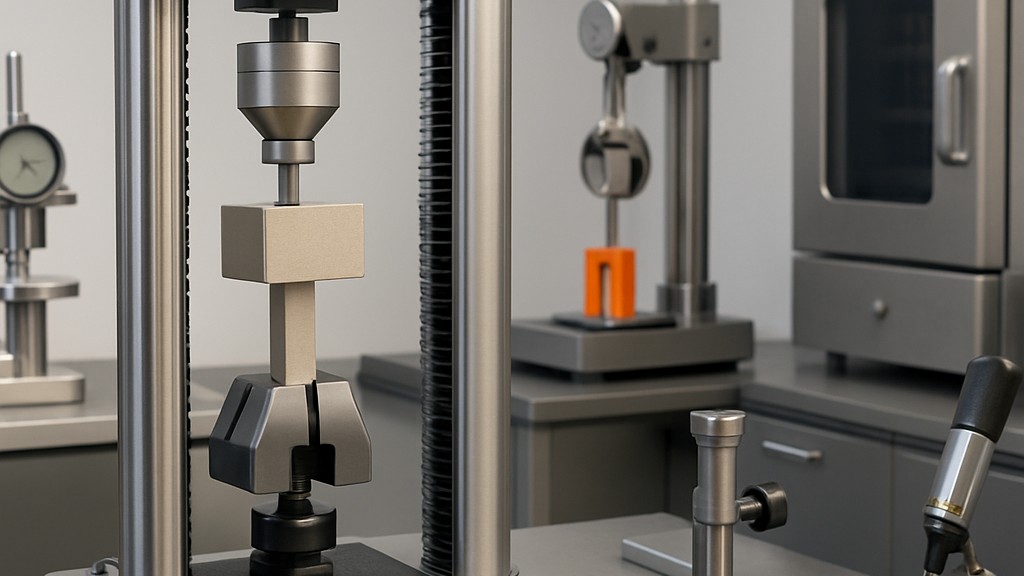
In principle, a test specimen of a certain shape is subjected to a tensile stress transmitted to the test specimen by means of a suitable device and the corresponding stress-strain curve is plotted.
The testing machine must have the following features:
Test specimens must have the shapes and dimensions shown in the standard. During the preparation and conditioning process, the molded surfaces on the test specimens are removed, the surfaces are cut with a mechanical saw, and, if necessary, they are machined without altering the structure. If necessary, the test specimens are marked to indicate their orientation relative to the isotropy direction. Conditioning of the test specimens must be carried out in accordance with the requirements of the ISO 291 standard. For accurate measurements, test specimens must be conditioned for at least 6 hours under the following conditions:
The test is performed on at least five test specimens. All test specimens that fall outside the extensometer measurement range are rejected, and if necessary, the number of test specimens subjected to the test is increased to ensure that the number of significant results is at least five. If more than seven test specimens are required to obtain five valid readings, the method described in the section entitled “Variation: use of metal plates” should be used.
The test is performed in a chamber maintained under one of the atmospheric conditions described above. The test specimen is placed between clamps. If necessary, proceed as described in the section titled "Variation: Use of metal plates." The original measurement length is marked on the test specimen. The force to be applied to the test specimen is applied uniformly by the movable grip. The displacement rate should be 5 plus/minus 2 mm/min. If an extensometer is not used, the elongation corresponding to a given force is recorded at appropriate intervals. A stress-strain curve is plotted.
Then the elongation amount, maximum tensile stress and breaking stress (tensile stress) are calculated.
In the world of materials engineering, particularly in the plastics industry, standardized test methods are crucial for ensuring consistency, reliability, and safety in product development and quality control. One such critical standard is ISO 1926, which focuses on determining the tensile properties of rigid cellular plastics. These materials, often referred to as rigid foams, are widely used in a variety of applications, from insulation panels and structural components to packaging and automotive parts, due to their lightweight structure and excellent mechanical properties.
This standard provides a rigorous methodology for evaluating how these materials behave under tensile stress. The scope of this standard is narrowly focused on rigid cellular plastics that can withstand the compression required for secure specimen grip. This standard does not apply to flexible foams or materials that crumble under minimal pressure. The primary focus of this standard is on tensile stress response, including tensile strength and elongation. The test is performed at a controlled and constant rate of extension until the specimen fails. This standard is often used in conjunction with ASTM D1623 and EN 1607, which share similar objectives but may differ in procedural details. This standard is indispensable for manufacturers ensuring compliance with legal requirements such as building codes or automotive safety standards.
The ISO 1926 standard is designed for precision and simplicity and requires basic tensile testing equipment, such as universal testing machines. The steps in the procedure are generally as follows:
The ISO 1926 standard quantifies two basic tensile properties:
These metrics provide insight into the material's ductility and brittleness. For example, high-strength foams used in structural insulation can exhibit tensile strengths exceeding 1 MPa, yet their rigidity can result in low elongation.
Compliance with the ISO 1926 standard is vital for quality assurance in industries that rely on rigid foams. In construction, it verifies the durability of thermal insulation boards under mechanical loads. In automotive design, it helps select lightweight components that maintain their integrity in crashes. Environmentally, standardized testing supports the development of sustainable foams containing recycled content, ensuring they meet performance criteria.
Non-conformance can lead to product failures, recalls or legal liability, highlighting the role of the standard in risk reduction.
As a result, the ISO 1926 standard stands as a cornerstone in the characterization of rigid cellular plastics, combining laboratory precision with real-world reliability. By standardizing tensile property determination, it empowers engineers to innovate with confidence, from energy-efficient buildings to next-generation vehicles. For those working in materials testing, adopting this standard isn't just about compliance; it's about building a stronger, more durable future. For those involved in foam production or R&D, this standard is a crucial step toward mastery.
Our organization, which has been serving for many years and meticulously following global developments in science and technology, employs a team of experienced professionals and a broad infrastructure to conduct testing, measurement, and analysis in a wide range of areas for businesses across all sectors. In this context, we also provide testing services in accordance with the ISO 1926 Rigid cellular plastics - Determination of tensile properties standard.
To get an appointment, to get more detailed information or to request an evaluation, you can ask us to fill in our form and reach you.

