

The standard “PI-14 Hip ball compression test, static/dynamic” developed by PI Medical Implants describes the fatigue testing of ceramic heads. This procedure, including the materials testing, is performed in accordance with the standard “ASTM F2345-21 Standard test methods for determining static and cyclic fatigue strength of ceramic modular femoral heads” developed by the American Society for Testing and Materials (ASTM). These test methods cover the evaluation of the cyclic fatigue strength of ceramic modular femoral heads mounted on a cone as used in the femoral stem of total hip arthroplasty.
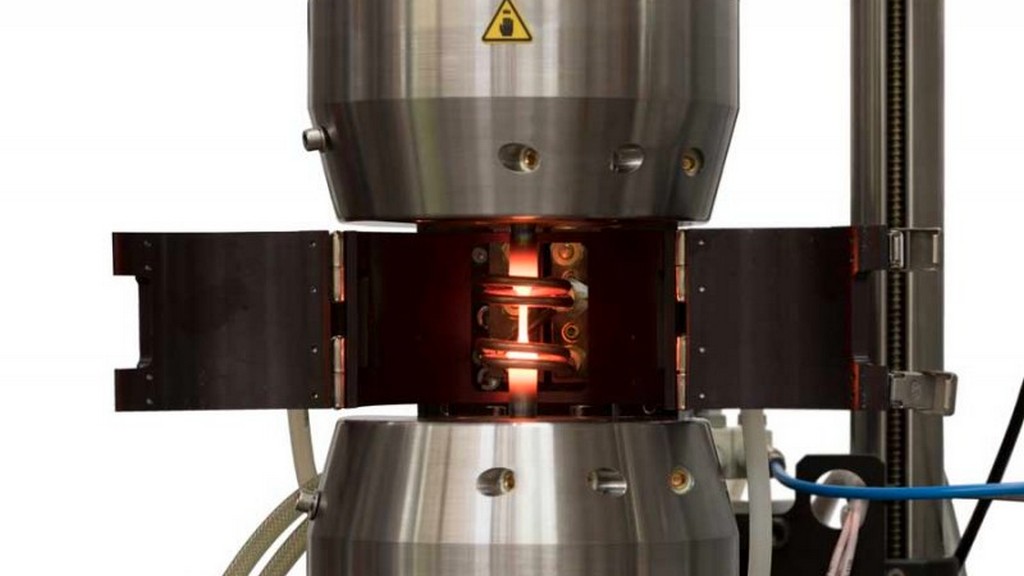
During these tests, a force is applied until the modular connection between the body and the head of the hip endoprosthesis deforms. The head is placed on a conical hole with a copper ring to ensure an equal load distribution.
These test methods can be used to determine the effects of head and cone materials, design variables, manufacturing, and other conditions on the static and cyclic load-carrying ability of modular femoral heads mounted on the cones of femoral stem prostheses.
In vivo loading of modular femoral heads is generally different from the loading described in these methods. The results obtained here cannot be used to directly predict in vivo performance. However, these methods are designed to allow comparisons between the fatigue performance of different ceramic modular femoral head designs when tested under similar conditions.
These test methods can use actual femoral prostheses or neck cone models with simplified geometry, with the same geometric and material properties as the implants. In both cases, the matching metallic cone region of the selected test specimen consists of the same material, tolerances, and coating as the final femoral stem prosthesis.
Fatigue test methods recognize that actual loading in vivo is highly variable and that no test condition can cover all possible variations. The test methods presented herein therefore represent a simplified model for comparisons between designs and materials. These test methods are intended to be performed in physiological solution in air. Test data can provide valuable information about the relative strengths of different head and cone designs.
These tests also refer to the “ISO 7206-10 Implants for surgery - Partial and total hip joint replacements - Part 10: Determination of the resistance of modular femoral heads to static load” standard developed by the International Organization for Standardization (ISO). This standard includes methods for determining the compressive (fracture) or tensile (disassembly) loads required to cause failure of the modular head system under specific laboratory conditions. This standard applies to components made of metallic and non-metallic materials, such as femoral heads of partial or total hip joint replacements (i.e., head/neck conical connection) with a modular structure. However, this standard does not cover methods for examining and reporting test specimens.
A static compression or tensile force is applied to the head/neck assembly of the hip joint prosthesis and increased until the head or neck, or the connection between them, is severed or the selected maximum force is applied without failure occurring.
Among the numerous tests, measurements, analyses and evaluation studies that our organization has carried out for businesses in various sectors, it also provides testing services defined in the “PI-14 Hip ball compression test, static / dynamic” standard with its trained and expert staff and advanced technological equipment.
To get an appointment, to get more detailed information or to request an evaluation, you can ask us to fill in our form and reach you.

