

The standard "ASTM D4482-11 Standard Test Method for Rubber Properties - Extension Cycle Fatigue" published by the American Society for Testing and Materials (ASTM) describes a test method for determining the fatigue life of rubber compounds subjected to tension-strain cycling. During this test, the stress is relaxed to zero during part of the cycle. Specimens are tested without intentionally induced flaws, cuts or cracks. Failure is indicated by complete failure of the test specimen.
No definitive correlation is given or implied between these test results and service. This is due to the variable nature of service conditions. These test procedures provide data that can be used in the comparative evaluation of rubber compounds with respect to their ability to resist (dynamic) extension cycle fatigue.
This test method includes a procedure for determining fatigue life at various rates of extension. The stress cycle is characteristic of the type of tester specified. Experience in fatigue testing has shown that fatigue life can have a wide, non-normal distribution and therefore a large standard deviation depending on the compound. For example, natural rubber has a narrower distribution than many synthetic rubbers. Therefore, a large number of samples may be required to obtain the desired accuracy. Comparisons of different rubber compounds should be made by considering the standard deviation for each.
The fatigue data generated in this test method provides primarily an estimate of the crack initiation behavior of a rubber vulcanizate and only a very approximate measure of the rate of crack propagation. The information obtained may be useful in predicting the flexural life performance of a compound in active service. However, the user should be aware that in actual use products are subject to many other fatigue factors not measured in this test method.
Briefly, this test determines the fatigue life of rubber compounds when subjected to a continuous tension-strain cycle. Specimens are tested intact, without cuts, cracks or flaws. Failure is indicated by complete failure of the test specimen, so any flaws may be an undesirable catalyst.
While the information obtained by this test method can be useful in predicting the flex life performance (flex fatigue) of a compound in actual service, there are many other fatigue factors in the real-life environment that are not measured by this test method. However, this test procedure produces data that can be used for a comparative assessment of the ability of rubber compounds to withstand long-cycle fatigue. This is particularly useful when evaluating the suitability of a rubber compound from a range of possible options.
For the purposes of this standard, the following terms and definitions apply:
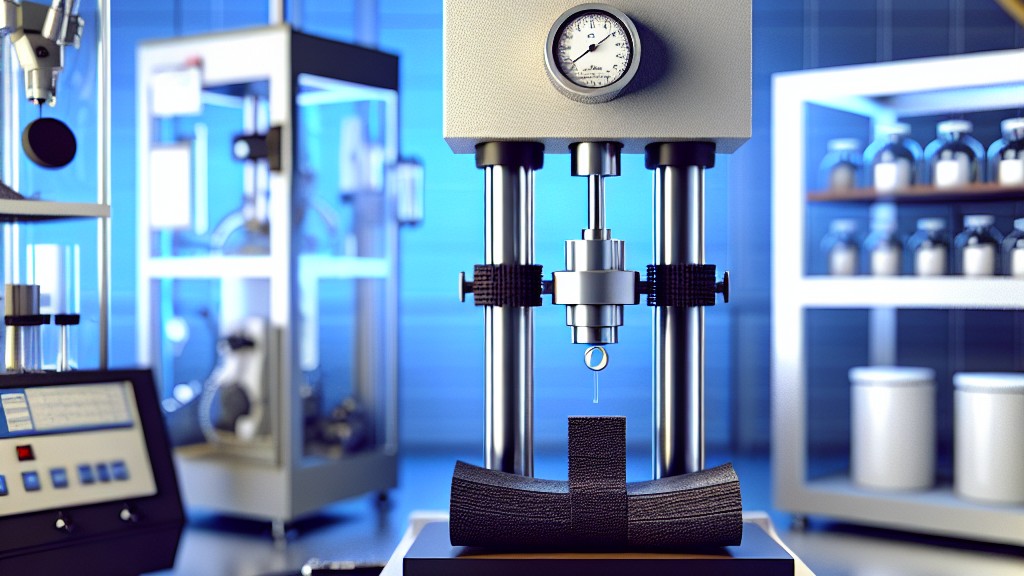
During testing, dumbbell test specimens are cyclically stretched at a constant frequency and through a series of fixed maximum extension rates such that little or no temperature rise occurs. This cyclic stretching action is called flexing. As a result of flexing, cracks, usually initiated by a naturally occurring defect, grow and eventually cause failure, defined as complete failure of the test specimen. The number of cycles to failure (fatigue life) is recorded.
Fatigue, as used in this test method, refers to a rupture failure mechanism resulting from the growth of defects in the specimen. Fatigue does not refer to the sudden change of the physical-chemical rubber structure of high-frequency flexing tests resulting in a significant temperature increase.
Fatigue life can be determined at each of several different extension rates and plotted as a function of log (fatigue life) versus extension rate or log (strain energy). For limited comparisons of rubber vulcanizates with similar stress-strain properties and the same polymer system, a single extension rate or log (strain energy) can be used.
This test method covers a procedure for determining fatigue life at various rates of extension. The strain cycle is characteristic of the type of test apparatus specified. Experience in fatigue testing has shown that fatigue life can have a wide, non-normal distribution and therefore a large standard deviation depending on the compound. For example, natural rubber has a narrower distribution than many synthetic rubbers. Therefore, a large number of samples may be required to obtain the desired accuracy. Comparisons of different rubber compounds should be made by considering the standard deviation for each.
Our organization has a strong staff that closely follows the developments in the world in the field of science and technology and constantly improves itself. Among the numerous test, measurement, analysis and evaluation studies provided for businesses in various sectors, there are also test services in accordance with the "ASTM D4482-11 Standard test method for rubber properties - Extension cycle fatigue" standard.
To get an appointment, to get more detailed information or to request an evaluation, you can ask us to fill in our form and reach you.

