

The standard “ASTM E756 Standard test method for measuring vibration damping properties of materials” developed by the American Society for Testing and Materials (ASTM) describes a test method for measuring the vibration damping properties of materials, including loss factor, Young's modulus E and shear modulus G.
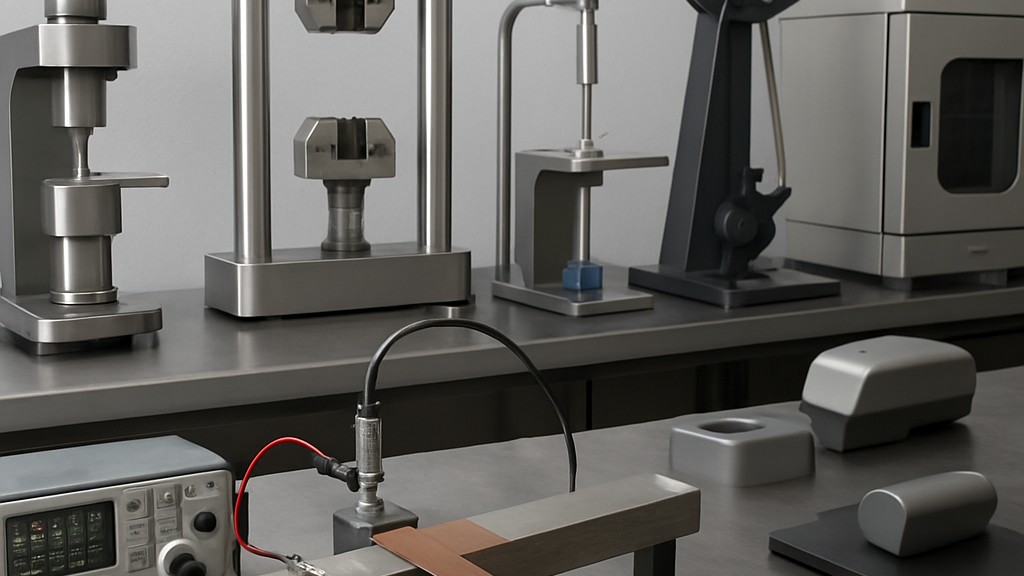
This test method, accurate over the frequency range of 50 to 5 kHz and the material's useful temperature range, is useful for testing materials with applications in structural vibration, building acoustics, and audible noise control. Such materials include metals, enamels, ceramics, rubbers, plastics, reinforced epoxy matrices, and woods, which can be shaped to test specimen configurations.
The material loss factor and modulus of damping materials are particularly useful in designing measures to control vibration in structures and the sound propagated from them at resonance. This test method determines the properties of a damping material by indirect measurement using damped cantilever beam theory. By applying beam theory, the resulting damping material properties are made independent of the geometry of the test specimen used to obtain them. These damping material properties can then be used in conjunction with mathematical models to design and predict the performance of damping systems before hardware fabrication. These models include simple beam and plate analogies as well as finite element analysis models.
This test method has been found to produce good results when used to test materials composed of a single, homogeneous layer. In some damping applications, a damping design may consist of two or more layers with significantly different properties. To ensure the highest possible accuracy of mathematical model predictions, the component layers of these complex designs must be tested separately.
All damping measurements are made in the linear range, meaning the damping materials behave according to linear viscoelastic theory. If the applied force excites the beam beyond the linear region, data analysis is not applicable. For linear beam behavior, the peak displacement from rest for a composite beam must be less than the thickness of the base beam.
The amplitude of the force signal applied to the excitation transducer is held constant with frequency. If the force amplitude cannot be held constant, the beam response must be divided by the force amplitude. The response-to-force ratio (called compliance or pickup) as a function of frequency is then used to evaluate damping.
The ASTM E756 standard is deemed necessary primarily for the following reasons:
In short, the ASTM E756 standard is essential because it provides a reliable, repeatable, and industry-accepted method for characterizing how materials respond to vibration. This supports material selection, system design, product safety, and innovation across multiple sectors.
The vibration-damping properties of materials describe how well a material absorbs and dissipates vibration energy, preventing it from passing through or being reflected back. Simply put, when something shakes or vibrates (like a car engine or washing machine), certain materials can help calm the vibration (like a cushion that absorbs the energy). This ability is called vibration damping.
The key property measured is the dissipation factor. This is the primary metric. It indicates how much vibration energy a material converts into heat rather than conducting it. A higher dissipation factor indicates better damping. The dynamic modulus reflects how stiff the material is when vibrating. It is often combined with damping to understand how the material behaves under real-world conditions.
Examples of damping materials include:
The vibration-dampening properties of materials are important for reducing noise (especially in cars, buildings, and electronics). They also protect parts from fatigue or failure due to constant vibration. They also improve system comfort and performance (such as quieter vehicles or smoother machinery).
Our organization, which has been supporting businesses across all sectors for years through a wide range of testing, measurement, analysis, and evaluation activities, has a strong team of employees who closely follow global developments in science and technology and are constantly improving themselves. In this context, we also provide testing services in accordance with ASTM E756 Standard Test Method for Measuring the Vibration Damping Properties of Materials.
To get an appointment, to get more detailed information or to request an evaluation, you can ask us to fill in our form and reach you.

