

DIN 53509-1 Rubber Tests - Determination of Ozone Cracking Resistance - Part 1: Static Conditions
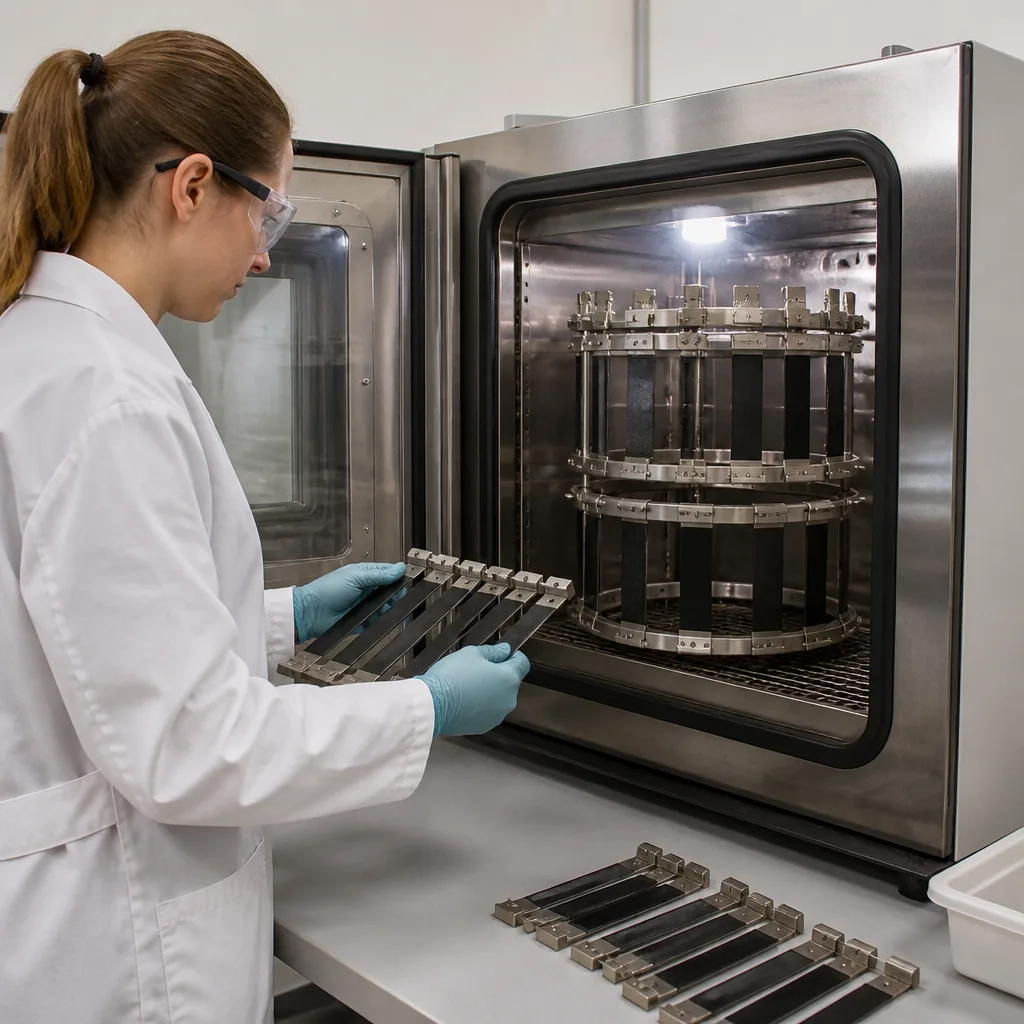
The standard “DIN 53509-1 Rubber tests - Determination of resistance to ozone cracking - Part 1: Static conditions”, published by the German Institute for Standardization (DIN), describes test methods for determining the resistance of rubbers and elastomers to ozone cracking.
Atmospheric ozone, even at very low concentrations, can cause surface cracking in many vulcanized or thermoplastic rubbers, especially those containing double bonds (e.g., natural rubber, SBR, NBR). This is a critical issue for seals, tires, hoses, O-rings, and other rubber products exposed to outdoor or high-altitude environments.
Essentially, the DIN 53509-1 standard is the main section. It describes how to expose rubber test specimens to a controlled ozone atmosphere under static tensile stress and how to evaluate cracking. This standard includes two common methods:
Cracks are graded according to a classification scheme (usually based on crack density and size). Common grading scales range from 0 (no visible cracks) to higher numbers indicating increasing severity (e.g., many small cracks, few large cracks, deep cracks). Sometimes a simple pass/stay criterion is applied (e.g., “cracks not allowed”).
Typical uses include quality control, material comparison, or checking whether a compound conforms to a specification under realistic service-like exposure times. It is the more commonly used method in practice.
During the evaluation, the result is reported as the exposure time (in hours) required for the first cracks to form at the given stress level. A longer time to first cracking indicates better ozone resistance. It can also be used to determine the critical stress or threshold stress (the maximum stress at which no cracks will form even after very long exposure).
Typical applications include research and development, sequencing different compounds, or determining the safe working stress limit for a rubber in ozone environments.
Test conditions typically involve ozone concentrations of 25–200 pphm (parts per hundred million), temperatures of around 40 degrees Celsius, and elongation levels (e.g., 10–60 percent tensile strength). Cracks are usually visually assessed under 10x magnification and graded according to their severity.
Reference methods (wet chemical reference methods) are used to determine ozone concentration in laboratory test chambers. This ensures accurate control of ozone levels during testing.
The DIN 53509-1 standard is technically very similar to the “ISO 1431-1 Rubber, vulcanized or thermoplastic – Resistance to ozone cracking – Part 1: Static and dynamic tensile testing” standard and is generally considered equivalent or a national adaptation. Many laboratories now prefer the updated ISO version, which includes both static and dynamic tensile testing. The DIN 53509 standard is still used as a reference in older specifications, particularly in German and European industry (such as automotive and sealing technology).
In short, the DIN 53509 standard specifies methods for evaluating the resistance of rubber and elastomeric materials to ozone-induced cracking. Ozone in the atmosphere can degrade rubber materials, especially under stress. This standard provides a controlled way to simulate such conditions and assess material durability.
The DIN 53509 standard focuses on the following:
The test method described includes:
Following exposure, samples are visually inspected for cracks or surface deterioration.
This test determines how resistant the material is to ozone attack under real-world stress conditions.
The basic test equipment used in the tests includes the following:
The typical conditions that are checked are as follows:
After the test, the results are evaluated according to the following:
Materials are classified according to their ozone resistance performance, which is critical for durability.
The DIN 53509 standard is widely used in industries where rubber is exposed to air and stress. For example,
This standard is considered important for the following reasons:
In conclusion, the DIN 53509 standard played a significant role in standardizing how to assess the ozone resistance of rubber materials. Although it has been superseded by the ISO 1431 standard, its methodology remains fundamental to understanding rubber aging and environmental durability.
Currently, parts of the DIN 53509-1 standard have been withdrawn in favor of the compatible ISO 1431 series of standards, but this standard is still widely referenced in technical literature, material data sheets, and legacy specifications. Laboratories in Germany and Europe often have equipment calibrated according to both DIN 53509 and ISO 1431 standards to ensure compliance with customer requirements.
For many years, our organization, with its competent and experienced staff, has been understanding the needs of its clients, providing the advanced testing services they require, and assisting them in the establishment, implementation, and improvement of management systems. Within this framework, we also provide testing services in accordance with the DIN 53509-1 standard.
To get an appointment, to get more detailed information or to request an evaluation, you can ask us to fill in our form and reach you.

