ISO 14243 Implants for Surgery - Wear of Total Knee Joint Prostheses
The standard “ISO 14243 Implants for surgery - Wear of total knee joint prostheses” developed by the International Organization for Standardization (ISO) includes the following substandards published under the same title:
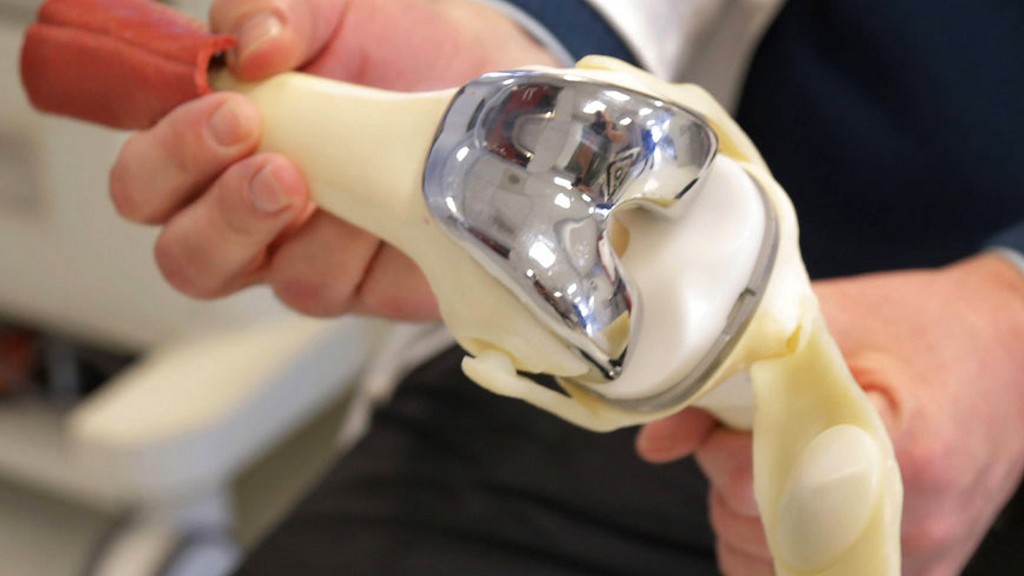
- “ISO 14243-1 Part 1: Loading and displacement parameters for load-controlled wear testing machines and corresponding environmental conditions for testing”. This standard describes the flexion/extension angular motion between articulating components used in wear testing of total knee joint prostheses on load-controlled wear testing machines, the pattern of applied force, test speed and duration, specimen configuration and test environment. The total knee joint prosthesis is mounted in an apparatus that applies a cyclic variation of the flexion/extension angle and the contact force to the interface between the tibial and femoral components, simulating normal human walking. The tibial component is free to move relative to the femoral component under the influence of the applied contact forces, this motion having all degrees of freedom except the flexion/extension angle, which follows a specified cyclic variation.
- “ISO 14243-2 Part 2: Measurement methods”. This standard describes measurement methods for the assessment of wear of the tibial component of total knee joint prostheses using the gravimetric technique for components tested in accordance with ISO 14243-1 or ISO 14243-3, as appropriate. During the test, the specimen is immersed in a lubricant. It is repeatedly removed from the lubricant, cleaned, dried and weighed until a constant rate of liquid absorption is achieved. The test specimen is then assessed for wear by testing for loss of mass in a knee joint simulator. A non-articulated control specimen, loaded or unloaded, immersed in the same lubricant fluid medium is designed to provide liquid absorption and undergoes the same procedure for reference purposes.
- “ISO 14243-3 Part 3: Loading and displacement parameters for displacement-controlled wear-testing machines and corresponding environmental conditions for testing”. This standard describes a test method specifying the flexion/extension angular motion between articulating components, the pattern of applied force, test speed and duration, specimen configuration and test environment used for wear testing of total knee joint prostheses on wear testing machines having axial load control, flexion/extension angular motion control, AP displacement control and tibial rotation control. The kinematics of this standard may not be applicable to knee designs with a high degree of restraint, which may lead to damage to the articulating components in the early stages of testing that may not be representative of clinical service. The total knee joint prosthesis is mounted in an apparatus that applies cyclic variations of the flexion/extension angle, tibial rotation angle, AP displacement and axial force to the interface between the tibial and femoral components, simulating normal human walking. The tibial component moves relative to the femoral component under the influence of applied flexion/extension rotation, tibial rotation, AP displacement, and axial forces. The applied contact force/displacement actions are axial force, flexion/extension rotation, AP displacement, and tibial rotation. All applied force/displacement actions follow a specific cyclic variation with a fixed relationship between the phases of the actions. Testing takes place in a controlled environment simulating physiological conditions.
Among the numerous tests, measurements, analyses and evaluation studies that our organization has carried out for businesses in various sectors, it also provides testing services defined in the “ISO 14243 Implants for surgery - Wear of total knee joint prostheses” standard with its trained and expert staff and advanced technological equipment.



