

The standard "DIN 53357 Testing of plastic sheets and films - Layer separation test," developed by the German Institute for Standardization (DIN), describes a test method used to assess the adhesion of layers to each other or of upper layers to the substrate. This method determines the separation force. This test method can be applied to products in accordance with DIN 16922. Depending on the product type, two methods, Method A or Method B, can be used. The method must be agreed upon.
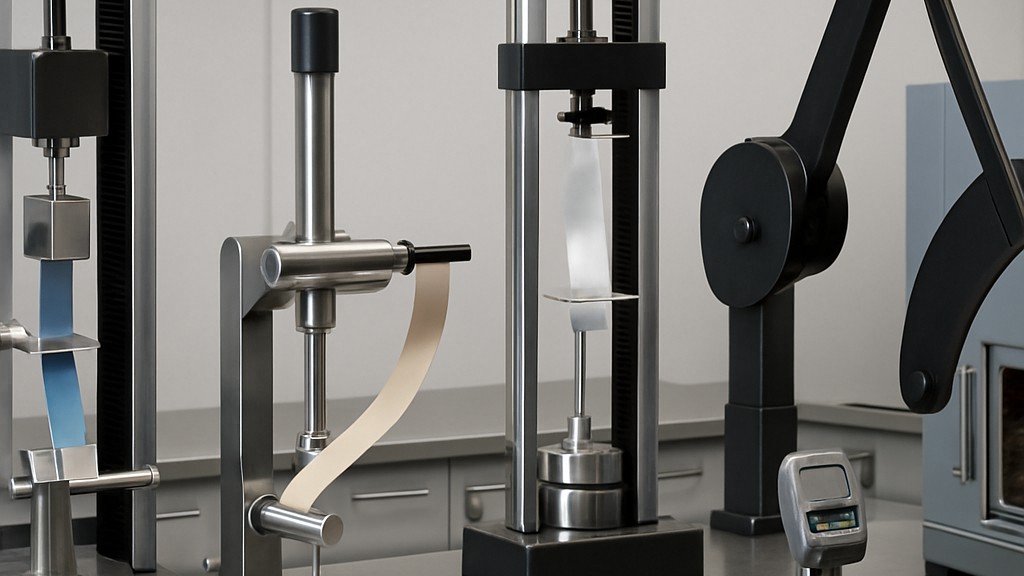
For the purposes of this standard, separation force refers to the force required to separate two layers from each other or an upper layer from a lower layer, as determined in accordance with this standard.
When performing this test, any tensile testing machine conforming to the "DIN 51221 Tensile Testing Machines" standard, with low-inertia force measuring equipment meeting Class 1 requirements as defined in the "DIN 51220 Material Testing Machines" standard, can be used. The force measurement range of the testing machine should be selected so that the average separation force does not lie within the first fifth of the measurement range. The tensile force acting on the sample can be recorded.
Sampling and pretreatment must be carried out in accordance with the standard "DIN 16906 Testing of plastic sheets and plastic films - Samples and specimens - Preparation and conditioning." The shape and number of samples are determined as follows:
When preparing test specimens, the layers to be separated are mechanically separated, if possible along a narrow edge of the specimen and parallel to its surface, for a length of at least 40 mm. The layers themselves should not be significantly damaged.
If separation of the layers is not possible, this can be facilitated, if necessary, by immersing the sample in a suitable solvent or solvent vapor for a length of approximately 40 mm. The solvent should then be removed by drying at a temperature not exceeding 70°C. If the top layer cannot be separated from the substrate even after this treatment, the test cannot be performed. For thin top layers whose strength is less than the separation force, the bond can be enhanced by bonding the two samples (top layer to top layer) with a solvent-free polyurethane adhesive. Only one of the top layers is mechanically separated for a length of approximately 40 mm, as described above. After preparation, the test samples are pretreated in accordance with this standard.
Although largely superseded today by ISO standards such as ISO 4593, DIN 53357 is historically important in materials testing, particularly for evaluating the properties of plastic films and sheets. This standard is considered important for the following reasons:
As a result, modern standards such as ISO 4593 or its ASTM equivalents have largely superseded DIN 53357. However, it has nevertheless contributed significantly to the establishment of rigorous and reproducible testing protocols that improve the quality and performance of plastic materials across various industries.
Focusing primarily on the testing of plastic films and sheets, the DIN 53357 standard includes specific test methods for evaluating mechanical and adhesion properties. These methods are specifically designed to evaluate the performance of plastic films in applications such as packaging, laminates, and coatings. The main test methods are:
Many methods from DIN 53357 have been incorporated into or superseded by ISO or ASTM standards, but the principles remain similar.
Our organization, which has been supporting businesses across all sectors for years with a wide range of testing, measurement, analysis, and evaluation activities, has a strong team of employees who closely follow global developments in science and technology and are constantly improving themselves. In this context, we also provide testing services in accordance with the DIN 53357 "Testing of plastic sheets and films - Layer separation test" standard.
To get an appointment, to get more detailed information or to request an evaluation, you can ask us to fill in our form and reach you.

