

The ASTM D522 Standard Test Methods for Mandrel Bending of Bonded Organic Coatings , published by the American Society for Testing and Materials (ASTM) , describes test methods for determining the crack resistance (flexibility) of organic coatings bonded to surfaces made of sheet metal or rubber.
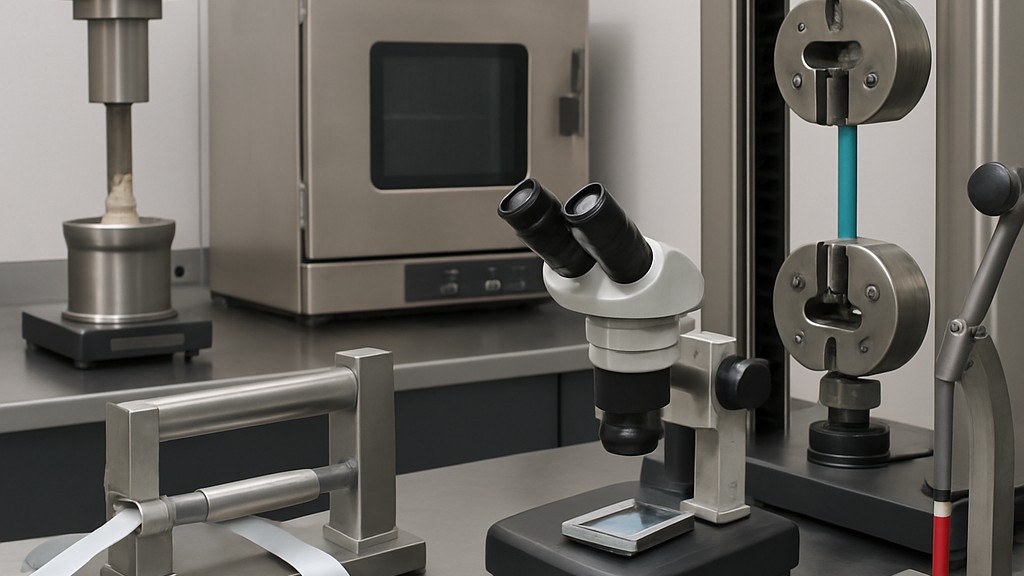
Coatings bonded to substrates will stretch when bent during product manufacture or during use due to excessive handling. These test methods have been useful in rating the ability of bonded coatings to resist cracking when stretched and in evaluating the flexibility of coatings on flexible substrates.
The coating materials being tested are applied in uniform thickness to panels made of sheet metal or rubber-like materials. After drying or curing, the coated panels are bent over a mandrel, and the coating's resistance to cracking is determined. In test method A, the coated panels are bent over a conical mandrel. In test method B, the coated panels are bent over cylindrical mandrels of various diameters.
If the test purpose is to determine the percentage elongation of the coating material, the substrate should be 0,8 mm thick cold-rolled steel strip. If the test purpose is to evaluate the crack resistance of the coated material, the substrate can be any sheet metal or rubber-type material (e.g., steel, aluminum, tinplate, or synthetic rubber). Sheet metal can be less than 0,8 mm thick, and rubber-type materials can be up to 13 mm thick.
The recommended panel size is 100 mm wide by 150 mm long. The maximum size a tapered mandrel can accommodate is 115 mm wide by 190 mm long. Substrate surface preparation must be agreed upon between the buyer and seller. Before coating application, the edges of the metal panels are lightly rounded to remove burrs to eliminate abnormal edge effects. If elongations are to be determined for coatings applied to substrates other than 0,8 mm thick cold-rolled steel, they should be measured with a dedicated mandrel jig.
For coated panels, smooth coatings of the materials being tested are applied to the substrates in accordance with ASTM D823 and air-dried or cured under conditions mutually acceptable to the buyer and seller. If percentage elongation is to be measured, a minimum thickness of 1,0 mils is required on 0,8 mm thick cold-rolled steel. At least three coating thickness determinations are made on each sample in accordance with the test methods of ASTM D1005, ASTM D1186, or ASTM D1400. At least three specimens of the specified size are cut from pre-coated sheets. Only flat sheets are used, and the edges of the panels are lightly rounded. The coating surface must be free of oil and other foreign matter that could increase the flexibility of the coating or prevent crack observation.
Test specimens are conditioned for at least 24 hours at a temperature of 23 degrees Celsius (plus/minus 2 degrees Celsius) and a relative humidity of 50 percent (plus/minus 5 percent) and tested in the same environment or immediately after removal from the environment unless otherwise specified by the buyer and seller. At least three replicates are tested in test method A and at least two replicates in test method B for each mandrel diameter of interest.
In short, ASTM D522 is a standard test method designed to evaluate the flexibility and crack resistance of organic coatings applied to substrates such as sheet metal or rubber-type materials. The purpose of this standard is to simulate real-world bending stresses, such as those under harsh conditions during manufacturing or use, and to measure how effectively coatings prevent cracking or delamination. Common applications of this standard include industries such as automotive, aerospace, construction, and consumer goods, where coated products are frequently bent or flexed and must maintain their integrity and appearance.
Two test methods are described in this standard:
Tests are typically conducted at a temperature of 23°C (75°F) plus or minus 2°C (85°F) and a relative humidity of 50% (85°F) plus or minus 5% (85°F). Typical specimen sizes are 10,2 mm x 15,2 cm for steel or rubber materials, approximately 0,8 mm thick.
During testing, coated samples are prepared and cured according to specifications. Panels are prepared under controlled laboratory conditions (approximately 24 hours). Bending on the mandrel takes approximately 1 second. Cracks are examined using appropriate lighting and ideally magnification (7-10x). Results are documented, preferably with photographs. Multiple samples (3-5) are tested for statistical reliability. Testing at extreme temperatures is recommended to mimic real-world conditions.
When interpreting results, the smallest mandrel diameter that the coating can withstand without cracking is determined. This determines the degree of flexibility. Visual inspection is crucial. Cracks penetrating the substrate or coating separation are observed. Results can be based on pass/fail or absolute failure thresholds.
The ASTM D522 standard provides a reliable and repeatable method for evaluating the flexibility of coatings. Specifically, it evaluates how well a coating resists cracking, flaking, or delamination when the underlying material is bent or deformed.
This standard is important for the following reasons:
This is critical for metal roofing, automotive body panels, appliances and piping that frequently bend or flex during handling, installation or service.
Routine quality control testing is ideal for this standard, providing a clear pass/fail result.
Our organization, which has been serving for many years and meticulously following global developments in science and technology, employs a team of experienced professionals and a broad infrastructure to conduct testing, measurement, and analysis in a wide range of areas for businesses across all sectors. In this context, we also provide testing services in accordance with ASTM D522 Standard Test Methods for Mandrel Bend Testing of Adhesive Organic Coatings.
To get an appointment, to get more detailed information or to request an evaluation, you can ask us to fill in our form and reach you.

