

The standard “ASTM D6793-02 American National Standard Standard Test Method for Determination of Isothermal Secant and Tangential Volume Modulus” developed by the American Society for Testing and Materials (ASTM) describes a procedure for determining the isothermal secant and tangential volume modulus of liquids that are compatible and stable with stainless steel under the test conditions. This test method is designed for use in the temperature range of minus 40 degrees to 200 degrees and from ambient temperature to 68,95 Mpa. Due to the design of the test apparatus, the upper pressure limit that can be achieved is limited by the volume modulus of the test liquid. For liquids with relatively low volume modulus at the test temperature, pressures as high as 68,95 Mpa will not be achieved.
This test method assumes that the user is competent in the assembly and use of medium pressure threaded and tapered fittings designed for use at pressures up to 137,9 Mpa.
For the purposes of this International Standard, the isothermal secant volume modulus is the product of the original liquid volume and the slope of the secant drawn through any specified point on a graph of pressure versus volume at constant temperature. The isothermal tangent volume modulus is the product of the liquid volume at any specified pressure and the partial derivative of the liquid pressure with respect to volume at constant temperature.
When determining the isothermal secant volume modulus, a piston in the form of a mid-pressure valve is forced into a liquid-filled chamber. The pressure generated by the piston's placement is measured. A system constant is determined according to the formula given in the standard, using a known volume modulus standard. The system constant is therefore a constant determined only by the system volume and piston displacement. It is temperature-independent and, when known, can be used to determine the isothermal secant volume modulus from the pressure data obtained for various piston placement degrees.
If desired, the isothermal tangent volume modulus and sample density can be determined from the isothermal secant volume modulus data determined as a function of pressure using the calculations given in this standard.
Isothermal secant bulk modulus (static bulk modulus) is a property that measures the compressibility of a liquid. The larger the value, the less compressible the liquid.
Isothermal secant volume modulus is used in the design of high performance hydraulic fluid and brake systems. A high volume modulus is desirable because the response time of the system is faster due to the faster compression of the working fluid when the applied pressure directly affects the action of the system.
If the isothermal secant volume modulus is known as a function of pressure, the data can be used to calculate the isothermal tangent volume modulus and the density as a function of pressure. However, the data cannot be used to determine the isentropic (dynamic) volume modulus. This property is usually determined from sound speed measurements and differs from the isothermal volume modulus by the ratio Cp/Cv (the ratio of the heat capacity at constant pressure to the heat capacity at constant volume for the test specimen).
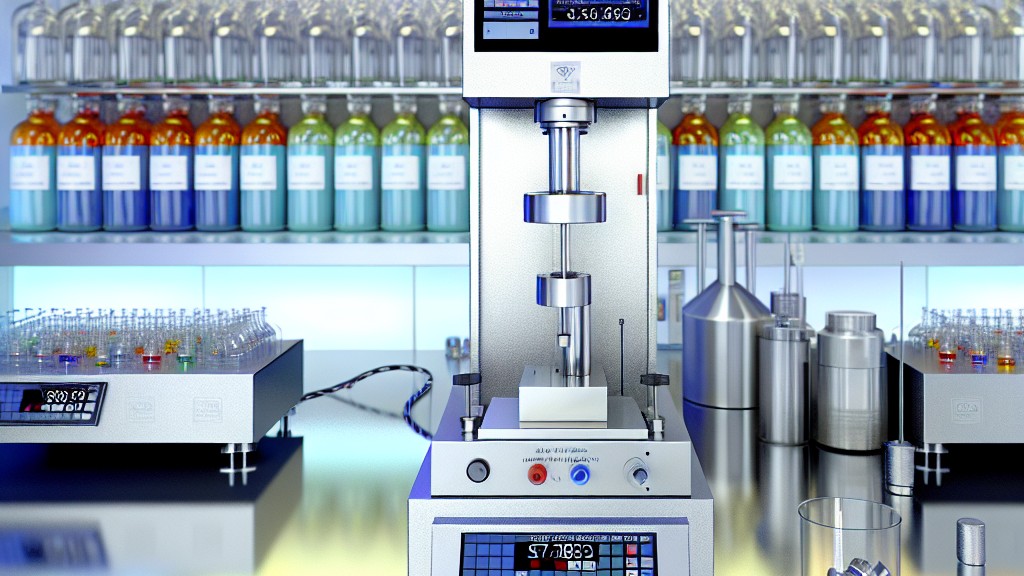
The apparatus used for determining the isothermal secant volume modulus is shown schematically in the standard. An oven capable of maintaining the temperature within plus/minus 0,1 degree at the desired test temperature is required. All fittings are of the conical and threaded type for use at operating pressures up to 137,9 Mpa. Pressure is generated in the system using a pressure valve. In this valve, a piston (valve stem) is inserted into the liquid-filled system with each rotation determined by a scale attached to the valve stem to ensure repeatability of rotations from the starting point. Pressure transducers, thermocouples and system fixtures should be such that they contribute minimally to the system volume. Thus, the system volume should be such that it will permit the maximum pressure rise for any degree of placement of the pressure valve stem.
Our organization has a strong staff that closely follows the developments in the world in the field of science and technology and constantly improves itself. Among the numerous test, measurement, analysis and evaluation studies provided for businesses in various sectors, there are also test services in accordance with the standard "ASTM D6793-02 American national standard standard test method for determination of isothermal secant and tangent volume modulus".
To get an appointment, to get more detailed information or to request an evaluation, you can ask us to fill in our form and reach you.

