

The International Organization for Standardization (ISO) standard "ISO 15184 Paints and varnishes - Determination of film hardness by pencil test" describes a method for determining film hardness by pressing pencils of known hardness onto film. This method can be performed on a single coat of a paint, varnish, or related product, or on the top coat of a multi-coat system.
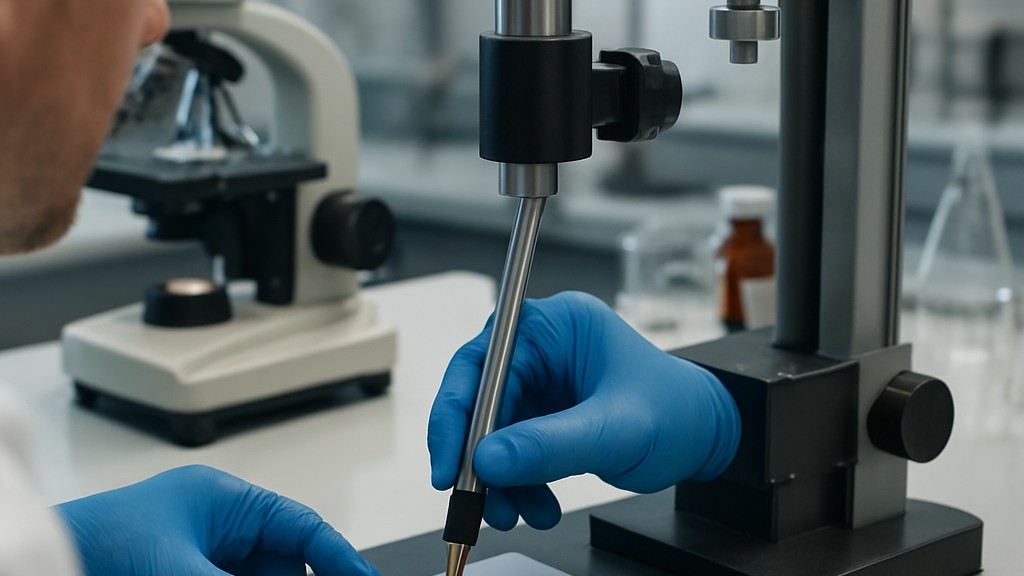
This quick test has not been found to be useful for comparing the pencil hardness of different coatings. It is more useful for providing relative ratings for a range of coated panels that exhibit significant differences in pencil hardness. This method is only valid for smooth surfaces.
In principle, a pencil tip with a specific geometry is pressed against the coating surface at a 45-degree angle, applying a force of 7,35 N plus/minus 0,15 N. The pencil tip's hardness is gradually increased until visible defects appear on the coating surface. The test result is the highest hardness at which no stains are formed.
In the world of coatings and surface finishes, assessing the durability and resistance of a paint or varnish film is crucial to ensuring product quality and performance. One of the simplest yet most effective methods for this assessment is ISO 15184. This standard provides a simple technique for measuring the scratch resistance of coating films using pencils with varying hardness ratings.
This standard is particularly valuable in industries like automotive, furniture, and construction, where coatings must withstand daily wear and tear without easily scratching or deteriorating. Unlike more complex tests requiring specialized equipment, this method relies on everyday tools (pens), making it accessible to both quality control labs and manufacturers.
The pencil hardness test arose from the coatings industry's need to quickly distinguish between films of different hardness levels. It simulates real-world scratch scenarios, such as those caused by a key, tool, or fingernail, by applying controlled pressure with the pencil tip.
The main objectives of the ISO 15184 standard are:
The test method is quite simple; it is not designed to make definitive quantitative comparisons between slightly different coatings. Instead, as the testers emphasize, it is best suited to assessing significant differences across a range of panels.
The ISO 15184 standard applies to organic coatings on rigid or semi-rigid substrates such as metal, wood, or plastic panels. This method is versatile for both clear varnishes and pigmented paints, provided the film is fully cured and has good adhesion to the surface. The main exceptions are:
An appendix to this standard addresses applicability, emphasizing that results may vary with environmental factors such as temperature and humidity. In multi-coat systems, the test evaluates the hardness of the topcoat after specified drying times.
This testing method requires minimal equipment: a set of pencils graded from 6B (softest) to 9H (hardest) on the HB scale, a flat test panel, and optional tools such as a hardness tester for consistency. The method's steps are typically as follows:
For greater accuracy, automated pencil hardness testers are commercially available that meet standards such as ISO 15184 and ASTM D3363. These devices provide uniform pressure and angle, reducing operator variability.
The pencil hardness scale is a qualitative progression:
For example, a 3H grade indicates a tough film suitable for high-wear applications. However, higher grades do not always correlate linearly with real-world durability; factors such as flexibility and adhesion play a role. This standard cautions against over-reliance on pencil tests for absolute performance estimates.
Our organization, with its competent and experienced team, has been understanding our customers' needs for years, providing them with the advanced testing services they need, and assisting them in establishing, implementing, and improving management systems. In this context, we also provide testing services in accordance with the ISO 15184 Paints and varnishes - Determination of film hardness by pencil testing.
To get an appointment, to get more detailed information or to request an evaluation, you can ask us to fill in our form and reach you.

