

The “ASTM E1461 Standard Test Method for Thermal Diffusivity by Flash” standard, developed by the American Society for Testing and Materials (ASTM), describes a test method primarily involving the determination of the thermal diffusivity of homogeneous isotropic solid materials. Thermal diffusivity values in the range of 0,1 to 1000 (mm) ² s⁻¹ can be measured using this test method at temperatures ranging from approximately 75 to 2800 K.
ASTM E2585 Standard Practice for Thermal Diffusivity by the Flash Method is a supplement to this test method and provides detailed information on the use of the flash method. These two standards complement each other.
This test method is a more detailed form of the ASTM C714 standard test method and is applicable to a much wider range of materials, applications and temperatures, and measurement accuracy is increased.
This test method is intended to allow for a wide variety of device designs. It is impractical for such a test method to specify construction and procedural details that would cover all situations that would pose a challenge to someone lacking the relevant technical knowledge, or to restrict research and development to improvements in the basic technique.
This test method is applicable to measurements performed on essentially completely dense (preferably, but low porosity is acceptable), homogeneous, and isotropic solid materials that are opaque to the applied energy pulse. Experience shows that some deviations from these strict rules can be accommodated through careful and appropriate experimental design and can significantly increase the usefulness of the method.
Thermal diffusivity is an important transient thermal property required for purposes such as design applications, determination of safe operating temperature, process control, and quality assurance.
The flash method is used to measure the thermal diffusivity of a wide variety of solid materials. It is particularly advantageous due to its simple sample geometry, small sample size requirements, measurement speed, and ease of use.
Under certain stringent conditions, when the method is used quantitatively, the specific heat capacity of a homogeneous, isotropic, opaque solid sample can be determined. Thermal diffusion results, along with the corresponding values of specific heat capacity and density, can be used to derive thermal conductivity, in many cases according to the relationships given in the standard.
For the purposes of this standard, the thermal conductivity of a solid material is the time rate of steady heat flow through a unit thickness of an infinite plate of homogeneous material, perpendicular to the surface, resulting from a unit temperature difference. Because this property varies with temperature, it must be defined in terms of a specific mean temperature. The thermal diffusivity of a solid material is determined by dividing the thermal conductivity by the product of its density and heat capacity per unit mass.
During the test, a small, thin disk sample is subjected to a high-intensity, short-duration pulse of radiant energy. The energy of the pulse is absorbed at the front surface of the sample, and the resulting back-face temperature increase (thermal curve) is recorded. The thermal diffusivity value is calculated from the sample thickness and the time required for the back-face temperature increase to reach a specified percentage of its maximum value. If the thermal diffusivity of the sample is to be determined over a specific temperature range, the measurement must be repeated at each relevant temperature. This test method is described in detail in a number of publications and review articles. A summary of the theory is included in the standard appendix (Annex X1).
The typical sample is a thin circular disk with a front surface area smaller than that of the energy beam. Samples are typically 10 to 12,5 mm in diameter (in special cases, samples as small as 6 mm and as large as 30 mm can be used). The optimum thickness depends on the magnitude of the estimated thermal diffusion and should be selected so that the time to reach half the maximum temperature is in the range of 10 to 1000 ms. Thinner samples are preferred at higher temperatures to minimize heat loss corrections, but samples should always be thick enough to represent the test material. Thicknesses typically range from 1 to 6 mm.
Specimens should be prepared so that their surfaces are flat and parallel within 0,5 percent of their thickness to keep the thermal diffusion error due to the measured average thickness below 1 percent. Irregularities (craters, scratches, marks) should be avoided on both surfaces.
Before performing measurements, it is good practice to apply a very thin, uniform coating of graphite or other high-emissivity material to both surfaces of the sample to be tested. The coating can be applied by methods such as sputtering, painting, or spraying. This increases the sample's ability to absorb the applied energy, especially for highly reflective materials. For transparent materials, a layer of gold, silver, or other opaque materials should be applied first, followed by the graphite coating. For some opaque reflective materials, sandblasting the surface can provide sufficient shock absorption and emissivity, especially at high temperatures where coatings may be unstable or react with the material.
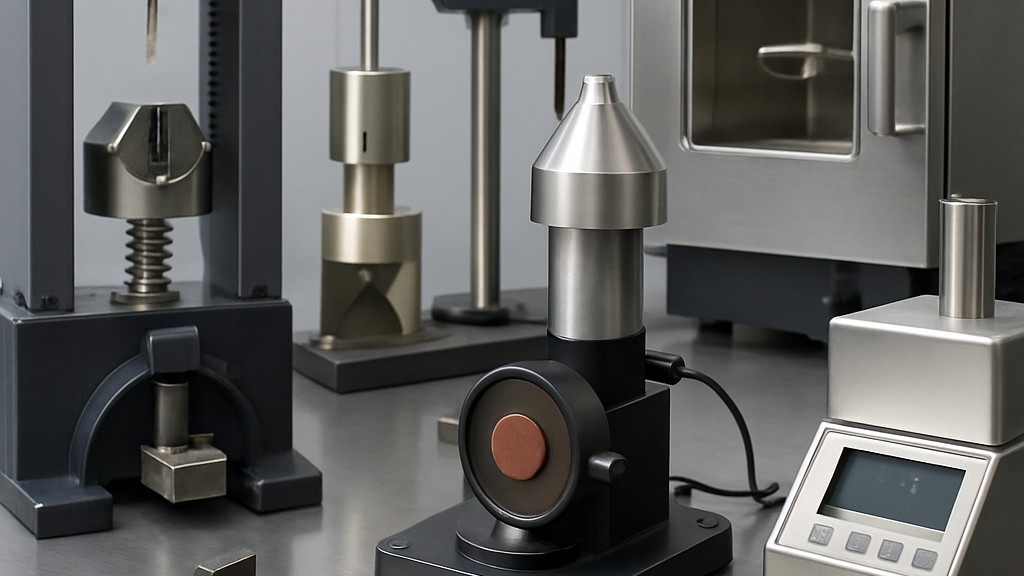
The basic components of the device used in the tests are the flash source, sample holder, environmental enclosure (optional), temperature detector and recorder.
Our organization, which has been operating for many years and meticulously follows global developments in science and technology, employs a skilled team and extensive infrastructure to conduct testing, measurement, and analysis in a wide range of areas for businesses across all sectors. In this context, we also provide testing services in accordance with ASTM E1461 Standard Test Method for Thermal Diffusion by Flash Method.
To get an appointment, to get more detailed information or to request an evaluation, you can ask us to fill in our form and reach you.

