

The American Society for Testing and Materials (ASTM) standard, "ASTM B193 Standard Test Method for Resistivity of Electrically Conductive Materials," describes a test method for determining the electrical resistivity of metallic electrically conductive materials. This method provides an accuracy of plus or minus 0,30 percent for test specimens having a resistivity of 0,00001 Ω (10 μΩ) or greater. Weight resistivity accuracy may be adversely affected by possible inaccuracies in the assumed density of the conductor.
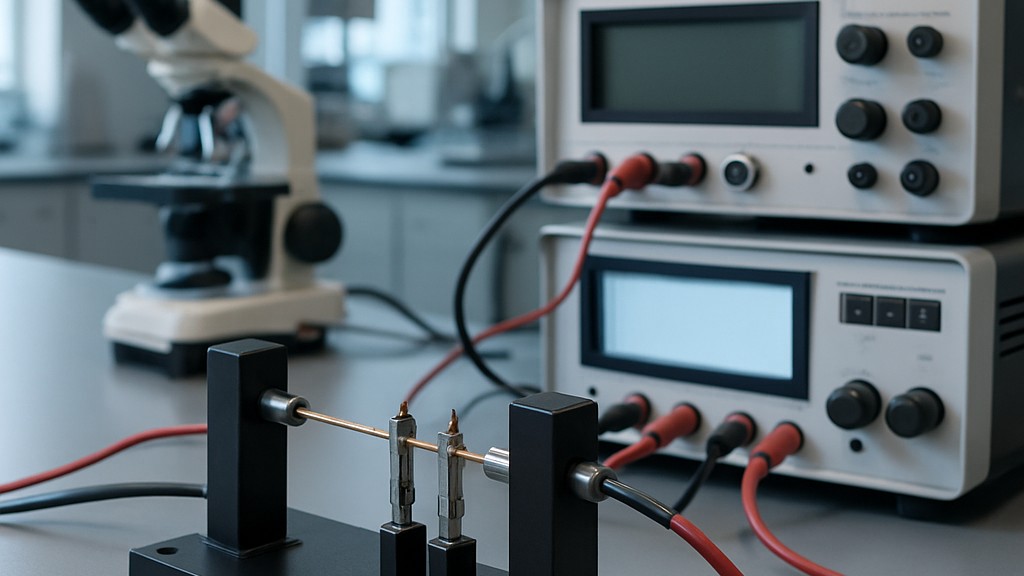
This test method covers the determination of the electrical resistivity of metallic electrically conducting materials. The accuracy of the weight resistivity may be adversely affected by possible inaccuracies in the assumed density of the conductor. This standard provides a definition of resistivity and equations for calculating volume resistivity and weight resistivity.
Resistance shall be measured using an instrument with a circuit configuration and instrumentation capable of measuring resistance to the specified accuracy. Test sample requirements and the test procedure are detailed, including:
The formula for calculating the corrected resistance when the measurement is made at any temperature other than the reference temperature is given. No statement of accuracy is made, and no work is planned to develop such a statement. Since the resistivity value is determined solely for this test method, there is no bias in this test method.
In the world of electrical engineering and materials science, ensuring the performance and reliability of conductors is paramount. Metals such as copper, aluminum, and their alloys form the backbone of electrical wires, cables, and components in everything from household appliances to high-voltage power lines. One critical property that determines a conductor's efficiency is its electrical resistivity, a measure of how strongly a material resists electric current. High resistivity means more energy is lost as heat, which reduces efficiency and can potentially lead to failure.
ASTM B193 was developed to standardize the measurement of this property. This standard provides a precise and repeatable method for determining resistivity. This standard is essential for manufacturers, engineers, and quality control laboratories to verify that materials meet the requirements for conductivity, the inverse of resistivity.
The ASTM B193 standard is widely used in industries such as aerospace, automotive, telecommunications, and power generation. It ensures compliance with international standards and helps prevent costly problems such as overheating in electrical systems.
Resistivity refers to the inherent resistance of a material to the flow of current, regardless of its shape or size. For electrical conductors,
For example, pure copper has a bulk resistivity of approximately 1,724 x 10⁻⁸ at 20 degrees Celsius , making it an ideal conductor. Impurities, temperature, or manufacturing defects can increase this value, reducing performance. The ASTM B193 standard addresses these measurements with high accuracy, noting that bulk resistivity calculations can be affected by density assumptions. The standard defines resistivity in two basic forms:
The ASTM B193 standard standardizes these measurements, eliminating variability from different test setups and ensuring overall consistency.
This standard outlines a comprehensive test method for metallic electrically conductive materials, including solid wires, stranded cables, and rods. Its scope includes:
This standard emphasizes two types of calculations:
Temperature correction is very important because resistivity increases with temperature.
Samples must be representative, free of surface oxides, and tested under controlled conditions (e.g., 23°C plus/minus 5°C ambient temperature). The method supports both bridge and direct resistivity techniques, with extensions for advanced calculations.
The ASTM B193 standard is a cornerstone of electrical manufacturing. Its primary applications include wire and cable manufacturing, aerospace and defense, power distribution companies, and electronics.
Ultimately, the ASTM B193 standard is a testament to the rigorous science behind everyday electricity. By providing a reliable method for measuring resistivity, it enables engineers to build safer, more efficient systems, from residential wiring to Earth-orbiting satellites.
Our organization has long distinguished itself as a reliable company providing certification services to its clients for compliance with international standards and various management systems. With a competent and experienced team, we understand our clients' needs, provide the advanced testing services they require, and assist them in establishing, implementing, and improving management systems. In this context, we also provide testing services in accordance with ASTM B193 Standard Test Method for Resistance of Electrically Conductive Materials.
To get an appointment, to get more detailed information or to request an evaluation, you can ask us to fill in our form and reach you.

