

The standard “DIN 53122-1 Testing of plastic and elastomer films, papers, cardboard and other sheet materials - Determination of water vapor permeability - Part 1: Gravimetric method”, published by the German Institute for Standardization (DIN), describes a test method for determining water vapor permeability using the gravimetric method.
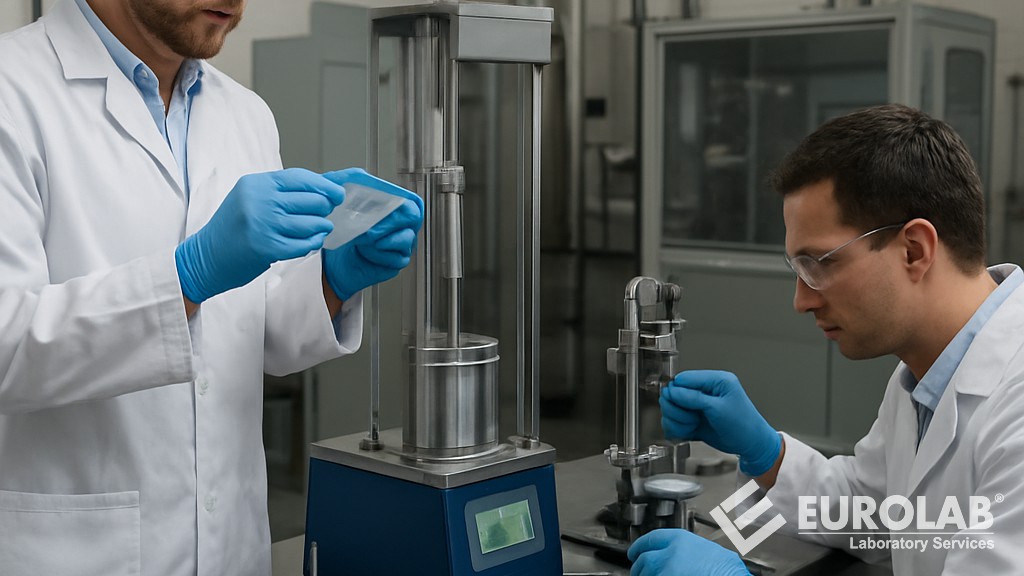
The DIN 53122-1 standard includes a gravimetric test method for measuring the water vapor permeability ratio (WVTR), also known as the moisture vapor permeability ratio (MVTR), of sheet-like materials. This standard provides a reliable, conventional method for measuring how easily water vapor passes through flat materials. This method is widely applied in quality control and material development in industries such as:
High-barrier materials (e.g., aluminum foil laminates) typically exhibit very low water vapor permeability rates (<0,1–1 g/m²/day), while more permeable materials such as paper or some plastics can exceed 10–50 g/m²/day.
This test method relies on weight change (gravimetry) to determine the amount of water vapor passing through the test sample. Two common configurations exist (often referred to as dry cup and wet cup):
This process generally follows these steps:
Transmission rate is generally expressed in g/(m²·day) (grams of water vapor per square meter/day), normalized to the reference thickness, for homogeneous materials.
In terms of test conditions, temperature and humidity are precisely defined (e.g., tropical conditions such as 23 degrees Celsius with 85 percent relative humidity or 38 degrees Celsius with 90 percent relative humidity).
In terms of stabilization time, materials must reach a stable diffusion state (typically days to weeks for good barriers).
In terms of sensitivity and sources of error, edge effects, poor sealing, temperature fluctuations, or non-homogeneous materials can affect the results.
This method is suitable for a wide range of water vapor permeability values, from very low (high barrier foils) to high values. For ultra-low permeabilities, the DIN 53122-2 standard (carrier gas/manometric or electrolytic methods) or the ISO 15106 standard can be preferred.
The capping method is very similar to ASTM E96 (Procedure A or B), ISO 2528, JIS Z 0208, and TAPPI T 464 standards. Many modern devices also claim to be compliant with the DIN 53122-1 standard.
Although still used as a reference, particularly in Europe, for some older specifications, many laboratories now employ faster sensor-based methods (e.g., ISO 15106-1/2/3 infrared, electrolytic, or modulated infrared sensors) for routine testing. However, gravimetric cup methods remain the reference technique for verification and for materials with very low or very high transmission rates.
In short, the DIN 53122-1 standard describes a method for determining the thickness of paper and cardboard using mechanical measurement under specific conditions. Accurate thickness measurement is crucial for density and volume calculations and quality control in the paper production and converting industries.
This standard defines:
Thickness is determined by placing a paper or cardboard sample between two parallel measuring surfaces under specific pressure. The vertical distance between the surfaces is recorded as the material thickness.
The equipment used in the tests typically consists of the following:
The DIN 53122-1 standard specifies rigorous test parameters to ensure repeatability:
Multiple measurements are taken at different locations, and the arithmetic mean is reported.
The DIN 53122-1 standard is widely used in the following areas:
Industries such as packaging, publishing, and specialty paper manufacturing rely on standardized thickness measurements to ensure performance consistency.
Thickness directly affects the following:
In conclusion, the DIN 53122-1 standard provides a precise, repeatable, and internationally harmonized method for determining the thickness of paper and cardboard.
For many years, our organization, with its competent and experienced staff, has been understanding the needs of its clients, providing the advanced testing services they require, and assisting them in the establishment, implementation, and improvement of management systems. Within this framework, we also provide testing services in accordance with the DIN 53122-1 standard.
To get an appointment, to get more detailed information or to request an evaluation, you can ask us to fill in our form and reach you.

