

The "EN 771 Specification for masonry materials," a European standard, has the following sub-sections published under the same title:
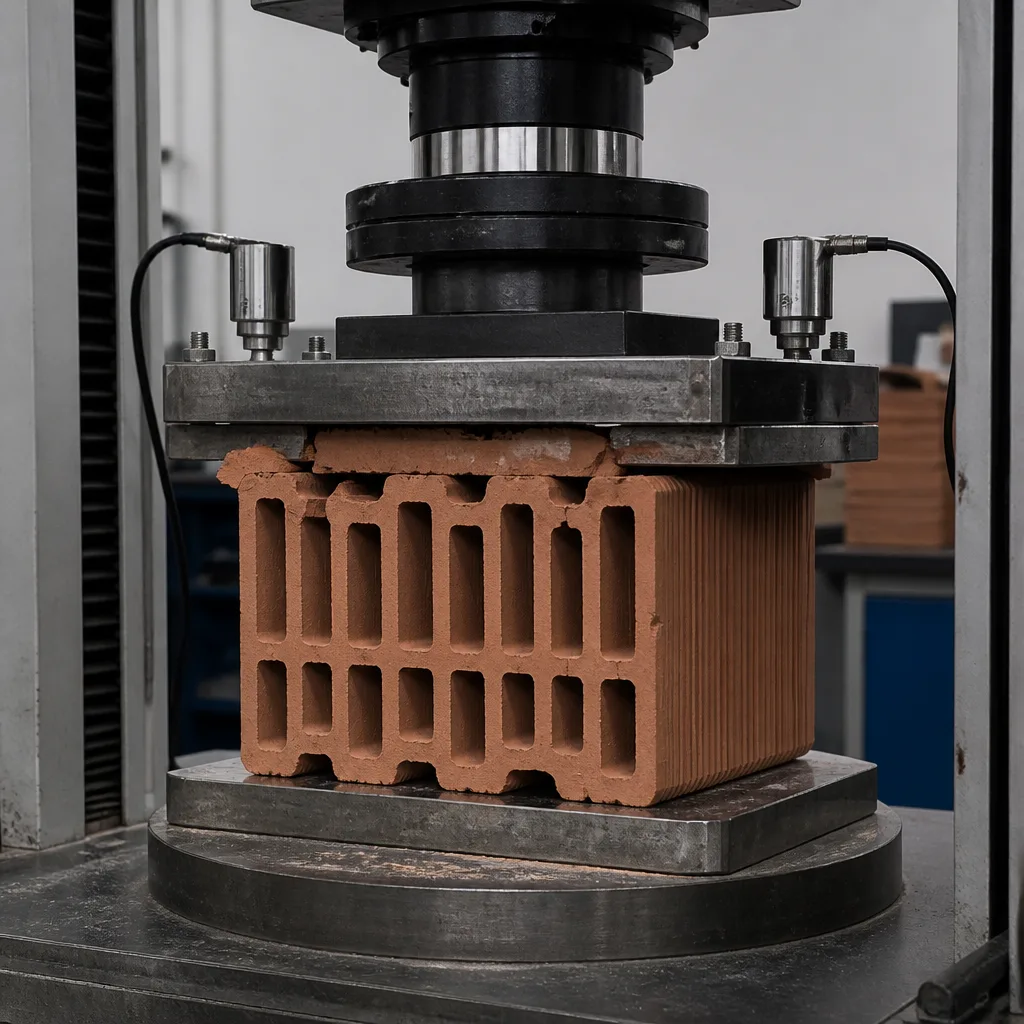
This standard also includes clay masonry units, which are generally parallelogram-shaped rather than rectangular. For example, it defines performance measured according to relevant test methods included in the relevant standards, such as dimensional tolerances, strength, and density. This allows for the evaluation and verification of the product's consistent performance according to this standard.
This standard does not specify standard dimensions for clay masonry units, nor does it specify standard working dimensions, angles, and radii for specially shaped clay masonry units. This standard does not include a method for measuring the angle and radius characteristics of specially shaped clay masonry units.
This standard does not cover requirements for: pavement units, chimney liners, and floor-height clay masonry units, and clay masonry units with integrated thermal insulation material bonded to unit surfaces susceptible to fire exposure. However, it does include clay masonry units for external chimney masonry.
This standard is designed to apply to all calcium silicate masonry units, including generally non-rectangular parallelogram-shaped units, specially shaped units, and accessory units. For example, it defines performance related to strength, density, and dimensional accuracy by measuring them according to the relevant test methods found in separate standards.
This standard enables the evaluation and verification of the product's consistent performance according to this standard.
This standard does not specify standard dimensions for calcium silicate wall units, nor standard working dimensions and angles for custom-shaped and accessory units. It does not cover units with more than 60 percent void space by volume or products made from shale as the main raw material. It does not cover floor-height panels. Furthermore, it does not cover units designed for use as moisture barriers, units containing integrated thermal insulation material bonded to unit surfaces that may be exposed to fire, or flue pipe units.
This standard generally covers aggregate reinforced concrete wall units in the shape of parallelograms rather than rectangles, as well as specially shaped and accessory units. For example, it defines performance related to strength, density, and dimensional accuracy, and enables the evaluation and verification of the product's consistent performance according to this standard.
This standard does not specify standard dimensions for aggregate reinforced concrete wall units or standard working dimensions and angles for specially shaped aggregate reinforced concrete wall units. It does not cover floor-height panels, flue pipe linings, or units designed for use as moisture barriers. It also does not cover units containing integrated thermal insulation material bonded to unit surfaces that may be exposed to fire.
This standard covers integrated insulated autoclaved aerated concrete wall units that are not exposed to fire, and generally rectangular prism-shaped, specially shaped, and accessory units. Autoclaved aerated concrete wall units may consist of layers of varying densities, all of which are non-load-bearing. This standard ensures the evaluation and verification of the product's consistent performance according to this standard.
This standard does not cover requirements for floor-height panels, chimney linings, and wall units with integrated thermal insulation material bonded to surfaces that may be exposed to fire. It does not specify standard dimensions for automatically ventilated concrete units or standard working dimensions and angles for custom-shaped and accessory units. It does not provide permissible deviations for custom-shaped and accessory units. It does not cover products designed for use as moisture barriers or chimney linings.
This standard covers concrete masonry units produced using casting or pressing techniques, with or without textured surfaces produced by casting, splitting, washing, sandblasting or machining, and with or without varying contour effects, to resemble natural stone. It covers homogeneous masonry units and units composed of different facade and support concrete mixtures, but excludes those produced with an adhesive-bonded decorative surface.
This standard does not cover masonry units intended to conform to the EN 771-3 standard. For example, regarding performance, it defines the following: This standard covers properties such as strength, density, dimensional accuracy, and surface appearance, and enables the evaluation and verification of the product's consistent performance according to this standard.
This standard does not apply to floor-height panels, masonry units used in chimney flues, or manufactured units with adhesively bonded decorative surfaces. It does not cover products designed for use as moisture barriers, nor does it specify standard dimensions for manufactured stone masonry units or the working dimensions and angles of custom-shaped units. It does not cover units with integrated thermal insulation material bonded to the surfaces of the unit where there is a possibility of fire exposure.
This standard covers natural stone masonry units, generally in the shape of parallelograms rather than rectangles, as well as specially shaped accessory units for indoor and outdoor applications. For example, it defines performance related to strength, petrographic identification, density, porosity, dimensional accuracy, thermal conductivity, water absorption, and frost resistance, and enables the assessment of a product's conformity to this European Standard.
This standard does not cover floor-height panels, natural stone for paving, chimney flue linings, or units designed for use as moisture barriers.
For many years, our organization, with its competent and experienced staff, has been understanding the needs of its clients, providing the advanced testing services they require, and assisting them in the establishment, implementation, and improvement of management systems. Within this framework, we also provide testing services in accordance with the EN 771 standard.
To get an appointment, to get more detailed information or to request an evaluation, you can ask us to fill in our form and reach you.

