

In the standard “EN ISO 8307 Flexible cellular polymeric materials - Determination of flexibility by ball rebound”, which has its origin in a European standard and was subsequently published by the International Organization for Standardization (ISO), a method for determining the strength of flexible cellular polymeric materials by ball rebound is described.
For the purposes of this standard, the following terms and definitions apply:
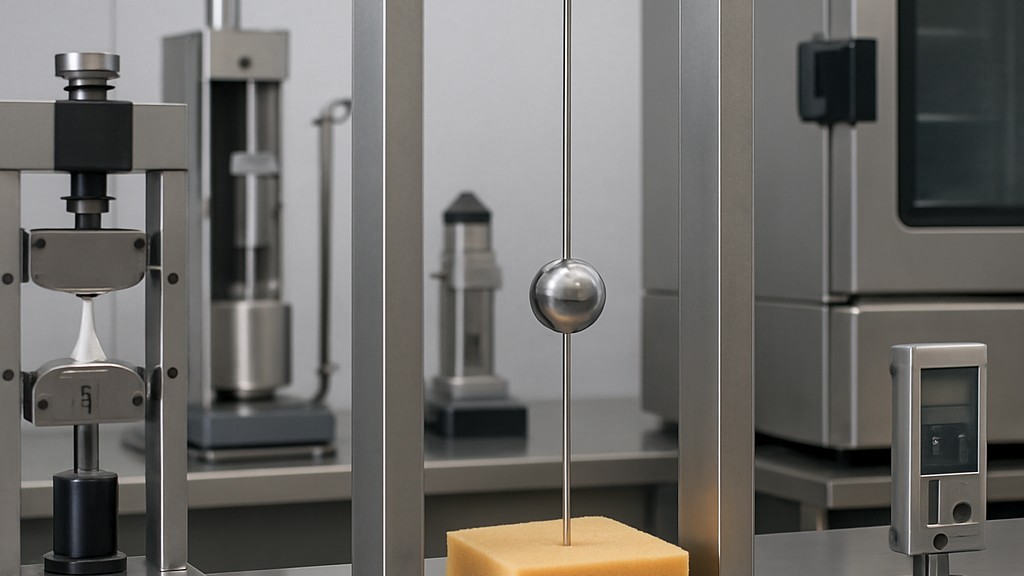
In principle, in this method, a steel ball is dropped onto the test piece from a certain height and the rebound height is measured.
The rebound tester used in the tests shall consist of a vertical, transparent tube with an internal diameter between 30 mm and 65 mm. A steel ball with a diameter of 16 mm plus or minus 0,5 mm and a mass of 16,8 g plus or minus 1,5 g is dropped vertically onto the test piece through the tube from a height of 500 mm plus or minus 0,5 mm using a magnet or other suitable device. The steel ball shall be released so that it falls without rotating and is effectively centered. If the tube is not held vertically, measurement errors may occur, and measurements may be invalid due to contact of the rebound ball with the inner surface of the tube. Therefore, it is important to use a spirit level or similar device to ensure that the tube is mounted at right angles to the rigid base plate and that the base plate itself is horizontal.
A manual reading apparatus is also used for the tests. The scale on the back of the tube should be graduated directly in percentages as follows: a full circle should be drawn at every 5 percentile (25 mm), and a 120-degree arc should be drawn on the tube at every 1 percentile. Full circles are an essential part of the apparatus because they are used to eliminate parallax errors.
An automatic readout device capable of determining the rebound height of a steel shot by electronic means may be used, provided that testing has shown it to produce the same results as a manual readout device. The rebound height can be calculated from, for example, the rebound velocity or the time interval between the first and second contact of the shot with the foam surface. Any such device may be equipped, as long as the device can determine the rebound height to an accuracy of plus or minus 1 percent of the total drop height (i.e., plus or minus 5 mm). For this type of device, graduations on the tube are not required.
The top and bottom surfaces of the test pieces should be flat and parallel. Test pieces should consist of the entire product sample or a suitable portion thereof, but in no case should the thickness be less than 50 mm or the area be less than 100 mm x 100 mm. Test pieces thicker than 50 mm should be folded to at least 50 mm without using cement. For molded products, the top shell should be removed. Thicker test pieces can be used to avoid erroneous results that may occur with very soft materials due to the influence of the base plate.
The minimum test piece thickness of 50 mm may not be sufficient for very soft materials. If inaccurate results are obtained, a thicker test piece can be used. Very low-density materials can also cause problems due to the test piece's own rebound. In multi-layered test pieces, slippage between the layers can occur. This problem can be overcome by using the largest possible test piece area.
Three test pieces per sample shall be tested. The three test pieces may be obtained using separate items or different locations on a given item.
The material shall be tested at least 72 hours after production, provided that it can be demonstrated that the average rebound resilience values obtained at 16 hours or 48 hours after production do not differ by more than plus or minus 10 percent from those obtained at 72 hours.
If the above criterion is met at the selected time, testing is permitted after 16 or 48 hours. Before testing, the test pieces must be conditioned for at least 16 hours in one of the following atmospheres given in ISO 23529:
This period may constitute the final portion of the post-production period. For quality control testing, test pieces may be collected sooner (up to a minimum of 12 hours) after production, and tests may be conducted after conditioning in one of the atmospheres specified above for a shorter period (up to a minimum of 6 hours).
Our organization, which has been supporting businesses across all sectors for years through a wide range of testing, measurement, analysis, and evaluation activities, has a strong team of employees who closely follow global developments in science and technology and are constantly improving themselves. In this context, we also provide testing services in accordance with the EN ISO 8307 Flexible cellular polymeric materials - Determination of flexibility by ball rebound.
To get an appointment, to get more detailed information or to request an evaluation, you can ask us to fill in our form and reach you.

