

The standard “ISO 813 Rubber, vulcanized or thermoplastic - Determination of adhesion to a rigid substrate - 90 degree peel method” published by the International Organization for Standardization (ISO) describes a method for determining the adhesion strength of vulcanized or thermoplastic rubber bonded to a rigid substrate using a test piece consisting of a strip of rubber bonded to a single plate of rigid material.
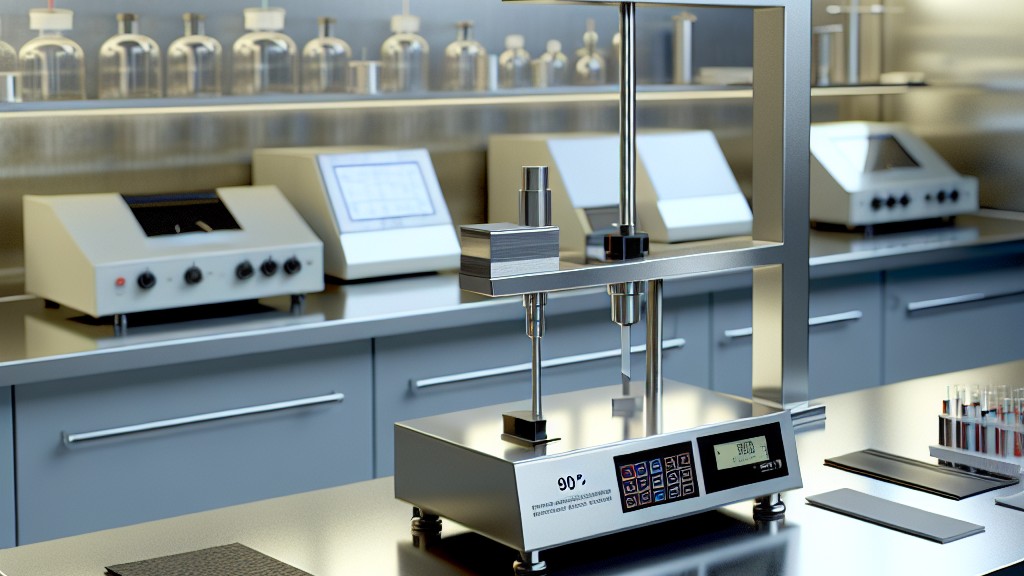
This method is performed with a 90 degree peel angle. This method is primarily applicable to test pieces prepared in the laboratory under standard conditions, which can be used to provide data for the selection of rubber compounds or adhesive systems, the development of such materials and the control of manufacturing processes. This method is not suitable for high hardness rubbers, typically above 85 IRHD hardness.
In principle, during this test, the force required to cause separation of a rubber strip bonded to a rigid substrate is measured. The separation angle is 90 degrees and the width and thickness of the rubber and rigid substrate are fixed within the specified limits.
The equipment used in these tests includes:
The standard test piece consists of a rubber strip 6 mm plus/minus 0,1 mm thick, 25 mm plus/minus 0,1 mm wide and 125 mm long in the test area and is bonded to a square area 25 mm long and 25 mm plus/minus 0,1 mm wide on the surface of a rigid substrate strip. The determination of the dimensions of the test piece shall be in accordance with ISO 23529. The substrate shall be sufficiently thick to prevent deformation during the test (a minimum thickness of 1,5 mm is recommended). The width shall be 25 mm plus/minus 0,1 mm and the length shall be 60 mm plus/minus 1 mm. Each test piece shall be prepared in such a way that the bonded area 25 mm long and 25 mm plus/minus 0,1 mm wide is approximately in the middle of the substrate as shown in the figure.
Two types of moulds can be used for preparing test pieces: moulds for several test pieces or moulds for single test pieces. If test pieces are to be made using one type of rubber and one type of adhesive system, one mould can be used for several test pieces. The inner mould dimension parallel to the longitudinal axis of the substrate strip should be 125 mm. The dimension corresponding to the transverse axis of the substrate strip can be varied depending on the number of test pieces to be prepared at one time. The dimension perpendicular to the longitudinal and transverse axes of the substrate can be varied, for example by using metal plates of various thicknesses depending on the thickness of the substrate, so that a depth of 6 mm plus/minus 0,05 mm can be left for the rubber. If only one test piece of a given rubber is to be made, the mould specified above should be used, but the dimension corresponding to the transverse axis should be limited by the width of the test piece.
From the rubber compound, sheets of the required size and sufficient thickness for the mold are cut (length 125 mm, width corresponds to the number of test pieces to be prepared), so that maximum pressure is ensured between the rubber and the substrate during the test piece preparation process.
During test piece preparation, the surfaces to be bonded must be clean and free from dust, moisture, and other foreign matter. The substrate strips of the required dimensions are prepared as required by the adhesive system being examined. Both ends are masked with pressure-sensitive tape so that only the specified area can be used for bonding. The rubber surface to be bonded is cleaned using solvent or other technique as required by the adhesive system being examined. The adhesive is applied and the substrate and rubber strips are joined. The assembly is placed in the mold with the substrate at the bottom. If more than one test piece is being prepared at the same time, the substrate strips are spaced approximately 3 mm apart to allow for later separation of the test pieces.
In the case of a rubber bonded with a heat-curing adhesive, the vulcanization or bonding process is carried out by heating the mold under pressure in a suitable press for the time and temperature required by the system under investigation. The test pieces are carefully removed from the mold so that the bonded surfaces are not subjected to excessive stress before the test pieces have cooled.
Four test pieces are used in the tests. The time interval between the preparation of the test pieces and the test must comply with the requirements of the ISO 23529 standard. It must be at least 16 hours after molding. The test pieces are conditioned in accordance with the requirements of the ISO 23 standard for at least 2 hours at a standard temperature (27 degrees plus/minus 2 degrees or 16 degrees plus/minus 23529 degrees) immediately before the test.
When testing outside of standard laboratory temperature is required, additional conditioning is performed at this temperature for a sufficiently long time to bring the material up to the required temperature.
Unless otherwise stated, tests are performed at standard laboratory temperature.
Our organization, which has been trying to support businesses from every sector with its testing, measurement, analysis and evaluation studies carried out in a wide range for years, has a strong staff that closely follows the developments in the world in the field of science and technology and constantly improves itself. In this context, testing services in accordance with the “ISO 813 Rubber, vulcanized or thermoplastic - Determination of adhesion to a hard substrate - 90 degree peel method” standard are also provided to businesses.
To get an appointment, to get more detailed information or to request an evaluation, you can ask us to fill in our form and reach you.

