

The standard, “ASTM F2723-08 Standard Test Method for Evaluating Resistance of Mobile Bearing Knee Tibial Base Plate/Cradle to Dynamic Separation,” developed by the American Society for Testing and Materials (ASTM), describes a laboratory test method for evaluating the potential for mobile bearing knee tibial base plate/bearing separation under cyclic forces. The test method described is applicable to any dual-compartment mobile bearing knee with a bearing retention mechanism. With modification, the test may be applied to a single-compartment mobile bearing knee with a bearing retention mechanism.
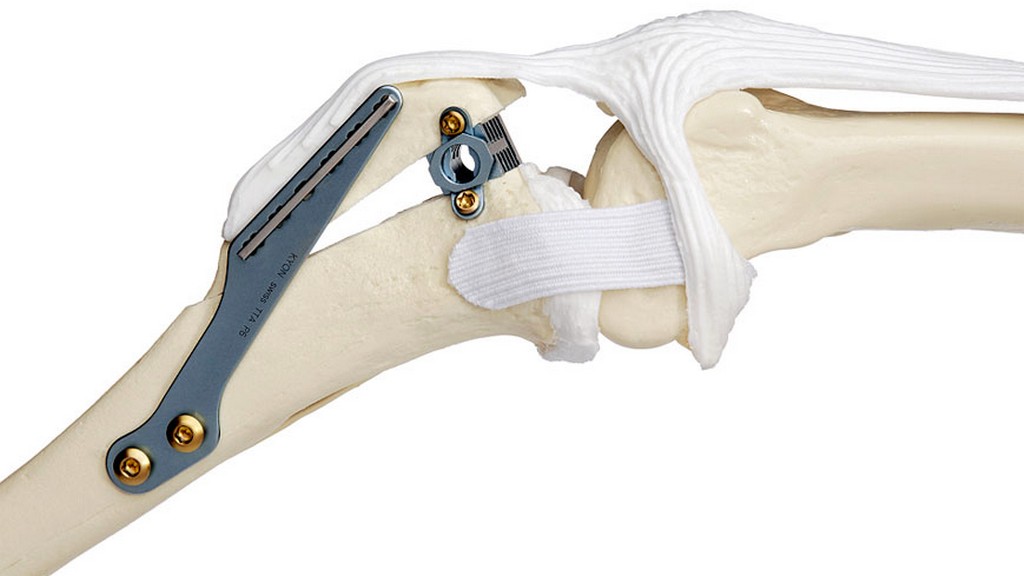
Although the methodology described does not replicate all physiological force conditions, it is a means of in vitro comparison of the strength of mobile bearing knee designs and the bearing retention mechanism between the tibial baseplate and bearing components under the specified test conditions.
This test method involves the use of static and fatigue shear and bending force conditions to evaluate the bearing retention mechanism and ability of a moving bearing knee design to prevent separation.
In general, separation does not occur during activities where the contact points are within the boundaries of the bearing surfaces. Separation is most likely to occur with forces at the edges of the bearing component or with large AP shear forces on the posteriorly stabilized knee tibial component post. Excessive bearing rotation, bone/bearing impingement, severe varus or valgus moments, high flexion, or any combination of the above may increase the likelihood of separation.
The test method described is applicable to any two-compartment movable bearing knee with a bearing retention mechanism. With modification, the test can be applied to a single-compartment movable bearing knee with a bearing retention mechanism.
The total knee replacement should be standard or intermediate size as specified by the manufacturer unless the bearing retention mechanism changes with the size of the knee. If the retention mechanism changes, an engineering analysis should be performed to justify the worst case. The implant should be in the original packaging provided to the user by the manufacturer. If the implant is not available in packaging, the condition of the device should meet all geometry and material specifications, but may contain slight surface irregularities (i.e. cosmetic rejections) that are not considered effective in areas of the device considered critical for the particular test.
The test specimens are exposed to a clean atmosphere at 24 plus/minus 37 degrees for 2 hours prior to testing. The test is run in a 37 plus/minus 2 degree bath covering the tibial bearing surface. The bath may be bovine serum, mineral oil, olive oil, or deionized water. Before testing, the implant should be rotated three times in the desired direction before data are obtained. These three repetitions can be done manually. This procedure is designed to distribute lubricant between the bearing surface and the tibial component. If the bearing is installed on the tibial component in the presence of lubricant, it may be omitted.
A biaxial orthogonal load frame with feedback control in both axes is required for dislocation testing. The machine must be able to record force and displacement in both axes.
Test specimens should be selected to maximize the force in the bearing retention mechanism. Considerations should include bearing thickness (a thicker bearing tends to increase the forces in the retention mechanism but can also increase the material support for the retention mechanism), bearing profile/size, and tibial base plate profile/size (a large bearing on a small tibial base plate tends to increase protrusion with rotation). The minimum number of test specimens should be five.
Mobile bed knee components should be assembled as they would be in live use. The femoral component flexion angle should be selected to maximize the forces on the bed retention mechanism. An engineering analysis may be required to determine the appropriate femoral flexion angle that generates the greatest shear or bending forces on the retention mechanisms. For example, a 0-degree flexion angle for a walking-friendly design can minimize any bending forces by distributing the forces on both the front and back of the locking mechanism.
Among the numerous testing, measurement, analysis and evaluation studies that our organization has provided for businesses in various sectors, our organization also provides testing services defined in the standard “ASTM F2723-08 Standard test method for evaluating mobile bed knee tibial base plate / bed resistance against dynamic separation” with its trained and expert staff and advanced technological equipment.
To get an appointment, to get more detailed information or to request an evaluation, you can ask us to fill in our form and reach you.

